Changing your electricity seller in Poland: steps and timing
Short answer: Any household can switch electricity seller. Sign with the new seller, who notifies the operator; the change takes up to 21 days. Ending an indefinite contract should be free.
Every household in Poland can choose who sells it electricity. The wires and the meter belong to a regional distribution operator that you cannot change, but the company that sells you the energy and bills you is your choice. This guide uses the Energy Regulatory Office (URE) pages on changing the seller, including its consumer notice of 14 August 2025 and the step-by-step procedure on its Masz wybór site. The rules were checked in October 2026. Since the procedure and the national IT system for changes have been evolving, the practical timings can differ from the text of the procedure, so confirm with the new seller.
Two different companies
URE explains that electricity involves a distribution system operator (OSD), whose network your home is connected to, and a seller. The list of sellers that can serve you is published by the operator on its website, because only sellers that have a general distribution agreement with that operator can serve customers on its network. This list includes the default seller (sprzedawca z urzędu). Examples of default sellers named by URE are PGE Obrót, Tauron Sprzedaż, Enea, Energa Obrót and E.ON, among others. You can check who the default seller is for your address on the operator's website.
Tariff or market offer
URE says that besides tariff offers, with prices approved by the President of URE, there are market offers, including a newer type of contract with a dynamic energy price. A consumer can go back from a market offer to a tariff offer if they currently use the offer of their default seller, or if they sign again with the seller that serves as the default seller for them. The URE site also provides a comparison of the offers on the market for households and small businesses.
How to switch
URE gives these steps for a household.
1. Compare offers of sellers active in your operator's area and choose one. 2. Sign a contract with the new seller, at the seller's office or on the internet. Before you sign, the seller must show you the full text of the contract and a summary of the most important provisions. 3. Optionally give the new seller a power of attorney to represent you in the process, including terminating the old contract. You can also terminate it yourself. 4. Settle with the old seller. The meter reading for the final bill is passed on by the distribution operator. The old seller must settle with the consumer within 42 days from the day the seller was changed.
You do not need the old seller to confirm the termination of the contract.
Timing
The URE procedure says the new contract should start on the day the old one ends, which guarantees continuity and avoids penalties for ending early. The new seller notifies the distribution operator at least 21 days before the planned start. The notification gives the start date, at most 90 days after the notification is filed. The operator verifies the notification within 5 working days. If the notification is positive, the new seller starts selling energy no later than 21 days after filing, unless a later date was given. For meters without remote data transmission, the reading can be delayed, but should not be later than 5 working days after the change.
URE also notes that a central energy market information system (CSIRE) was launched on 1 July 2025, which is meant to allow a change of seller within 24 hours. The URE notice says to check the progress of its roll-out on the website of the operator of that system.
Rules that protect consumers
- Household customers can only sign comprehensive contracts since February 2024, which combine the sale of energy and distribution services. The seller you sign with concludes the distribution agreement on your behalf.
- Contracts with household customers concluded door-to-door, outside the seller's premises, have been banned since 3 July 2021, and such a contract is invalid.
- If you sign a contract at a distance, as a household customer you can withdraw within 14 days without giving a reason.
- Ending a contract for an indefinite period should always be free.
- If you have a fixed-term contract, check whether you will pay a fee for ending it early, and whether it is worth it. URE suggests you may wait until the end of the term.
What to check before you sign
URE says the energy price is only one of the parameters. Look at fixed fees, other benefits and costs, and the conditions for terminating the contract. Some offers require a smart meter with remote reading. The URE notice also reminds households that, until the end of September 2025, a maximum price of 0.5 zł/kWh net applied to the energy price component. Our electricity bills guide explains what happened after the freeze ended, so check the current prices in an offer rather than relying on an old figure.

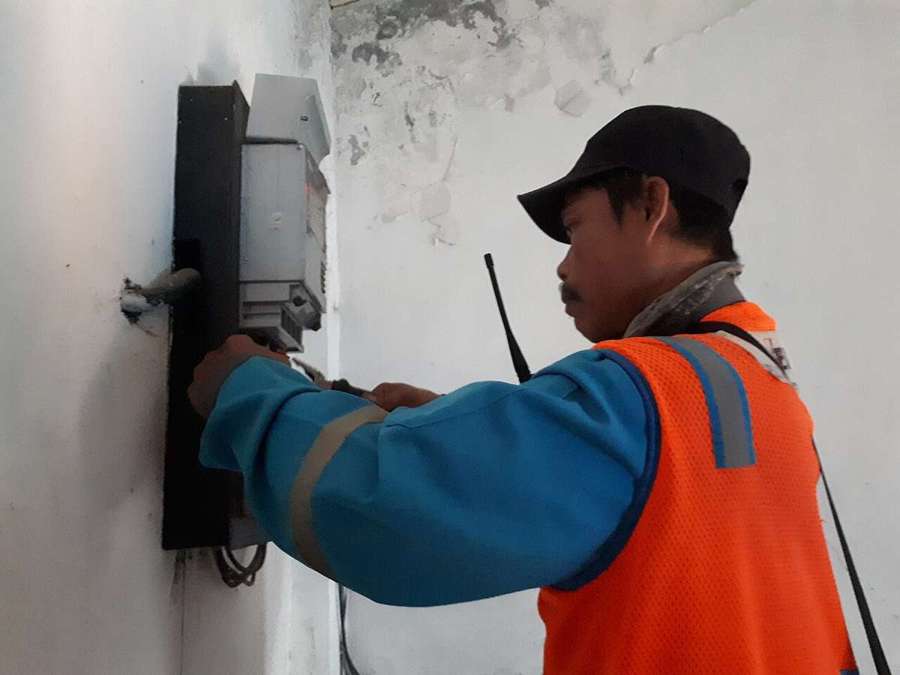
* Photos: electricians working on an electricity meter (CC0, Wikimedia Commons); LED lamp (CC0, Wikimedia Commons). Photos are illustrative.
Frequently asked questions
Who can choose an electricity seller?
According to URE, every end customer in a household can choose a seller. Its notice is titled "from 18 years everyone can choose". If the supply contract for your home is in someone else's name, ask them, because this guide does not cover who may sign.
Does it cost anything to switch?
URE says ending a contract for an indefinite period should always be free. For a fixed-term contract, check your old contract for fees for ending it early.
How long does the switch take?
Under the URE procedure, no later than 21 days after the notification is filed, unless a later date is set. The new system CSIRE aims at 24 hours.