Kołobrzeg Weekend Guide: Lighthouse, Beach and the Fortress Town
The essentials: Kołobrzeg, Poland's biggest Baltic resort, mixes beach and history: climb the brick lighthouse (15 PLN, family 45-55 PLN), tour the Museum of Polish Arms (32 PLN), and walk the 220-metre pier. Prices checked 22 October 2026.
Kołobrzeg is Poland's biggest seaside resort, and it earns the title twice over: as a beach town, with a long pier and kilometres of sand, and as a spa, drawing brine and mud cures since the nineteenth century. For a family weekend it has the rare combination of proper sights and proper sand: a lighthouse you can climb at the harbour mouth, a serious military museum, a small but handsome old town, and a promenade built for strollers and scooters. The spa side still hums in the background, with sanatoria and graduation-tower air that gives the resort a calmer, older clientele alongside the bucket-and-spade crowd, which keeps the town from tipping into pure funfair. The city sits on the West Pomeranian coast roughly two hours northeast of Szczecin. This guide plans two days with current ticket prices, checked on 22 October 2026.
Getting there and where to stay
Kołobrzeg lies about 150 km northeast of Szczecin, around two hours by car, and regional trains link the city with Szczecin in about two and a half to three hours. From Warsaw the drive is about five and a half hours, so most visitors combine Kołobrzeg with a longer Baltic stay or come from the western half of Poland. The resort splits naturally into zones: the port and lighthouse quarter, the old town a short walk inland, the spa district with its parks and sanatoria, and the long hotel strip along the beach. Distances between them are walkable, and a rented bike or scooter makes the whole town feel like one connected promenade. Stay near the promenade if the beach is the point, or by the old town for quieter evenings and easier parking. July and August book out early; May, June and September bring the same sand with space on it. The spa district works as a middle option, greener and calmer than the strip, a ten-minute walk from both beach and centre.
Data source: route and rail planners, checked 22 October 2026.
The lighthouse and the harbour
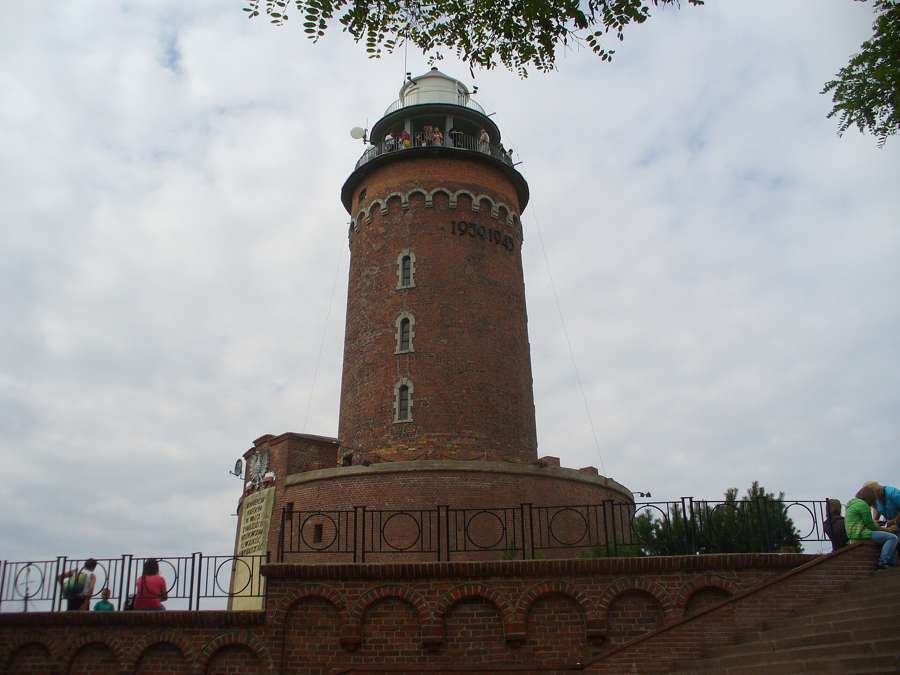
The red-brick lighthouse at the harbour entrance is Kołobrzeg's signature climb. The tower stands where the Parseta river meets the sea, carrying a memorial plaque to the brutal March 1945 battle for Festung Kolberg that destroyed most of the old city; the fort terrace below holds old cannon and a small exhibition on that fighting. From the gallery on top you get the full resort geography in one look: harbour, pier, beach and the old town's towers inland. The harbour below stays working as well as pretty: fishing boats, cruise boats running short trips along the coast in season, and the yacht marina, so the walk between lighthouse and pier passes constant boat traffic.
As of the official price list checked on 22 October 2026, entry costs 15 PLN normal and 10 PLN reduced. Family tickets are priced by size: 45 PLN for two adults with two children, 50 PLN with three and 55 PLN with four, and holders of the Large Family Card pay the family rate regardless of the number of children. Groups above twenty people pay 10 PLN each. The climb is short but steep, manageable for school-age children and a genuine view rather than a token one.
Data source: Kołobrzeg lighthouse, official price list (latarnia.kolobrzeg.eu/cennik), checked 22 October 2026.
Museum of Polish Arms
The city's museum, the Museum of Polish Arms, tells the story it knows best: the 1945 battle that flattened Kołobrzeg, plus a broader run through Polish military history with vehicles and equipment in the open air. As of the museum's posted price list, a normal ticket costs 32 PLN and a reduced ticket 22 PLN, while a family ticket for two adults with children aged 7 to 18 costs 80 PLN. An audioguide in Polish, English or German rents for 10 PLN, and guided tours run 150 PLN per hour in Polish or 200 PLN per hour in English, German, French or Spanish. Allow two hours; children gravitate to the outdoor hardware while adults work through the battle rooms. The 1945 section is detailed and sobering, so calibrate for younger visitors; the vehicle yard keeps them busy while you read.
Data source: Museum of Polish Arms in Kołobrzeg, posted price list (muzeumkolobrzeg.pl), checked 22 October 2026.
Old town, pier and beach
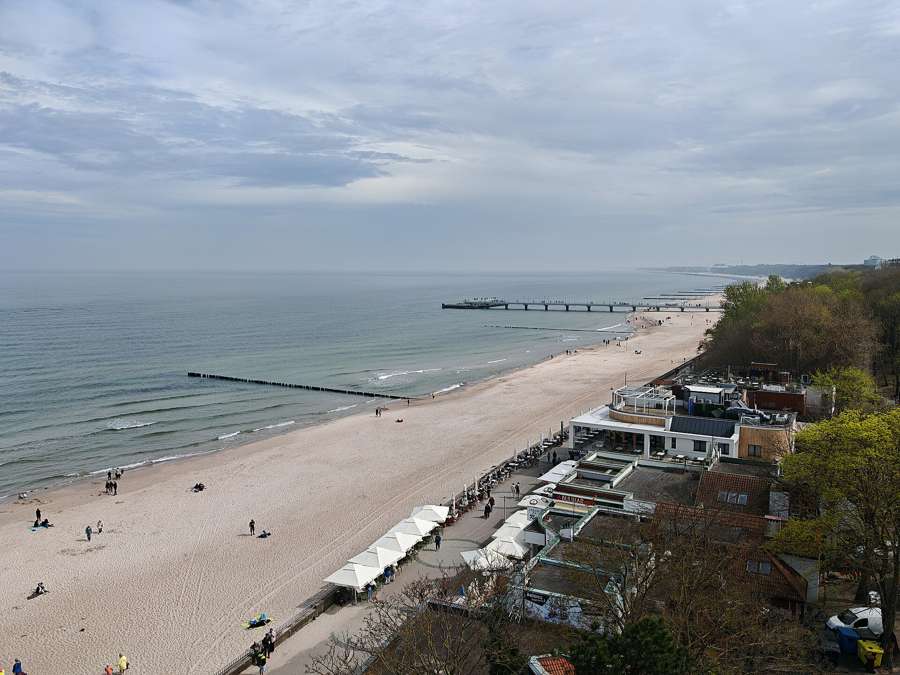
Kołobrzeg's old town was rebuilt after 1945, and it wears the rebuild honestly: a neo-Gothic town hall, the Gothic basilica of the Assumption whose tower anchors the skyline, and fragments of the medieval fortifications including the old gunpowder tower. It is compact and calm, good for a coffee hour rather than a full day. The scale tells the story of March 1945, when the declared fortress city was fought over street by street and most of the historic centre burned; what you see now is a careful reconstruction around the few survivors, the basilica chief among them. The pier, running about 220 metres into the Baltic, is the town's front porch: a walk out and back at whatever pace the children set, with the whole beach spreading east and west from its base. In season the promenade behind the sand fills with the usual Baltic kit of waffle stands, amber stalls and fish smokehouses; off-season the same walk turns bracing and empty, which many people prefer.
For a wilder hour, the Ekopark Wschodni on the city's eastern edge protects coastal meadows where migratory birds stop over, with paths and viewing spots that cost nothing and rarely see crowds. Bring binoculars if you own them; spring and autumn passages turn the meadows busy, and even non-birders tend to leave having learned what a godwit is. It is the easiest nature fix on this stretch of coast, and the flat paths suit every age.
Data source: City of Kołobrzeg visitor information, checked 22 October 2026.
Visiting with children
The resort is built for families, which mostly means logistics are easy: flat promenades for pushchairs, guarded swimming areas in season, public toilets and changing points along the main beach entrances, and food at every turn. The lighthouse climb suits children from about six; the museum's outdoor vehicles work at any age; the pier gives toddlers a contained mission with a dramatic middle. The beach itself is the main engine, wide enough that even August leaves room at the eastern end, and shallow enough near the shore for supervised paddling. Bring windproof layers in any month, and in summer arrive at the beach before ten for a good patch of sand. Rainy hours go to the museum, and the bigger hotels' pools often sell day access even to non-guests. In peak season, time the pier and promenade for early morning or evening, when the day-trippers thin out and the light does the sea favours; midday in August belongs to the sand or the shade.
Data source: Kołobrzeg lighthouse and Museum of Polish Arms visitor information, checked 22 October 2026.
A two-day plan
Saturday: arrive by midday, walk the old town, the basilica and the town hall, then out along the promenade for a first beach session and a sunset pier walk, dinner at a smoked-fish stand or one of the port restaurants. Sunday: the lighthouse first, before the queue builds, then the museum for the late morning, lunch back in the old town, and a last hour on the sand or in the Ekopark before the drive home. In the off-season, keep the same shape and simply dress warmer; Kołobrzeg out of season is a different, quieter town, and the sea is the same.
Frequently asked questions
How much is the Kołobrzeg lighthouse?
Entry costs 15 PLN normal and 10 PLN reduced, with family tickets from 45 to 55 PLN depending on the number of children, as of the official price list checked on 22 October 2026.
Is Kołobrzeg worth visiting outside summer?
Yes. The beach and pier work in any month for walks, the lighthouse and museum stay open, and the off-season town is calmer and cheaper, with the same sea. Autumn storms are a show of their own, best watched from the pier end with a firm grip on your hat.
What is there to do in Kołobrzeg with children?
The lighthouse climb, the military museum's outdoor vehicles, the pier and the guarded beach in season, plus the Ekopark Wschodni's bird meadows for a free wild hour.
How do I get to Kołobrzeg without a car?
Regional trains run from Szczecin in about two and a half to three hours, and long-distance buses serve the resort from larger Polish cities, especially in season. * Photos: Cover - nocnalunatyczka, CC BY-SA 3.0, via Wikimedia Commons (Kołobrzeg lighthouse). Body - Zala, CC BY-SA 4.0, via Wikimedia Commons (the beach and pier).