Świdnica Weekend Guide: The Wooden Peace Church and Lower Silesia
The essentials: Świdnica, an hour from Wrocław, centres on the UNESCO-listed wooden Church of Peace (entry 18 PLN, family 45 PLN). Add the market square, the trade museum (15 PLN, free Fridays) and the 103-metre cathedral tower. Prices checked 22 October 2026.
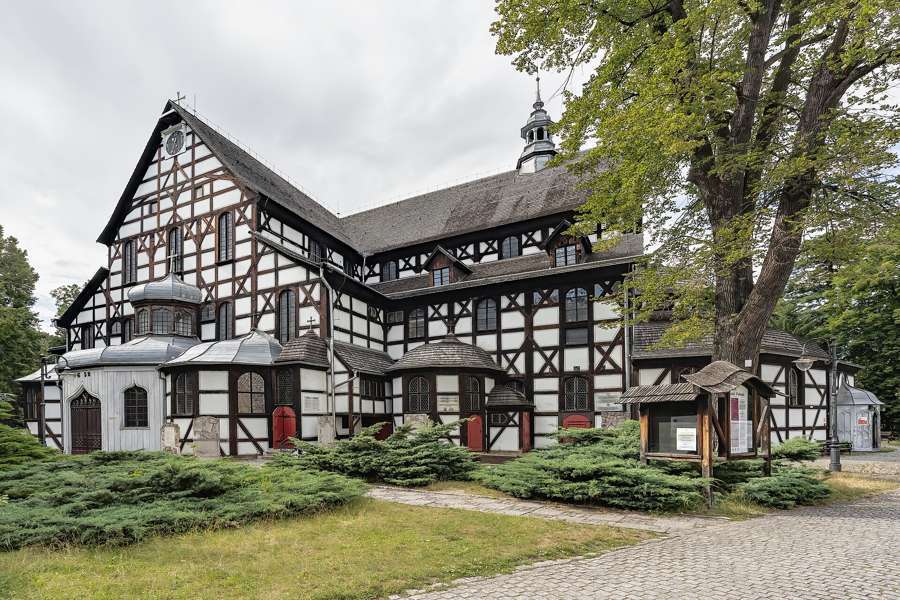
In 1648 the Peace of Westphalia ended the Thirty Years War, and among its stranger clauses was permission for the Protestants of Silesia to build exactly three churches, made of wood, clay and straw, without towers, outside the city walls. The Church of Peace in Swidnica is the largest of the two that survive, a half-timbered giant that holds several thousand people under ceilings painted like a stone basilica, and since 2001 a UNESCO World Heritage site. It alone justifies the trip. Around it, Swidnica offers one of Lower Silesia's prettiest market squares, a cathedral tower over 100 metres tall and an easy small-city rhythm an hour from Wroclaw. This guide plans the weekend, with prices checked on 22 October 2026.
Getting there and where to stay
Swidnica lies about 55 km southwest of Wroclaw, under an hour by car and well served by regional trains and buses from the capital of Lower Silesia. From Warsaw, count on about four hours by car or a train with a change in Wroclaw, which makes Swidnica a natural add-on to a Wroclaw stay as much as a destination in itself. Drivers should know that parking around the Rynek is paid and tight on Saturdays; the signed lots a few streets out are easier and only minutes from the square. Hotels and guesthouses cluster around the market square and the streets toward the church, at prices well below Wroclaw's weekend rates, and the whole centre is walkable once you arrive. Book ahead only for the summer organ-festival weekends, when the church recitals draw visitors from across the region; the rest of the year, Swidnica keeps room for the spontaneous.
Data source: route and rail planners, checked 22 October 2026.
The Church of Peace
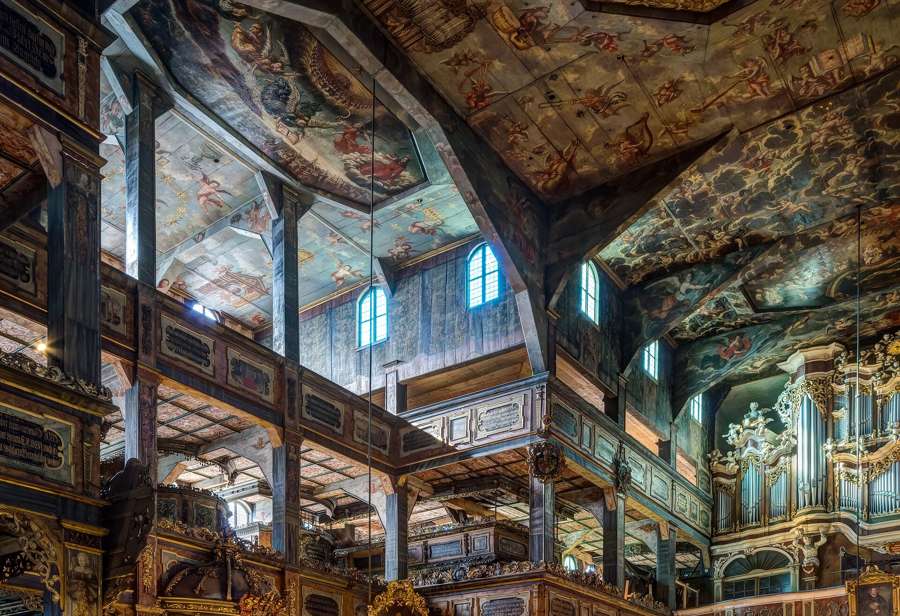
Nothing prepares you for the scale of it. From the outside the church reads as an oversized timber barn with dormers stacked on dormers; inside, galleries climb in tiers toward painted ceilings and an ornate baroque altar, all of it built from wood within the tight material restrictions the peace treaty imposed. The builders finished in about a year, and the congregation they served had waited decades for permission. Plan at least an hour, and look up: the ceilings are the point.
The restrictions shaped everything. The treaty allowed no stone, no brick and no tower, and demanded the church stand beyond the walls, so the architects answered with timber framing on a huge scale, a structure that could seat several thousand worshippers. Inside they ignored the spirit of austerity entirely: four levels of galleries, an altar dense with carving, and a baroque organ whose summer recitals still fill the building. The effect is a wooden box that behaves like a cathedral, which is precisely the quiet defiance the congregation intended.
The story did not end in 1657. The church survived the wars that redrew Silesia's borders, the shift of the region from Germany to Poland in 1945, and decades of patch repairs, and the ongoing restoration is one of the largest wooden-conservation projects in the country. Visiting now, you are watching a building being handed carefully to the next three centuries.
Entry works as a contribution ticket to the church's renovation fund, the cegielka. As of the parish's current visiting information, adults pay 18 PLN, students, pensioners and organized adult groups 15 PLN, children and youth 10 PLN, and a family ticket for two adults with children under 18 costs 45 PLN. The church closes to visitors on Good Friday, All Saints Day on 1 November and Christmas Eve, and it remains a working church, so services take priority over sightseeing. Check the day's opening before a long drive in the off-season.
Data source: Church of Peace in Swidnica, visiting information (kosciolpokoju.pl/zwiedzanie), checked 22 October 2026.
Market square, cathedral and the trade museum
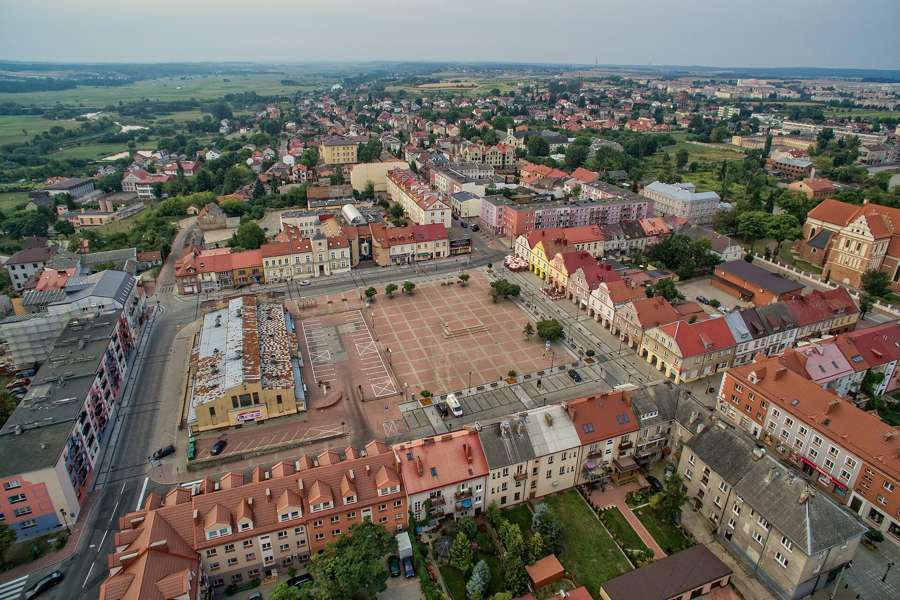
The Rynek repays a slow loop: baroque and gabled townhouses restored in warm colours, cafe tables in season, and the town hall whose tower now serves as a viewpoint over the roofs. Swidnica was one of Silesia's wealthiest trading cities, and the square is its ledger, every gable a line item of brewing and cloth money. A few streets away rises the Gothic cathedral of Saints Stanislaus and Wenceslaus, its tower reaching about 103 metres, the tallest church tower in Silesia, with a climb for the energetic. Between the two, the old town lanes hide the smaller pleasures: the plague column on the square, fragments of the medieval walls, and the kind of family-run cafes that remember your order on the second visit.
On the square itself, the Museum of Old Trade occupies a historic townhouse and tells the story of Swidnica's merchants and crafts, including its centuries of brewing. As of the current price list, a normal ticket costs 15 PLN and a reduced or excursion ticket 10 PLN, while a combined ticket with the town-hall tower costs 19 PLN normal and 12 PLN reduced. Friday is the free-entry day. A guided tour runs about 45 minutes for 50 PLN per group. Two hours covers the museum and the tower comfortably. The brewing rooms are the surprise: Swidnica shipped its beer across Silesia for centuries, and the reconstructed tavern interior explains why the city grew rich enough to build the square outside. Children tend to remember the tower stairs and the old shop counters; adults remember how much trade history one townhouse can hold.
Data source: Museum of Old Trade in Swidnica, ticket sales (muzeum-kupiectwa.pl/sprzedaz-biletow), checked 22 October 2026.
Visiting with children
Swidnica suits families who like their sightseeing in short bursts. The Church of Peace works for children as pure spectacle, the sheer size and the painted ceilings, and the square gives them room to move between sights. The museum is compact enough for a tired afternoon, and the tower climb rewards older children with the view. For a full rainy day, Ksiaz's interiors and tunnels absorb hours, so keep the castle as the weather card rather than a fixed appointment. Playgrounds and ice cream around the Rynek handle the rest, and prices across the city stay gentle enough that a family weekend here costs noticeably less than in the bigger tourist towns. One practical note: the church interior is cool even in summer, so pack a light layer for the children, and the cobbles around the Rynek favour carriers over pushchairs for the smallest visitors.
Data source: Church of Peace and Museum of Old Trade visiting information, checked 22 October 2026.
A two-day plan
Saturday: arrive by late morning, walk the Rynek, climb the town-hall tower, then the Museum of Old Trade, and finish with dinner on the square. Sunday: the Church of Peace as soon as it opens to visitors, an unhurried hour inside, then the cathedral and, if you have the car and the appetite, a run out to Ksiaz castle near Walbrzych, about twenty minutes away, whose terraced gardens and wartime tunnels make it one of the great castles of Poland. Home by evening, with Lower Silesia's two big impressions banked: wood that outbuilt its restrictions, and stone that outlasted its wars. If you stay a third day, the sister Church of Peace in Jawor, smaller and darker but built under the same treaty, completes the pair and turns the weekend into a proper UNESCO double.
Frequently asked questions
How much does it cost to enter the Church of Peace in Swidnica?
Admission is a renovation-fund ticket: 18 PLN for adults, 15 PLN for students and pensioners, 10 PLN for children and youth, and 45 PLN for a family of two adults with children under 18, as of 22 October 2026.
Why is the Church of Peace a UNESCO site?
It is one of two surviving seventeenth-century churches built by Silesian Protestants under strict material limits set by the Peace of Westphalia, and the largest timber-framed religious building of its kind in Europe, inscribed with the sister church in Jawor in 2001. UNESCO's listing covers what the buildings represent as much as what they are: a rare surviving testimony to religious tolerance negotiated into a peace treaty.
Is Swidnica worth a full weekend?
Yes for a relaxed one: the church, square, cathedral and trade museum fill two days gently, and Ksiaz castle twenty minutes away upgrades it to a full one. Families and architecture fans get the most from it; visitors wanting nightlife should day-trip from Wroclaw instead.
When is the best time to visit?
Late spring to early autumn for cafe life on the square, though the church and museum make Swidnica a solid year-round trip; avoid Good Friday, 1 November and 24 December, when the church is closed to visitors. * Photos: Cover - Krzysztof Popławski, CC BY 4.0, via Wikimedia Commons (Church of Peace, Swidnica). Body - Jar.ciurus, CC BY-SA 3.0 PL, via Wikimedia Commons (the church interior).