Train delay compensation in Poland: what you can claim and how
Short answer: If your train arrives 60 to 119 minutes late you can claim at least 25% of the ticket price, and 120 minutes or more earns at least 50%; you can also choose a refund or re-routing, and complain to PKP Intercity within seven days.
Trains in Poland run late sometimes, and EU rules say what you can claim when they do. The rules are the same on PKP Intercity, regional operators and other railway companies, because they come from a Regulation that applies across the Union. This guide sets out the delay compensation rates, the choices a railway company must offer you, and how to complain to PKP Intercity. It reflects the text of the EU rail passenger rights Regulation and PKP Intercity's own complaint pages as read on 15 October 2026.
The rule behind it
Regulation (EU) 2021/782 on rail passengers' rights and obligations is the main rule. It replaced the older Regulation 1371/2007 and its rules on compensation sit in Article 19. The compensation is measured against the delay between the place of departure and the final destination stated on your ticket. It is paid by the railway company, not by the station.
Two points are easy to miss. First, you keep the right to travel. If you took the delayed train, you can still claim compensation. Second, the figure is a minimum. A railway company may offer more, but not less.
How much you can claim
The Regulation sets two bands, measured on arrival at the final destination on your ticket:
- A delay of 60 to 119 minutes: at least 25% of the ticket price.
- A delay of 120 minutes or more: at least 50% of the ticket price.
Compensation is calculated on the full price you actually paid for the delayed service. On a return ticket, a delay on one leg is calculated on the price shown for that leg. If the ticket shows no price per leg, the calculation uses half of the price paid.
Railway companies may set a minimum threshold below which they do not pay, but the threshold cannot be more than EUR 4 per ticket. Fees, telephone costs or stamps cannot be deducted from the compensation. It must be paid within one month of your request. The company may pay in vouchers or other services if the terms are flexible, but you can insist on money.
Season tickets and travel passes are covered too. If you meet repeated delays or cancellations during the validity of the pass, you can claim adequate compensation under the company's own scheme. Repeated delays under 60 minutes can be counted together.
What the company must offer during the delay
Compensation is not the only right. When a delay of 60 minutes or more is expected at departure, or after a missed connection or cancellation, the railway company must immediately offer a choice between three options (Article 18):
- A refund of the full ticket price for the parts of the journey not made, and for parts already made if the trip no longer serves any purpose for you, plus a return to the first point of departure when relevant.
- Continuation or re-routing to your final destination at the earliest opportunity, under comparable conditions.
- Continuation or re-routing at a later date that suits you.
Re-routing must not cost you extra, even if it uses a higher class or another mode of transport. If you take the refund, you are not also entitled to delay compensation for that ticket.
Once a delay reaches 60 minutes, or a service is cancelled, the railway company must also offer free meals and refreshments in reasonable relation to the waiting time, where they are available or can reasonably be supplied. If you need an overnight stay, it must offer a hotel or other accommodation and transport to it, where and when physically possible. Passengers must also be kept informed of the delay and the expected times as soon as the information is available.
When you cannot claim
You have no right to compensation if you were informed of the delay before you bought the ticket, or if a delay caused by continuing on a different service or by re-routing stays under 60 minutes. The company also does not have to pay if it can prove the delay was caused directly by extraordinary circumstances not connected with railway operation, such as extreme weather or a major natural disaster, by your own fault, or by the behaviour of a third party it could not have avoided, such as persons on the track or cable theft. Delays that the company can show happened outside the Union are not counted.
How to complain to PKP Intercity
PKP Intercity's national complaints page (updated 17 April 2025) sets out the steps for comments and complaints about service quality:
- The deadline for complaints about service quality is seven days from the date of the event.
- You can submit in person at a PKP Intercity Customer Service Centre or any authorised ticket sales point, by post, or with the complaint form on the website.
- Include a copy or scan of the ticket and, if you can, a photo of the problem.
- Include your name and address. Letters without them are treated as comments and not investigated.
- PKP Intercity replies within one month, or tells you when to expect a reply, which must be less than three months from submission.
For refunds on unused or partly used tickets, the carrier's page on claim time limits says applications can be filed up to one year from the end of the journey for domestic tickets, and domestic answers are due within 30 days. Email applications go to [email protected], and original documents are not required for online tickets. That page was last updated in 2016, so check the current terms before relying on a specific deadline.
The EU Regulation gives a longer outer limit: a complaint to a railway company under Article 28 must be made within three months of the incident, and the company must give a reasoned reply within one month or say it will answer within three months.
Practical tips
- Keep the ticket, or a screenshot of the e-ticket, and note the scheduled and actual arrival times.
- Note the delay to the final destination on your ticket, not to an intermediate stop.
- Ask for compensation in money if you want money. A voucher is the company's offer, not your entitlement.
- File fast. The seven-day PKP Intercity deadline for service complaints is much shorter than the three-month EU limit.
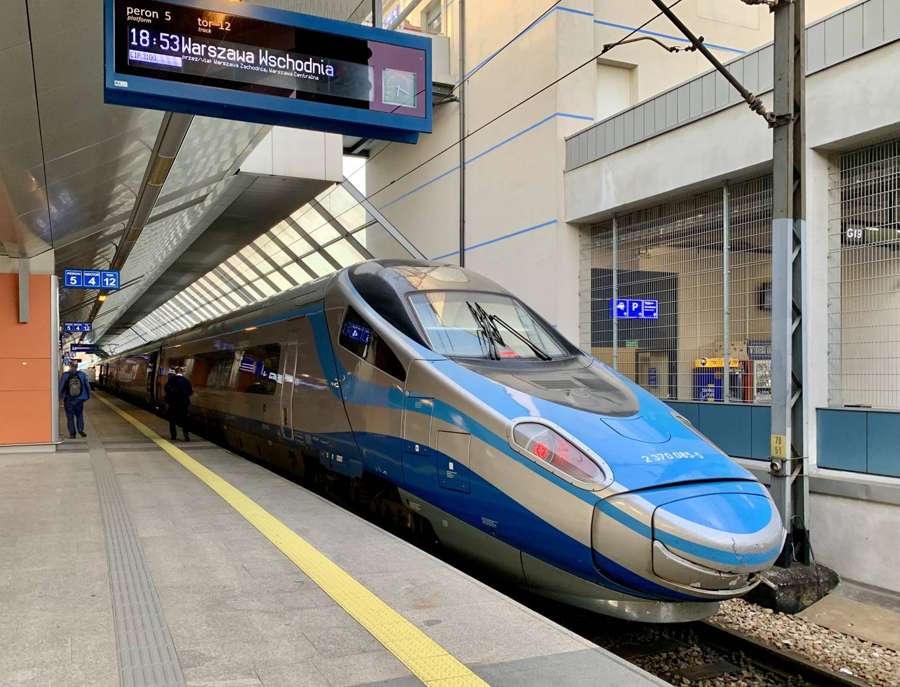
* Photos: ED250 train at Kraków Główny by Chris Olszewski, CC BY-SA 4.0; quiet zone sign by Zorro2212, CC BY 4.0, both Wikimedia Commons
Frequently asked questions
How much compensation do I get for a late train in Poland?
At least 25% of the ticket price for a delay of 60 to 119 minutes at your final destination, and at least 50% for 120 minutes or more, under Article 19 of Regulation (EU) 2021/782.
Can I claim if I still took the delayed train?
Yes. The Regulation says you keep the right to travel and can still claim compensation for the delay, provided you did not get a refund for that ticket.
Does a strike or storm count?
Extreme weather and other extraordinary circumstances outside railway operation can excuse the company from paying. Whether a strike by the company's own staff excuses it is set out in Article 19(10) of the Regulation, so check that wording for your case.
Is the compensation paid in cash?
It can be offered in vouchers if the terms are flexible, but you can ask for money and the company must then pay in money, within one month of your request.
What is the deadline to complain to PKP Intercity?
Seven days from the event for service-quality complaints, according to PKP Intercity's complaints page. The EU Regulation allows three months for complaints under Article 28.