Bełchatów Regional Museum: Manor Rooms, Free Sunday and Access
The essentials: Rodziny Hellwigów 11. Tue/Thu 10:00-18:00, Wed/Fri 10:00-16:00, Sun 12:00-16:00. Standard 10 zł, reduced 5 zł; Sunday admission free. Last entry 30 minutes before closing. Call for the southern ramp entrance; no lift upstairs.
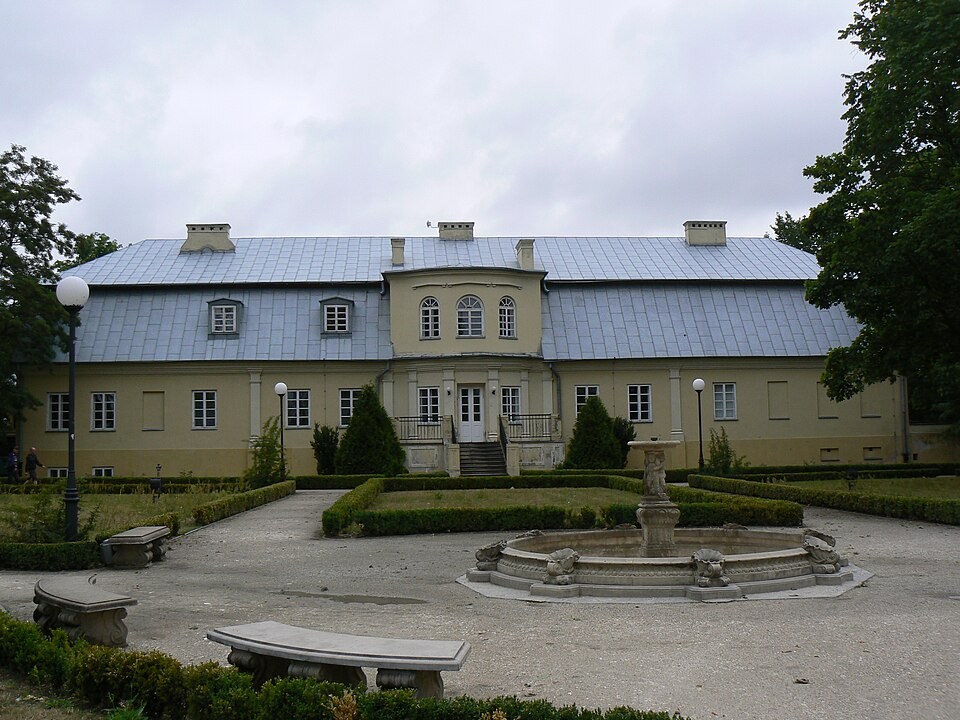
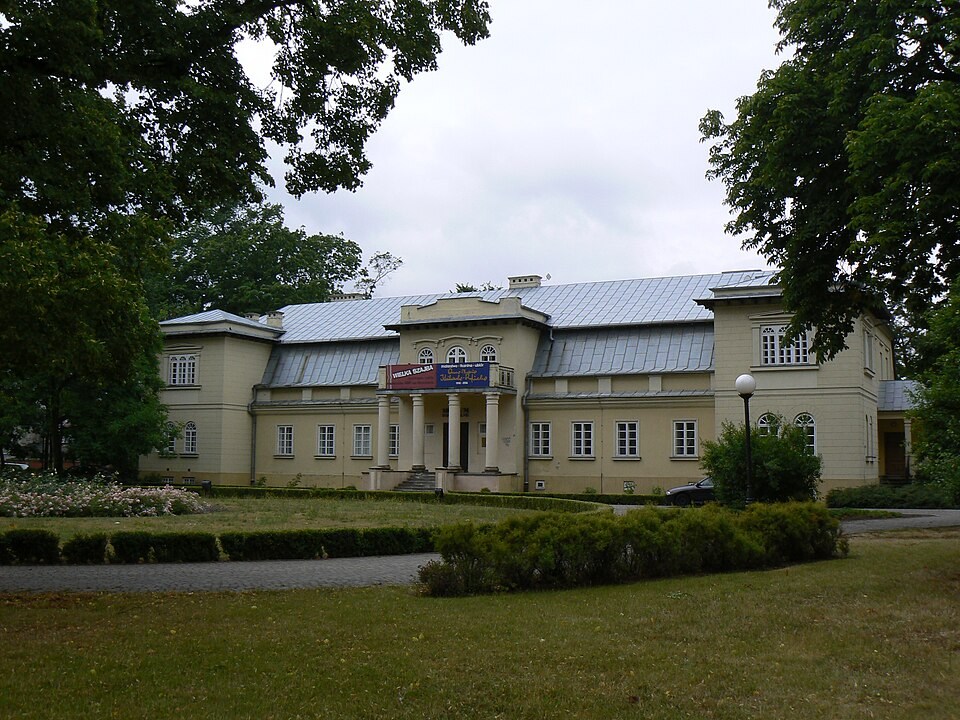
Cover: Olszewski manor in Bełchatów, west-facing garden exterior, photographed 14 July 2008. Historic view, not a current access survey. Photo: Jarosław Góralczyk / Wikimedia Commons, CC BY-SA 4.0. Resized and recompressed.
Bełchatów's Regional Museum offers a small-scale alternative to the city's industrial story: a historic manor, furnished rooms and exhibitions about the people who lived and worked in the area. It is a useful choice for residents looking for a modestly priced cultural visit, particularly on a free Sunday. The building is usually called Dworek Olszewskich, although several families shaped its history.
The practical detail that matters most is the difference between public visiting hours and staff working hours. The museum publishes both, and they are not interchangeable. Accessibility also needs careful planning: a southern entrance provides access to the ground floor, but there is no lift to the upstairs exhibitions.
The essentials
- Address: Muzeum Regionalne w Bełchatowie, ul. Rodziny Hellwigów 11, 97-400 Bełchatów.
- Public visiting hours: Tuesday and Thursday 10:00-18:00, Wednesday and Friday 10:00-16:00, Sunday 12:00-16:00. Closed to ordinary visits on Monday and Saturday.
- Tickets: standard 10 zł, reduced 5 zł, with two specified family-card tickets priced at 4 zł. Sunday admission is free.
- Last entry: 30 minutes before closing. Online admission sales stop earlier, one hour before closing.
- Access: call +48 44 633 11 33 to arrange the southern ramp entrance. Ground-floor access does not mean step-free access to the entire museum.
Choose public visiting hours, not office hours
The museum's opening-hours page lists separate schedules headed hours for visitors and museum working hours. For a normal exhibition visit, use the first: Tuesday and Thursday 10:00-18:00, Wednesday and Friday 10:00-16:00, and Sunday 12:00-16:00. Monday is an internal working day and Saturday is closed.
This distinction is especially important on Sunday. The working-hours section says 11:00-17:00, but the visitor schedule, contact page and visiting regulations specify 12:00-16:00. An office being staffed is not a promise that visitors can enter an exhibition. Likewise, arriving at 08:00 on a weekday because staff start then would be too early for the published public opening.
Special notices can replace the ordinary timetable for a particular holiday or event. Do not carry a past special opening forward to another weekend. The annual holiday text also mixes a 2026 closure list with a separate heading referring to 2025 openings, so it is not a sound basis for assuming a future holiday visit is available.
What the tickets cost, and what Sunday saves
The published tariff gives a 10 zł standard ticket and a 5 zł reduced ticket. A 4 zł "Historia za grosze" ticket is available with the Bełchatowska Karta Rodziny and an identity document. Another 4 zł ticket is listed for the nationwide Karta Dużej Rodziny issued by the large-family association "Trzy Plus". These are named schemes, not a blanket discount for every family.
Every Sunday, museum admission is free under the visiting regulations. That makes Sunday a sensible first visit if you want to see whether the manor and regional displays suit your household. It does not mean every concert, workshop or separately ticketed event is automatically included, nor does free admission extend the public visiting window.
The regulations also list children under three among those entitled to free admission. Bring documentation for any concession rather than assuming a foreign student card, a particular age or a disability automatically qualifies for the reduced ticket. The headline tariff does not explain every reduced-rate category, so ask the museum if your entitlement will determine the budget.
Allow for two different last-minute deadlines
Under the sales and visiting regulations, the last museum entry is 30 minutes before closing. That makes the ordinary Sunday last-entry time 15:30, rather than 16:00. Treat this as the final permitted entry, not as a recommended arrival time for an unhurried visit.
Online admission sales end 60 minutes before closing. During the remaining half-hour before the entry cutoff, tickets are available only at the museum counter. The rules accept printed electronic tickets or a ticket displayed on a mobile device; reduced-ticket holders must also show proof of entitlement. The counter takes payment in Polish złoty and accepts cashless payments.
For an online purchase, the museum requires payment within 30 minutes of making the reservation, otherwise it is cancelled automatically. Tickets apply to their stated date and time. The published rules say unused tickets are not refunded and online tickets cannot be exchanged for another date or type. Read those terms before paying, particularly if you are building the visit around uncertain travel arrangements.
A manor interior, not an untouched family home
The ground-floor manor-interiors exhibition is the strongest reason to choose this museum over a purely documentary local-history display. Its rooms evoke the late nineteenth and early twentieth centuries, with furniture, musical instruments and decorative details that make domestic life easier to picture.
There is an important distinction in the museum's own explanation: this is not a room-by-room reconstruction of the owners' original possessions. Much of the historical equipment did not survive, and documentation was incomplete. The exhibition uses comparable objects to suggest how the house could have looked in the Hellwig family's period. That is different from claiming every table or chair belonged to that family.
Original features do remain. The museum identifies much of the door and window joinery, portions of wooden parquet incorporated into the present floor, decorated tiled stoves and an early nineteenth-century fireplace. Looking for these building details gives the visit a focus even if you cannot read every Polish label.
What to notice in the furnished rooms
The concert room contains a harmonium made by Lindholm in Borna near Leipzig. It looks rather like a shortened upright piano, but it is a different instrument. This room also has civic uses, including weddings, which helps explain why its presentation combines a museum interior with a functioning ceremonial space.
In the oval salon, look for the large extendable table and the smaller Biedermeier tea-table arrangement. A nineteenth-century piano from Warsaw maker Krall & Seidler adds another connection between furnishing and social life. Rather than treating the collection as a row of expensive objects, compare the settings for a meal, a small conversation and musical entertainment.
The fireplace room contains a restored sandstone fireplace and a portrait of Albert Hellwig by Stanisława Pytaszowa. The museum links Albert with the founding of Bełchatów's volunteer fire brigade. Its account also identifies a women's room and dining room within the permanent interior exhibition. Actual access to a room can change during museum activities, so avoid planning around one object without checking if it is essential to you.
The upstairs visit is a separate access question
The museum's city-history exhibition is on the first floor in the Regional Gallery. The local-crafts exhibition is also upstairs. The manor-interiors description directs visitors to an independence-traditions room on that floor, with military memorabilia and an old copy of Jan Matejko's "Kościuszko at Racławice".
These exhibits can broaden a visit beyond the furnished rooms, but they should not be promised as part of a step-free route. The museum's accessibility declaration explicitly says there is no lift. A visitor who cannot use stairs needs to plan around the accessible ground-floor permanent exhibition and ask what alternative information the staff can provide.
For a family visit, choosing a handful of objects is more realistic than insisting on every display. The domestic rooms offer musical instruments, patterned floors and furniture to compare. Upstairs military material has a different subject and tone, so let children's interest and comfort guide how much you include.
Wheelchairs, parking and communication
The accessibility declaration, reviewed 31 March 2026, describes three entrances. The southern entrance has a concrete ramp and gives access to the ground-floor permanent exhibition. Visitors wishing to use it should contact the museum secretariat on +48 44 633 11 33.
Approaches to the entrances are paved with blocks. The building has a basement, ground floor and first floor, with stairs and handrails between levels. The museum describes itself as only partly adapted for people with mobility disabilities. Ask about any toilet or doorway requirement that matters to your visit, because the declaration does not provide a full room-by-room accessible-facilities specification.
There is no dedicated museum car park. The declaration places the nearest parking on W. Pileckiego Street. That is a location lead, not a guarantee of an available accessible bay or a suitable transfer route. The museum also says it has no sign-language interpreter. English guided commentary is not confirmed by the pages checked, so arrange language support before relying on it.
Groups and a simple plan for the day
Parents should note that the regulations require pushchairs to be left in the cloakroom, along with large bags and backpacks. A ramp therefore does not establish permission to take a pushchair through the galleries. Food and drink are not allowed in exhibition rooms, exhibits must not be touched, and flash photography is prohibited. Plan feeding and breaks around those rules.
Organised guided groups must book at least a week ahead, and a group entering the museum may contain no more than 30 people. The tariff lists a museum-guide fee of 30 zł on weekdays from Tuesday to Friday and 60 zł on Saturdays, Sundays, holidays and outside working hours. A Saturday guide rate does not turn Saturday into an ordinary walk-in opening day.
For an individual visit, start with the furnished ground-floor rooms, then decide whether to add the upstairs collections. Leave the surrounding park for before or after the interior visit rather than letting a walk use up the last-entry window. The city's manor history places the building within an eighteenth-century manor-and-park setting, while the museum's own history records its establishment in 1994 and the start of activity in 1995.
For final arrangements, use the museum contact page: +48 44 633 11 33 or [email protected]. The most useful questions are specific: whether your chosen exhibition is open, whether the southern entrance can be prepared, and whether a guide can work in your language. Those answers make a small local museum visit much easier to plan.
Frequently asked questions
Is Sunday admission free?
Yes, Sunday museum admission is free. Public visiting hours are12:00-16:00, not the separate11:00-17:00 staff schedule.
Can a wheelchair user reach every exhibition?
No. Arrange the southern ramp entrance for the ground-floor permanent exhibition. The museum has no lift to the upstairs city-history and crafts displays.
Can I take a pushchair through the galleries?
The visiting regulations require pushchairs to be left in the cloakroom. Contact the museum if this affects your plans.