Car breakdown in Poland: warning triangle distances and kit
Short answer: A car in Poland must carry a fire extinguisher and a warning triangle. Put the triangle 100 m behind on motorways, 30-50 m outside towns, close behind in towns. Hi-vis vests are not required by current rules.
A flat tyre on the S8 or a dead battery on a ring road is stressful enough without wondering what Polish rules expect of you. The good news is that the official guidance is short. This guide covers what a car must carry, where to put the warning triangle, and what the police say about hi-vis vests and first-aid kits, as of October 2026.
What you must carry
Several Polish police pages and the EU's Your Europe portal give the same short list for a car in Poland: a fire extinguisher and a warning triangle.
- The Rawa Mazowiecka county police page says Polish traffic rules oblige drivers to carry only two things: a fire extinguisher and a reflective warning triangle to set out after a breakdown or incident. The page is undated.
- The same page says the extinguisher must be easy to reach and the triangle must carry an approval mark. It advises every driver to practise unfolding the triangle before an emergency.
- The Your Europe in Poland page lists "fire extinguisher" and "warning triangle" as compulsory equipment for a car. This page is also undated.
- The Opolska police page of 30 May 2025 says every motor vehicle except motorcycles must have a warning triangle, and that not having one can lead to a fine, especially if the driver cannot secure the breakdown. It does not give an amount, so check the current tariff before assuming a figure.
None of these pages says whether the rule is applied differently to a car registered abroad or rented. If you drive a foreign-registered car, assume the same equipment is expected and check with your insurer or rental company.
Where to put the triangle
Two police pages give the same distances. The Ostrołęka city police page of 6 February 2026 and the Opole police page of 30 May 2025 say:
- On a motorway or expressway, at least 100 metres behind the vehicle. Opole adds that the emergency lane is best.
- Outside built-up areas, 30 to 50 metres behind the vehicle.
- In built-up areas, directly behind the vehicle or on it, for example against the rear window or bodywork, so that it is clearly visible.
The Ostrołęka page adds that the triangle and any extra reflective items should be placed visibly and stably and should not be hidden by other vehicles or road infrastructure. It stresses that an unmoving car is an obstacle other drivers may see too late, and that this matters most at night, in rain, fog or snow, and on unlit roads.
Hi-vis vests
The Śląska police FAQ answers the question directly: the vehicle-equipment regulation and the Road Traffic Act currently do not oblige a passenger car to carry reflective vests. The page is undated, so check that nothing has changed if you read this much later.
That does not make a vest a bad idea. The Rawa Mazowiecka police list it among sensible extras, and the Ostrołęka police suggest laying a vest on the broken-down car, for example on the boot lid, a door or a mirror, to reflect the headlights of approaching vehicles. This guide does not cover rules for pedestrians walking along a road after dark, because none of the sources above address them.
First-aid kit and spares
The Rawa Mazowiecka police page says a first-aid kit in the car is not mandatory, but giving first aid to someone who needs it is a duty. It lists what a sensible kit holds:
- a tourniquet;
- a mouthpiece for rescue breathing;
- a thermal blanket;
- a triangular bandage;
- disinfectant;
- sterile bandages and dressings;
- protective gloves.
The same page suggests tools, spare bulbs and a spare wheel for quick changes.
On a motorway
Your Europe in Poland says you must not drive, stop or park on a motorway's emergency lane unless there is a breakdown. So a stop for a phone call or a snack is not allowed, but a real breakdown is the reason the lane exists. The Opole page recommends placing the triangle in the emergency lane on such roads.
A simple breakdown routine
The sources do not give a numbered procedure, so this is a plain summary of what they say.
- Stop as far from moving traffic as you safely can, in the emergency lane on a motorway.
- Set the triangle at the distance for the type of road.
- Add reflective items, such as a vest on the boot lid, if you have them.
- Keep the triangle visible and stable.
Quick buying checklist
- Check that the extinguisher is within easy reach and not buried under luggage.
- Buy a triangle with an approval mark, as the Rawa Mazowiecka police advise.
- Fold and unfold it once at home.
- Add a vest and a first-aid kit even though neither is required by the sources cited here.
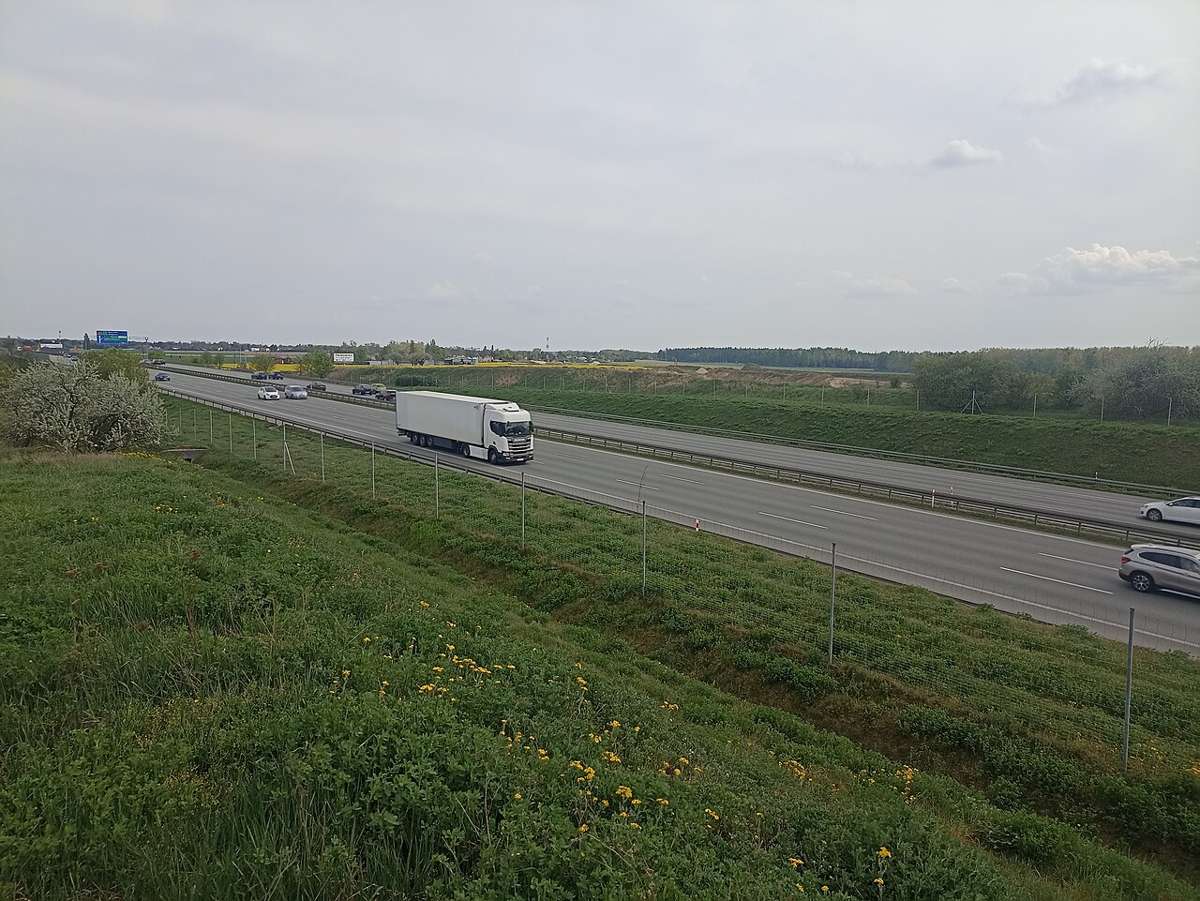
* Photos: A2 motorway near Poznań (April 2025) and A2 near Siedlce Południe (2024), Wikimedia Commons (CC0). Illustrative.
Frequently asked questions
Do I need a hi-vis vest in my car in Poland?
According to the Śląska police FAQ, current rules do not oblige a passenger car to carry reflective vests. The Ostrołęka police still suggest one as a visibility aid on a broken-down car.
How far from the car should the warning triangle go?
Per Opole and Ostrołęka police: at least 100 m on a motorway or expressway, 30 to 50 m outside built-up areas, and directly behind or on the car in built-up areas.
Is a first-aid kit compulsory?
The Rawa Mazowiecka police page says a kit is not obligatory, but giving first aid to someone who needs it is a duty.
Does this apply to a rented or foreign-registered car?
The sources reviewed do not say. Check with the rental company or your insurer.