When someone dies in Poland: report the death, burial and transport
Short answer: Report a death at the civil registry office (USC) for the place of death within 3 days of the doctor issuing the death card (24 hours for infectious diseases). It is free. Closest family has the right to arrange the burial.

Few things are harder to deal with in a foreign country than the death of someone close. This guide sets out the official steps in Poland as of October 2026: who certifies the death, the 3-day deadline to report it, who may arrange the burial, and what is needed to take a body abroad. It is not legal advice, and a funeral director in Poland will handle most of the paperwork.
Step 1: the doctor certifies the death
Under the Act on Cemeteries and Burial of the Dead (consolidated text published 21 November 2025, Journal of Laws item 1590), the death and its cause are established by the doctor who treated the person in their last illness. If that is not possible, a doctor, or another person appointed by the district head (starosta) where no doctor is available, establishes the death by examination. The costs of that examination and certificate may not be charged to the family.
The doctor issues the death card (karta zgonu). You need it for every following step.
Step 2: report the death to the civil registry office
The gov.pl service page "Zgłoś zgon" and its English version on Your Europe in Poland say:
- You must report the death to the civil registry office (urząd stanu cywilnego, USC) before the burial.
- The deadline is 3 days from the day the doctor issued the death card, or 24 hours from the moment of death if the person died of an infectious disease.
- You report at the USC for the place of death. If the person died in Sopot, you go to the USC in Sopot.
- The service is free.
Who can report: the spouse, other family members (children, grandchildren, great-grandchildren, parents, grandparents, siblings, niece, nephew, in-laws), or a proxy for one of them.
What to bring:
- the death card;
- the ID card of the deceased;
- your own identity document, such as an ID card or passport.
The registry head registers the death on the day of the report and issues one free abridged copy of the death certificate. If registration is not technically possible that day, the office notes the report on the death card. With that note the cemetery administration can accept the burial. You then receive two copies of the certificate once it is registered, one for you and one for the cemetery administration.
When you report the death, the person is automatically deregistered from their permanent or temporary residence and their ID card becomes invalid.
Note that this gov.pl page shows a last update of 27 January 2020 and cites older versions of the laws. The 3-day and 24-hour deadlines match the British government's 2026 guide, but confirm the current procedure with the USC.
If the deceased was a foreigner
The UK government's guide "When someone dies in Poland" (published 29 January 2026) is written for British nationals, but it describes the Polish process in practical terms:
- Contact the insurance company as soon as possible. It may appoint a funeral director and may cover repatriation costs.
- The death is registered at the local USC within three days of the medical certificate being issued.
- You need the death card, the passport of the person who died and your own ID. If a third party such as a funeral director files, a power of attorney with a certified Polish translation is needed.
- Polish death certificates do not give the cause of death. The first copy is free and extra copies cost money. A multilingual extract with an English translation is available for a fee.
If you are not British, your own country's consulate in Poland can tell you what it offers. The Polish sources reviewed do not describe consular help.
Post mortems
The UK guide says a post mortem may be carried out in Poland when the cause of death is unknown, unnatural, sudden or violent. It warns that cultural or religious sensitivities may not be taken into account and that reports are not usually given to the next of kin. The Polish act also provides for bodies of people who died or were killed in public places to be taken to a forensic medicine institute or hospital to establish the cause of death.
Who may arrange the burial
Article 10 of the Act gives the right to bury a person's remains to the closest family, in this order:
- the surviving spouse;
- descendants;
- ascendants;
- collateral relatives up to the fourth degree;
- relatives by marriage in the direct line to the first degree.
The right also belongs to people who voluntarily undertake it. Remains that are not buried by these people may be handed to a medical university for teaching purposes, on a decision of the district head.
Burial, ashes and cremation
The Act allows burial in earth graves, masonry graves or catacombs, and ashes from cremation may also be kept in columbaria. Graves and columbaria may only be in cemeteries, and moving or carrying a body in an open coffin is forbidden. The UK guide says you need a local funeral director for a burial or cremation and that the exact rules differ by location. The sources reviewed do not set out a cremation consent procedure, so ask the funeral director and the cemetery administration.
Infectious diseases
The Chief Sanitary Inspectorate (GIS) page lists diseases that require burial within 24 hours of death, with the body wrapped, sealed in a coffin and taken directly from the place of death to the cemetery. The list includes cholera, plague, anthrax, rabies and viral haemorrhagic fevers. In these cases the USC deadline is 24 hours too.
Taking a body out of Poland
If a person died in Poland and the body or ashes are to leave the country, Article 14 requires a permit from the competent county sanitary inspector. The permit is issued after you present documents from the authority of the destination country, and of any transit country, confirming there is no obstacle to the burial or entry. The permit is issued on application by a person entitled to bury, within 3 days of the application. For a death from a listed infectious disease, the Act says such permits are not issued before two years have passed.
The UK guide adds that the funeral director must show the death certificate, get the sanitary inspector's permission and provide a special casket.
Quick checklist
- Get the death card from the doctor.
- Tell the insurer, if there is one.
- Report at the USC for the place of death within 3 days (24 hours for an infectious disease).
- Ask for extra copies of the certificate.
- Contact a funeral director before choosing burial, cremation or repatriation.
- If the body is going abroad, start the permit work early.
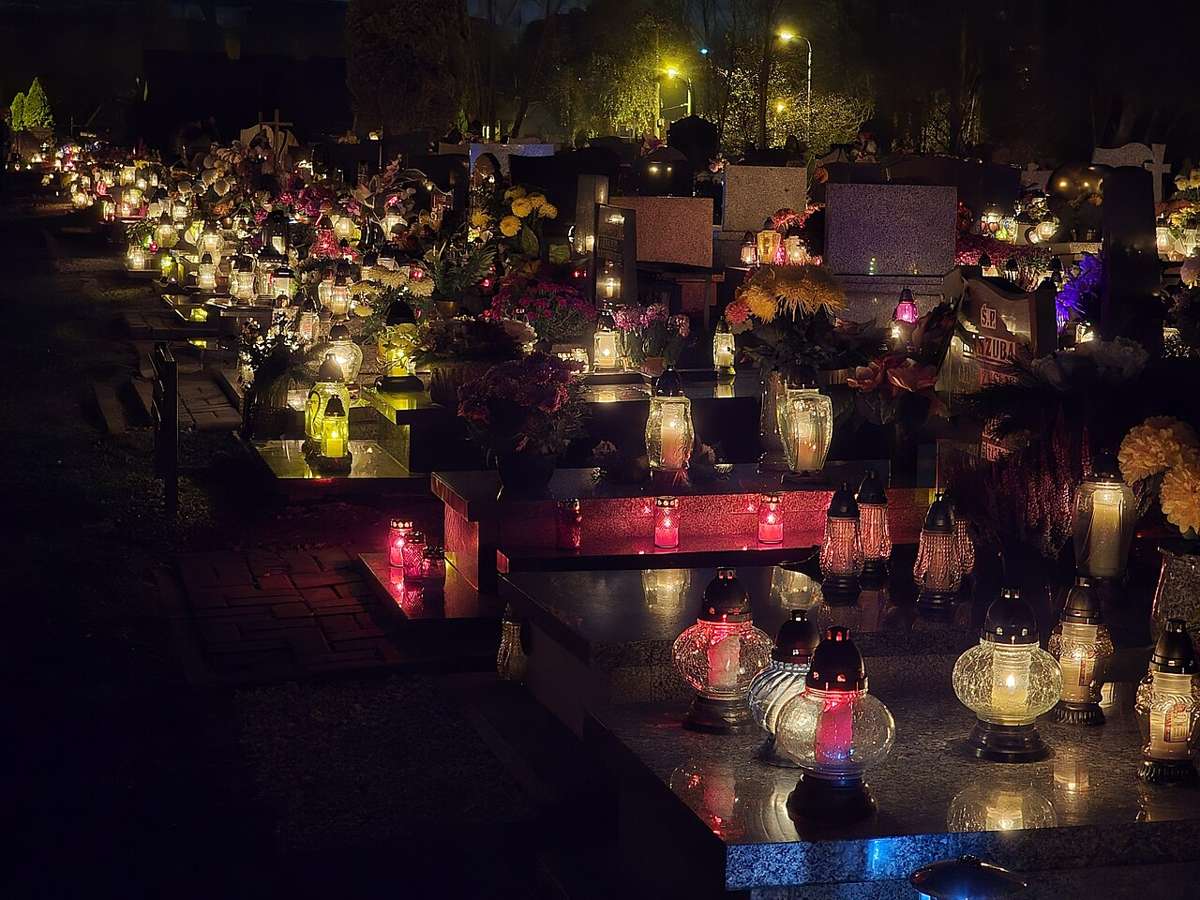
* Photos: Graves decorated with candles, Zabrze, November 2024, and a cemetery chapel in Tomaszów Mazowiecki, Wikimedia Commons (CC0 and public domain). Illustrative.
Frequently asked questions
How long do I have to report a death in Poland?
According to gov.pl, 3 days from the day the doctor issued the death card, or 24 hours from death if it was caused by an infectious disease. You report at the USC for the place of death. It is free.
Does the death certificate state the cause of death?
No. The UK government guide says Polish death certificates do not give the cause of death.
Who decides on the burial?
The closest family under Article 10 of the Act: spouse first, then descendants, ascendants, collateral relatives up to the fourth degree and in-laws in the direct line.
Can the body be taken abroad?
Yes, with a permit from the county sanitary inspector and documents from the destination country's authority. The permit is issued within 3 days of application, except after certain infectious diseases.