Kolbuszowa Skansen in Winter: Closures, Tickets and English Visits
The essentials: Kolbuszowa skansen opens daily 09:00–16:00 in November–March except listed holidays. Individual winter visitors view interiors through windows. Part of the Rzeszów sector is restricted by film works from 2 November 2026 and needs a pre-arranged guide. Winter admission is PLN 14, with separate guide and audio charges.
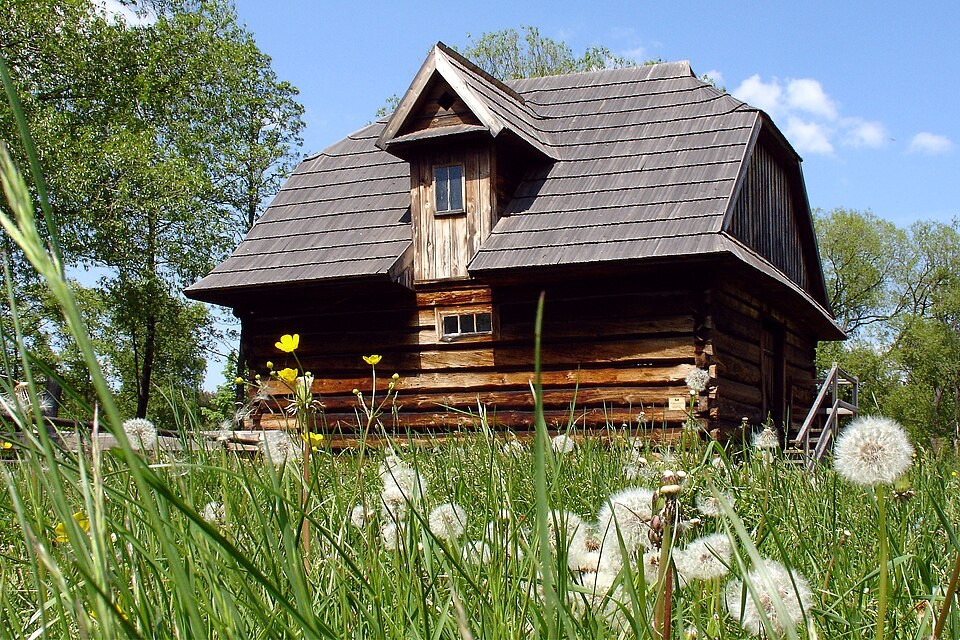
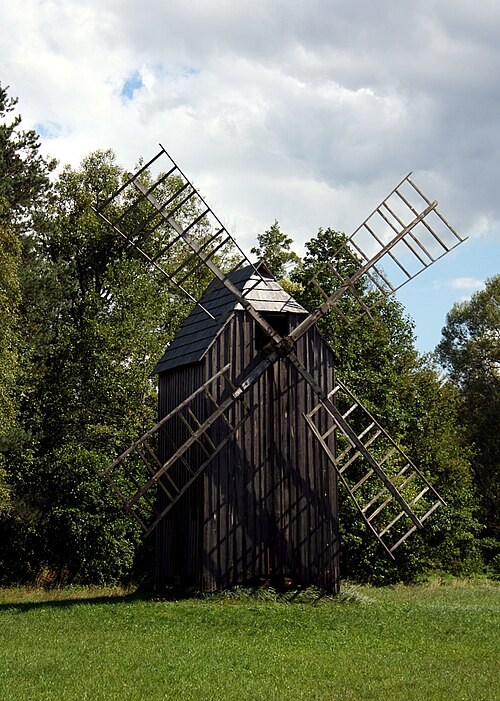
Cover: watermill from Żołynia in the Kolbuszowa skansen, photographed in September 2008. An archival green-season exterior, not a current winter or opening check. Photo: Jan Mazurkiewicz / Wikimedia Commons, CC BY-SA 3.0, selected from the available licences. Resized and recompressed under the same licence.
A winter walk, not unrestricted access to a film village
Kolbuszowa's open-air museum is still a place to visit in winter, but the current visit is different from a summer tour of open cottages and mills. Two restrictions matter: seasonal rules limit individual access to interiors, and part of the Rzeszów sector is affected by film-set construction. A general statement that the skansen is open does not cancel either condition.
The Muzeum Kultury Ludowej's notice dated 27 October 2026 says part of the Rzeszów sector is closed from 2 November. Walking through that part is possible only with a guide after arranging it in advance on +48 669 001 223. The same notice directs visitors towards the extensive Lasowiak sector and the forestry area.
The town's notice of 2 November 2026 gives an expected duration until early January 2027. That is an estimate for the works, not a guaranteed reopening date. This guide was checked on 28 November 2026. Before a trip specifically to see the affected sector, ask reception which route can actually be offered on your date.
Use the skansen address, not the office address
The ethnographic park's ticket and tour reception is at Wolska 36, Kolbuszowa. The museum also publishes an office address at Kościuszki 6. These are not interchangeable arrival points. If you are arranging a taxi, meeting friends or entering a destination into a navigation app, choose the ethnographic park and check that it points to Wolska.
The reception is in the historic house from Sędziszów Małopolski. The museum describes it as the place for admission tickets, souvenirs and its cafe. It is also where visitors can obtain a site plan and ask about the day's restrictions. The reception number, +48 669 001 223, is more useful for an actual route question than assuming an office-hours phone call confirms access to a particular cottage.
A first visit benefits from that short conversation. Tell staff whether you want an outdoor walk, an English-language explanation, access to interiors or assistance with a wheelchair route. Those requests lead to different products and arrangements, even though they all start at the same ticket point.
Winter hours are simple, holiday exceptions are not
For November–March, the museum publishes daily opening of 09:00–16:00. It separately lists days when the skansen is closed: 1 and 6 January, Holy Saturday, Easter Sunday and Easter Monday, 1 November, and 24, 25, 26 and 31 December. In particular, Christmas Eve and New Year's Eve are not ordinary winter visiting days.
Monday is normally the free-admission day. If that Monday is a public holiday, the tariff moves the free day to the next working day after the holiday. This is not a promise that every holiday Monday is open, and it does not mean that a guide, workshop or other paid service becomes free.
The museum's guided-visit page gives a winter group-entry limit of 14:00. A guided walk lasts about one and a half hours, so do not plan to start a full tour close to the 16:00 closing time. The checked pages do not establish a separate last-admission time for every individual walking visitor. Ask reception if you are considering a late arrival rather than borrowing the guided cutoff for a different product.
What a winter admission ticket buys
The current tariff lists a reduced ticket for everyone from November to March at PLN 14. It gives a winter family ticket at PLN 44, described as for parents with school-age children. Children under seven enter free. The page does not define a precise number of adults and children for that family product, so confirm that your group qualifies before comparing totals.
For Karta Dużej Rodziny holders, the museum advertises a fifty-percent reduction on admission. Bring the relevant card and ask which product it applies to for your party. A named Polish card discount should not be described as a general reduction available to every family visiting from abroad.
An easy-read page on the same site still quotes PLN 12 for admission and PLN 100 for a guide. Those figures do not match the dedicated current tariff and tour pages. Use PLN 14 as the winter admission planning figure, and the current language-specific guide prices below, rather than treating the older easy-read amounts as a lower-price offer.
The film-works notice also says reduced tickets are offered to everyone as compensation for the restricted sector. That is consistent with the winter tariff; it is not evidence of a second discount to subtract from PLN 14. Confirm the amount when buying, especially if you are combining admission, a guide and an audio-guide card.
Individual interiors are a window-only visit in winter
The operator's visiting-methods page makes a clear seasonal distinction. From April to October, individual visitors can enter selected buildings, including specified mills and exhibitions. From November to March, the interiors of all buildings are viewed through windows on an individual visit.
That changes the reason for going. An independent winter visit is mainly about the layout of the village, the timber architecture and the landscape between buildings, with views into rooms where windows allow. It is not a series of warm indoor galleries to shelter in throughout the afternoon.
The town's current notice says winter interiors can be visited only with a guide. Do not turn that into a guarantee that buying any guide opens every building, including the construction area. Agree the actual route and interiors in advance. The temporary sector restriction and the normal winter arrangements are separate limits that reception needs to reconcile for your visit.
English support is available in two different forms
The museum publishes a full guided walk in Polish at PLN 120, Ukrainian at PLN 150 and English at PLN 170. The standard walk is about ninety minutes, and guided groups may have no more than twenty-five people. Arrange the visit by telephone rather than treating a published price as a same-day booking confirmation.
A shorter option covers two selected buildings in thirty minutes for PLN 40. The checked description does not assign that short product a guaranteed language, so ask about English and the buildings available before relying on it. It also does not establish that the short route includes the film-affected area.
The other English option is a digital audio guide. Reception sells a card with an individual QR code for PLN 15, in Polish or English. Scanning it on your own mobile device gives access to recordings and photographs. The museum describes that access as permanent, which is useful if you want to revisit the stories after leaving.
The audio guide opens in the phone's browser rather than requiring an app installation. It is commentary, not an admission ticket, a live guide or permission to enter a closed building. Bring a charged device and suitable headphones, and ask about any connectivity needs before setting off around the grounds.
Read the landscape as two regional villages
The museum presents rural life around the turn of the nineteenth and twentieth centuries through the cultures of Lasowiaks and Rzeszowiaks. The names describe distinct regional communities, not simply two interchangeable collections of wooden houses. Looking at the arrangement of farms and the relationship between buildings gives an outdoor visit more meaning.
The Lasowiak sector represents communities associated with the former Sandomierz Forest and the area between the Vistula and San rivers. The museum connects their daily life with forest resources, crafts, farming and settlement. Its thematic guide routes explore those links rather than presenting the cottages only as picturesque backgrounds.
The Rzeszów sector represents communities around the Ropczyce–Rzeszów–Łańcut–Przeworsk area, with fertile agricultural land and crafts including weaving and blacksmithing. Some standard guide descriptions offer a comparison between both sectors. During the current works, those descriptions are ideas to discuss with reception, not proof that the complete usual route is available.
Expect a substantial outdoor site
The accessibility declaration, reviewed on 31 March 2026, describes a roughly thirty-hectare ethnographic park with around one hundred wooden architectural objects. It lists a broad, hardened gravel-and-earth route of about one kilometre through the park. That is not a promise that seeing every building requires only a one-kilometre walk.
Historic road surfaces, small bridges and uneven approaches are part of the setting. Choose footwear for outdoor ground and check weather and surface conditions separately before travelling. The museum's general description cannot tell you whether a particular path is icy, muddy or temporarily diverted on your date.
The published parking provision is thirty-nine car spaces, including three designated for disabled visitors, plus nine coach spaces. From parking, the declaration describes a 115-centimetre-wide gate on a bridge over the Nil and a hardened gravel path towards reception, about one hundred metres away. These are useful access details, not a live availability count for parking spaces.
Ramps require planning, and do not override closures
Reception has a ramp as well as entrance steps, but the declaration also records a five-centimetre threshold. In winter, opening the second leaf of the double doors requires staff help, including at the ticket-room doorway. A ramp symbol alone would hide those practical details.
Around the site, the museum lists eight historic buildings with portable ramps. Deploying them requires the visitor's companion and a museum employee. Many interiors have high thresholds and little artificial light, while mills and the pottery workshop have stairs, sometimes steep ones. There is no wheelchair loan service.
The declaration describes some buildings as accessible without a guide, but that general access information does not cancel the winter window-only rule or a current construction closure. Explain the route and mobility equipment you need when arranging a visit. Ask which ramps can be deployed and which interiors will actually be opened on that particular guided route.
The museum publishes assistance-dog access arrangements, including documentation of the dog's status and vaccination and use of a harness. Visitors with specific needs are asked to contact reception before arrival. Some guides have relevant training, but the museum does not offer a sign-language interpreter or induction loops at the ticket counters.
Toilets and tactile information
The declaration lists an adapted toilet behind reception, reached from a separate outdoor entrance with a ramp. A second adapted toilet is in the school courtyard in the building from Wólka Sokołowska, alongside baby-changing provision. Confirm which facilities are open and reachable on your intended route, especially if part of the grounds is restricted.
A Braille and large-print guide with six raised illustrations can be borrowed free at reception. There is also a tactile model of the Szylar family farm from Markowa near the ticket area. These can add useful context, but neither replaces a personal route discussion when thresholds, surfaces or lighting affect what you can visit.
The most satisfying winter plan is an honest one: choose an outdoor route first, add a pre-arranged guide if interiors or the restricted sector matter, and treat the English audio guide as a separate listening option. Check the museum's latest notices before setting off. Kolbuszowa remains a substantial rural-history visit, but its current winter restrictions should shape the plan from the start.
Frequently asked questions
Can I walk freely around the film-set sector?
No. The museum says part of the Rzeszów sector is closed from 2 November 2026, with access only through a guide arranged in advance. The town estimates works until early January 2027, not a confirmed reopening date.
Are cottages open to individual visitors in winter?
The operator says individual visitors see interiors through windows from November to March. Ask reception which interiors can be included in a guided route.
Is an English audio guide included in admission?
No. A Polish or English QR audio-guide card is listed at PLN 15, separate from winter admission at PLN 14. It uses your own phone and does not grant access to closed areas.
Sources
- Museum: current film-sector restriction
- Museum: winter tariff, guides and holiday closures
- Museum: individual visits, guide routes and English audio
- Museum: accessibility declaration reviewed March 2026
- Museum: sectors and rural cultures
- Town: November 2026 restrictions and estimated works period
- Museum: older easy-read information with conflicting prices
- Museum: current notices and daily winter hours
- Museum: accessibility report, January 2025 position