Museum of Toruń Gingerbread: Craft, Tickets and a First Visit
The essentials: The Museum of Toruń Gingerbread is at Strumykowa 4, not Rabiańska 9. October-April: Tuesday-Sunday 10:00-16:00; Monday closed. Exhibition 33/28 zł; Wednesday-Sunday combined baking 52/46 zł. Tuesday exhibitions free, baking extra. Confirm workshop language.
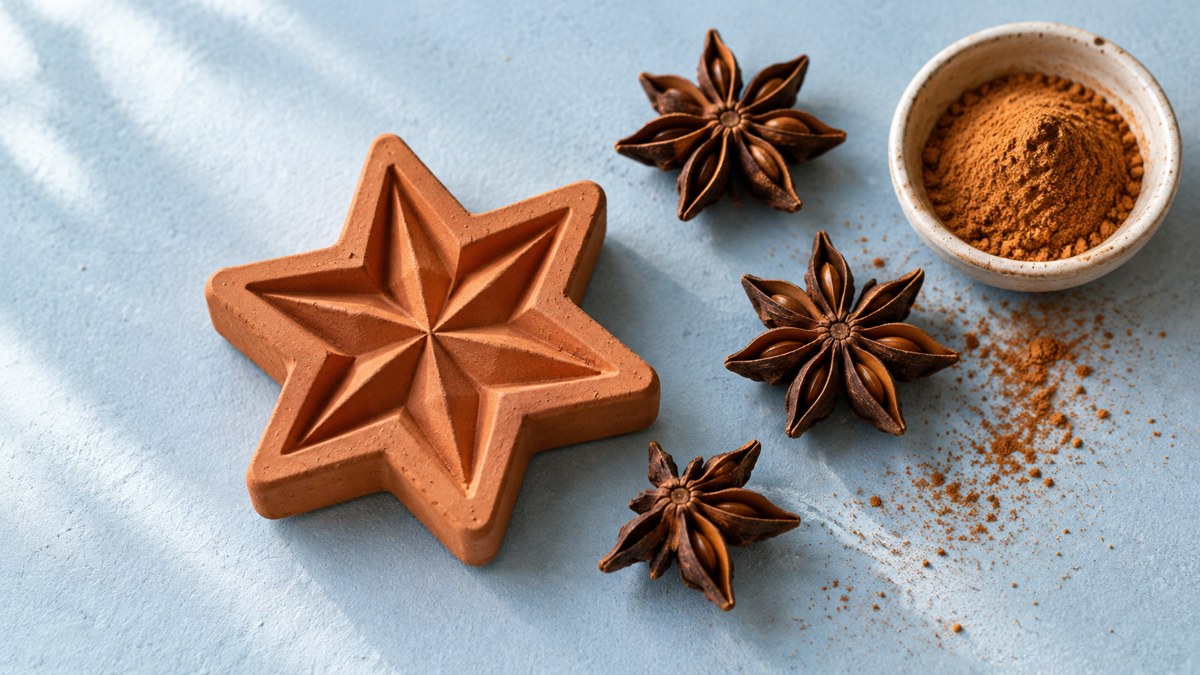
Generated editorial still life of modern modelling-stamp and spice props, not a historic gingerbread mould, museum object or view of the museum.
The Museum of Toruń Gingerbread is a good choice when you want the story behind the city's most familiar sweet rather than only a baking demonstration. At Strumykowa 4, the District Museum branch occupies a former Weese gingerbread factory. Its exhibitions connect carved moulds, ingredients, ovens, packaging and changing methods of production. Workshops are an additional option, not the only reason to enter and not something automatically included in every ticket.
The first decision is the address. Toruń also has the separate Living Museum of Gingerbread at Rabiańska 9. The names are easy to mix up, but tickets, show times and language arrangements are not interchangeable. This guide concerns the Museum of Toruń Gingerbread on Strumykowa. Check that street on the operator page and on any ticket before arranging the rest of your day around a workshop.
A factory setting, not a working production tour
The museum opened in 2015 in the converted factory of the Weese company. That setting gives the objects a useful context: you are looking at a craft that developed into an industry, with tools, transport and sales as well as recipes. It is a museum in a former industrial building, not a promise that you will tour a present-day commercial factory or watch every stage of current food production.
The operator describes a collection of wooden gingerbread moulds from the seventeenth to the twentieth centuries on the lowest level. These objects reward attention even if you do not usually seek out food museums. Look at the image carved into a mould and imagine the design reversed in dough. It links woodcarving with baking and explains why some gingerbread could be an object of display or a gift rather than simply an ordinary snack.
Ovens and production equipment provide another thread through the exhibition. The museum distinguishes reconstructed historic equipment from later ovens, including examples from the twentieth century. That is a reason to look for labels rather than assume that everything which looks old has the same date or function. Comparing the mould, oven and finished shape can make the process easier to understand than treating each case as a separate curiosity.
Follow the ingredients into everyday life
The ingredient room introduces dough components, spices and honey, with information about their origin and preparation. The museum also describes the work of beekeepers and the resting of dough. These subjects broaden the visit beyond a single famous biscuit. For an English-speaking visitor, they offer concrete things to recognise and compare even before you have read every historical explanation. Do not mistake a sensory display for a food-allergy statement or permission to taste anything you find.
Other rooms show domestic and commercial settings, including a nineteenth-century sitting room, kitchen and shop, followed by twentieth-century packaging and a delivery Żuk. The operator uses these displays to connect gingerbread with everyday life. Notice the change from the making of an object to its transport, sale and presentation. A tin, label or shop arrangement can tell you about customers and marketing as well as what people ate.
There are also multimedia elements, a virtual costume activity and spaces aimed at children. Treat those as parts of a museum route, not a guarantee that every screen will work or that an adult can leave children to a supervised activity. An older independent family account praised the subject but described friction around how children used some displays. That is a past experience, not a forecast of staff behaviour today; it is a useful reminder to follow the instructions for each activity.
Choose exhibition admission or baking deliberately
The current Polish operator page lists exhibition admission at 33 zł regular or 28 zł reduced. A combined exhibition and baking ticket on Wednesday through Sunday is 52 zł regular or 46 zł reduced. These are different products. Buying the exhibition ticket alone does not establish a place in a workshop, and paying for an activity at another Toruń gingerbread attraction does not admit you here.
Tuesday is the branch's free-exhibition day, but baking remains paid. The current Polish page lists Tuesday workshops at 33 zł regular or 28 zł reduced. It separately lists a workshop ticket for children aged four to seven at 21 zł, with exhibition visiting free for that category. Check the precise participant category and accompanying-adult arrangements for your party before paying. A child's activity price is not a general family admission price.
The museum's English page still displays lower figures, including 31/26 zł exhibition admission and a different combined tariff. This guide uses the current Polish branch tariff rather than silently treating the language versions as identical. Confirm the actual ticket product and total on the operator's booking page before purchase, especially if you are comparing old guidebooks or saved screenshots. This is a published-price guide, not a quote or a reservation.
Free exhibition admission should also be kept separate from a promise about every special event. The Polish page says the branch's permanent and temporary exhibitions are free on Tuesday; paid workshops remain a distinct item. If you are interested in a separately advertised activity, read that activity's own terms. An ordinary museum free day is not blanket permission to join any event taking place in the building.
Workshop timing, language and the finished piece
For October through April, the branch lists hourly baking workshops from 10:00 to 15:00 and asks participants to arrive ten minutes before the planned start. The summer schedule extends later. This timetable describes the programme, not the availability of a seat on a specific date. Use the operator's ticket system to check the intended session; groups can contact the reservation service. Do not leave language or access requirements to an assumption based on an empty-looking timetable.
English-language baking requires its own check. Older visitor reports describe English-guided experiences here, but that does not establish a daily English session now. In particular, the other museum's advertised 14:00 bilingual show must not be copied onto Strumykowa's schedule. Ask about the actual workshop language and format before committing if following the explanation in English is important. Exhibition multimedia and a live baking session are different kinds of interpretation.
The Polish operator description refers to decorative gingerbread, and a visitor account describes making an ornamental piece. Plan for a souvenir rather than relying on your own creation as a snack. Ask staff what can be eaten and which materials are being used. If food allergies, dietary needs or sensory sensitivities matter, check those details for the actual workshop in advance. A room that smells of spices is not evidence of an allergen-free or suitable food environment.
English displays and a realistic visit length
The museum's access statement says the gingerbread story uses roughly thirty multimedia stations, most in three language versions. Older visitor reports specifically mention Polish, English and German. That supports an independent English-speaking visit, but it does not guarantee that every label, temporary display or workshop is translated. Go in expecting a mixture of objects and multimedia, not a fully guided English performance included with ordinary admission.
The operator estimates about an hour for the exhibition, depending on individual interest, and recommends starting at least an hour before closing. An independent travel account also found roughly an hour appropriate for the display areas. Add time separately for a workshop, waiting and any break. A combined visit cannot sensibly be planned as though the exhibition and the baking session occupy the same hour or can always be entered in either order without checking.
Winter hours and the last-entry distinction
The ordinary October-to-April schedule is Tuesday through Sunday from 10:00 to 16:00, with Monday closed. From May through September the published closing time is 18:00. Last exhibition entry is thirty minutes before closing. That cutoff is not the same as the recommended visit length, and it does not create a final workshop session. Choose an arrival that leaves enough time for the parts you actually want.
The current Polish branch page lists 11 November among open holidays. Recheck the latest notices for your exact date rather than assuming either that every public holiday closes the museum or that ordinary hours override an exceptional change. The English page contains older movable-holiday dates, so it should not be used as a complete current-year calendar. This guide does not promise that a special event, workshop or particular exhibit is available merely because the branch is listed open.
Step-free routes and specific support
The access statement describes an entrance from the courtyard without thresholds, a lift serving all exhibitions and an adapted toilet on the ground floor. It also describes the building as free of narrow horizontal passages. Those are useful practical details for planning the exhibition route. If a particular workshop setup, chair position or transfer matters, ask about that activity itself rather than assuming that accessible galleries settle every participation need.
Other published facilities include tactile floor plans, voice information through the YourWay system and audio descriptions for the exhibition and selected objects. Visitors with disabilities can participate in gingerbread workshops according to the statement. Individual needs still deserve an individual check, including equipment availability and the easiest entrance on arrival. A general access list is a starting point, not a replacement for confirming something essential to your visit.
A visit that is more than a sweet souvenir
For a first visit, choose one mould, one piece of production equipment and one example of packaging to look at closely. That is a suggested way to make the exhibition manageable, not an official guided route. If you add baking, keep the time, language and ticket category clear. If you do not, the factory setting and objects still offer a complete museum subject. The useful distinction is between learning about a local craft and booking a particular hands-on experience.
Frequently asked questions
Is an English workshop guaranteed?
No. Confirm the language for your actual session. Do not transfer the other museum's bilingual14:00 show to Strumykowa.
Is baking free on Tuesday?
No. The exhibition is free, but workshops remain separately paid and require a place.
Sources
- Detailed architectural and interpretation access statement (checked8November2026)
- Current museum notices (checked8November2026)
- Official ticket platform, product and session checks (checked8November2026)
- Current Polish tariff, workshops and collection outline (checked8November2026)
- English branch page, stale prices not adopted (checked8November2026)
- Different Living Museum operator and address (checked8November2026)
- Independent museum account and branch distinction (checked8November2026)
- Independent practical overview (checked8November2026)
- Visitor reports, not current workshop-language guarantees (checked8November2026)