Music Rehearsal Rooms in Poland: Your First Booking
The essentials: Confirm the exact room, group size, supplied equipment, extras and final price. Complete the operator’s booking and payment process, check access and packing time, and save the applicable cancellation terms.
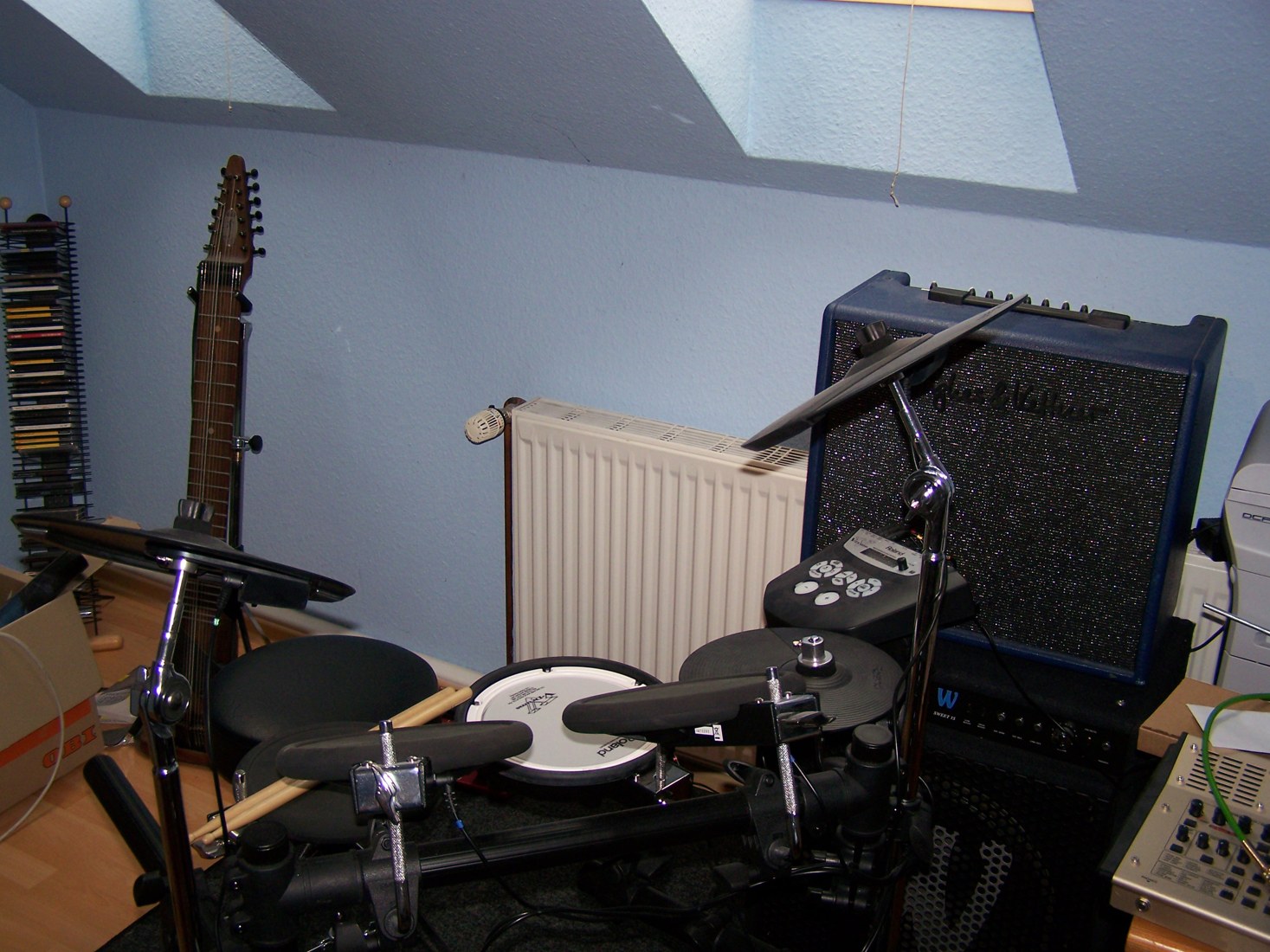
Home recording-studio corner with electronic drums and amplifiers, 6 June 2009. Historical contextual illustration, not a Polish hire room or offered equipment. Marcus Ilgner / Wikimedia Commons, CC BY 2.0. Resized and re-encoded.
Finding somewhere to rehearse can be one of the practical obstacles to making music after a move to Poland. A room advertised with drums and amplifiers sounds straightforward, until you discover that cymbals cost extra, the session must be at least two hours, or the last minutes belong to packing up rather than one more song.
This guide explains how to arrange a first session in a sala prób, or rehearsal room. It uses six primary pages across five operators, checked on 28 October 2026. Published rules describe how those businesses say they work; they do not confirm a room, equipment item or current price for your date. Older documents are identified rather than treated as newly issued policies.
Describe the session before choosing the room
Start with the number of people, instruments and voices, the date, the length of the visit and what you need supplied. A solo practice session, a loud full-band rehearsal and a recording session need different arrangements. Do not assume a rehearsal booking includes an engineer, recording equipment or help mixing a performance.
Send a short equipment list rather than just asking whether the room is equipped. For example, specify how many vocal microphones, guitar amplifiers and keyboard positions you need. Kuźnia Dźwięków asks applicants to say what they need, how many people are attending and how many microphones are required.
Ask which exact room is being offered. A studio can have several rooms with different equipment and restrictions. A photograph of one room does not establish what is in another, and a website inventory is not a guarantee that every listed item will be available or working for your session.
Check the small items that make a setup usable
A drum kit listing does not settle whether cymbals, stands, pedals, a stool or sticks are included. A guitar amplifier does not mean a guitar is supplied. Ask the operator for the complete included setup and tell it which personal items you plan to bring.
Kuźnia Dźwięków's room page illustrates the distinction. It lists drum kits and amplifiers, but separately prices cymbal sets, digital piano hire and guitar cables, and says it does not rent guitars. It also asks people using their own cymbals to bring their own upper hi-hat fixing mechanism. These details matter more to a first visit than a general "fully equipped" label.
Do not use that example as a universal packing list. Ask the chosen studio whether the items you need are included, available for an extra charge or unavailable. Confirm how extra equipment is reserved and whether it is shared with another room. Bring only the equipment you have agreed to use.
Ask for the full payable price
Request a total for your actual group, room, duration and extras. Check whether a quoted amount is per room, per person or per hour, and whether it includes applicable tax. Kuźnia Dźwięków's page uses a net-price label in one room description and gives different arrangements for group sizes, so a headline hourly number is not enough to calculate a final bill confidently.
Ask about minimum hire time too. Kuźnia Dźwięków's rules state a two-hour minimum. That is one operator's published condition, not a standard for every rehearsal room in Poland. A short solo visit or a last-minute booking may need a different product.
This guide does not quote a guaranteed current hire price. Obtain the final amount and payment deadline from the chosen studio before committing. If friends are splitting the bill, agree who is responsible for the booking and what happens if someone drops out.
A request is not necessarily a confirmed reservation
Several reviewed operators require their own confirmation. Kuźnia Dźwięków says a reservation is binding only after it confirms it. Baduuum's PDF rules likewise require email or telephone confirmation, while Proste i Krzywe says its technical staff must confirm by email or phone.
Payment requirements vary. SoundSpot's rules, hosted in its July 2023 document path, describe online payment within 20 minutes of reserving, otherwise automatic cancellation, followed by an email confirmation. Baduuum's July 2024-path document describes cash, advance transfer or prepaid hours, along with a requirement to send transfer confirmation where applicable.
Do not transfer one business's process to another. Ask which payment method applies to your selected slot and keep a confirmation showing the room, start and finish time, cost, extras and status. An outgoing enquiry or an unfinished checkout is not evidence that the studio is holding the room.
Plan entry, unloading and the end of the session
Ask whether someone meets you or whether entry uses a code. SoundSpot and Baduuum describe code-based access and a contact route if entry fails. Before travelling, make sure the studio has the correct contact details and that you understand how to get help during the booked period.
Treat access details as private. Follow the operator's instructions for the booked group; do not post codes in public event listings or leave them in an open invitation. A code is not permission for extra visitors, an unbooked session or access outside the agreed period.
Check unloading and parking separately from the room address. Baduuum's rules prohibit parking on the property where the room is located, referring instead to public spaces on nearby streets. That does not establish an available space or a free parking entitlement. Ask about the actual unloading route, steps, door widths and help with heavy equipment.
Leave time to pack. Proste i Krzywe's rules explicitly say the final booked hour includes packing, switching off or collecting equipment and personal belongings, with the room vacated at the end. Kuźnia Dźwięków asks users to finish five minutes before the reservation ends. Do not assume setup or teardown automatically extends your slot.
Ask for an equipment introduction, not permission to experiment
Tell the studio if a mixer, amplifier or drum setup is unfamiliar. Ask whether staff can explain the equipment in a language you understand and whether someone will be available if it stops working. An unattended entry system does not prove technical support is present in the room.
Reviewed rules restrict changes to supplied equipment. Kuźnia Dźwięków prohibits independently retuning or repositioning its drum kit and asks users to consult staff about changing amplifiers. SoundSpot prohibits changes to configuration, settings and arrangement without consultation. Proste i Krzywe requires staff permission and knowledge before switching amplifiers to other available speaker cabinets.
Follow the studio's equipment-specific instructions rather than general advice copied from another room. This guide deliberately gives no wiring, power-switching or amplifier-operating sequence. Report a fault before attempting a repair, and tell staff about damage or a missing item at the start rather than waiting until checkout.
Read the actual cancellation window
Rehearsal cancellation rules differ sharply. Kuźnia Dźwięków's published rules describe free cancellation up to 48 hours before the session, a 50% charge up to 24 hours before, and the full hire price later. Its rules page carries a May 2020 publication date, so confirm the version that applies to your new booking.
Baduuum's reviewed PDF describes a 24-hour free-cancellation deadline and no refund for a later cancellation or no-show. SoundSpot's older-path PDF describes a 48-hour free-cancellation threshold, a 50% refund with at least 24 hours' notice and no refund below that. Both describe contacting the operator to arrange the refund method.
Fabryka Muzyki at Studio Sienna 41 uses a different expression: cancellation or a change by 20:00 on the preceding day. Do not silently convert that to "24 hours". Proste i Krzywe's rules distinguish single bookings, subscriptions, cancellation charges and a possible one-time move, so read the section for the product you buy.
These are summaries of operators' stated conditions, not legal findings about a particular charge. Save the applicable terms and ask how to cancel or move the booking. A message to bandmates or a missing payment is not necessarily notice to the studio.
Do not start with a recurring commitment by accident
A monthly slot can be useful once a group has a reliable routine, but check what you are committing to. Proste i Krzywe describes a month booked in advance, advance payment for its subscription discount and conditions for changes. Ask how missed dates, holidays and ending the arrangement are handled.
For an unfamiliar room, a single confirmed visit gives you a chance to check the equipment, journey and working setup before agreeing a longer arrangement. Ask whether personal equipment may be stored between visits; room hire alone does not establish storage, insurance or responsibility for things left behind.
Privacy, visitors and house rules still matter
SoundSpot and Baduuum's reviewed rules describe camera monitoring. If that affects a private rehearsal or unreleased work, ask about the actual monitoring arrangement and applicable privacy information before booking. Do not assume room hire includes permission to film other people or publish a recording.
Food, drinks and smoking rules also vary in detail. Studio Sienna 41 permits water in capped bottles in the rooms while directing other drinks elsewhere. Other reviewed studios restrict food and alcohol and prohibit putting drinks on amplifiers. Follow the chosen room's rules, leave it ready for the next group and ask before bringing spectators.
A useful enquiry is: "We are four musicians and two singers. Which room and equipment are included, what must we bring, what is the final price, and when must we finish packing?" Add the confirmation and cancellation questions. Once those answers are written down, the first rehearsal can be about music rather than missing kit and uncertain access.
Frequently asked questions
Does a rehearsal-room booking include recording?
Do not assume so. Confirm recording equipment, an engineer, permitted use and the total cost separately.
Are cymbals and instruments included?
Ask for the exact room inventory and extras. A listed drum kit or amplifier does not establish that cymbals, cables or guitars are supplied.
Can I arrive after only sending an enquiry?
Wait for the operator’s confirmation and complete the required payment steps. An enquiry or unfinished checkout may not reserve the room.
Does packing time extend the booking?
Do not assume extra time. Reviewed studios require leaving at the booked end, and some explicitly include packing or an earlier finish within the slot.
Can I cancel free the day before?
Only under the applicable terms. Operators use different hour thresholds or a preceding-day clock cutoff; confirm the deadline and required cancellation channel.
Sources
- Kuźnia Dźwięków rules, page dated 19 May 2020; checked 28 October 2026
- Kuźnia Dźwięków rooms and extra equipment; checked 28 October 2026
- SoundSpot rules, document hosted in July 2023 path; checked 28 October 2026
- Baduuum rules, document hosted in July 2024 path; checked 28 October 2026
- Proste i Krzywe rehearsal-room rules; checked 28 October 2026
- Fabryka Muzyki Studio Sienna 41 rules; checked 28 October 2026