Oblęgorek Sienkiewicz Museum: Winter Hours, Sunday Tickets and Access
The essentials: The Sienkiewicz museum in Oblęgorek opens Tuesday-Sunday 08:00-16:00 from November to March, with last admission at 15:00. Permanent tickets cost 10/6 PLN; Sunday permanent-exhibition entry is free. English smartphone audio is included. There is no lift upstairs.
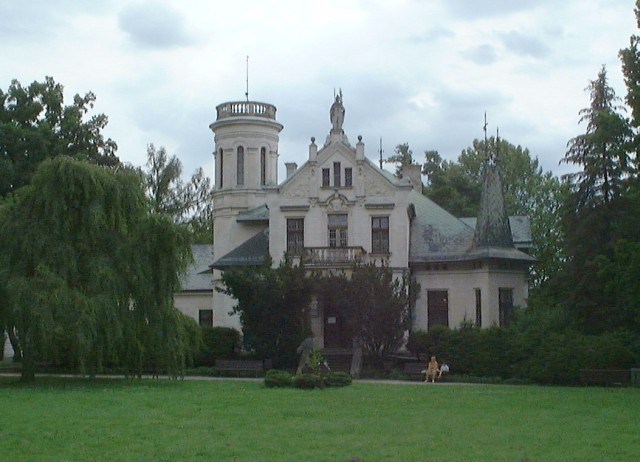
Cover: the Sienkiewicz mansion at Oblęgorek, photographed on 1 August 2004 according to the file metadata, uploaded in 2005. This archival summer image does not show current winter conditions. Photo: Merlin / Wikimedia Commons, CC BY-SA 3.0. Resized and recompressed under the same licence.
A writer's home rather than a city palace
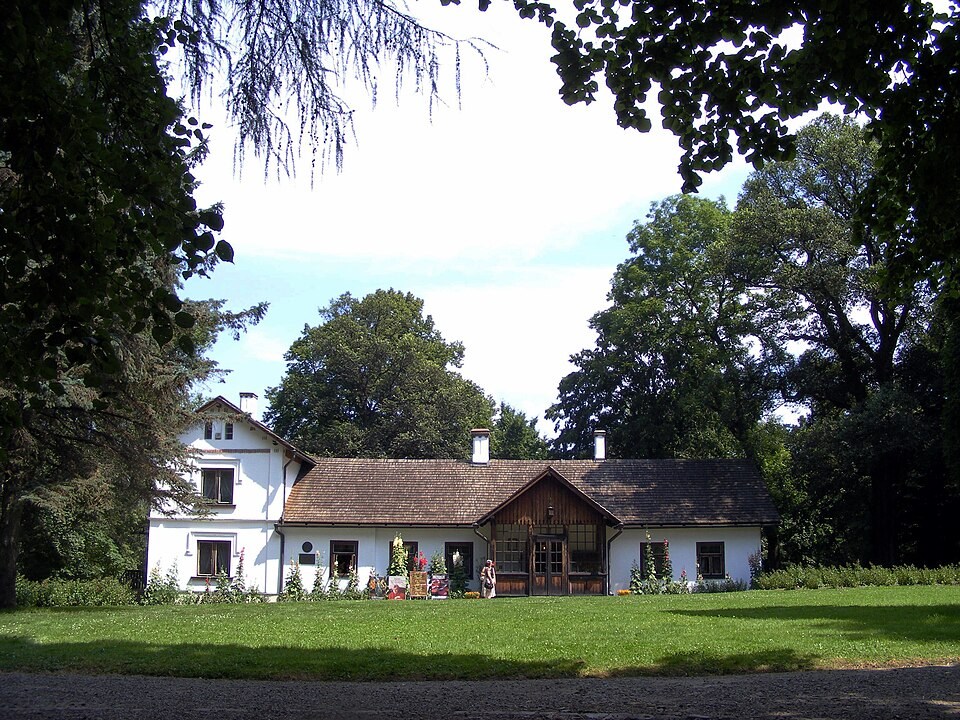
The Henryk Sienkiewicz Mansion in Oblęgorek is a small literary museum outside Kielce, useful for readers of Quo Vadis and visitors interested in how a famous Polish writer actually lived. Its main attraction is the reconstructed apartment, with original furniture, paintings, gifts and personal objects. It is a different sort of outing from a large royal residence: the rooms and their connection to one household matter more than the size of the building.
For a winter visit, start with the museum's dedicated opening-hours page rather than the general branch introduction. From November through March it lists Tuesday to Sunday, 08:00-16:00, with Monday closed. The museum admits its last visitors one hour before closing, so the useful winter arrival deadline is 15:00. Arriving at 15:50 is not a short version of the same visit. It is too late for ordinary admission.
Winter hours, Sunday admission and holiday closures
The seasonal distinction is important. The April-October timetable is 09:00-17:00 from Tuesday to Sunday, whereas winter starts an hour earlier and finishes an hour earlier. A generic 09:00-17:00 listing should not override the November-March table. The regional tourism listing also gives the same winter schedule, supporting the museum's more specific information.
Sunday is the museum's free-admission day for permanent exhibitions. That is a useful saving, but it is not a promise that every temporary exhibition, activity or guide service is free. Decide whether you want the permanent rooms alone or a wider programme before comparing the price of different days. Free admission also does not cancel the last-entry rule or a dated closure notice.
The official holiday table separates days when the museum opens from days when it closes. Its current schedule lists 24-26 December 2026 and 31 December 2026-1 January 2027 as closed. Those dated exceptions matter for a Christmas or New Year trip. They do not establish the arrangements for every later holiday in 2027. Check the branch's notices again close to travel, especially if your journey depends on a particular opening.
Tickets: permanent rooms and extras are different purchases
The current permanent-exhibition tariff lists an individual standard ticket at 10 PLN and a reduced ticket at 6 PLN. Reduced admission requires the relevant entitlement and document. Do not assume that travelling with a student or a child automatically makes every adult in the party eligible for the same rate. The museum also lists family and special youth schemes, whose conditions should be checked against your own circumstances at the ticket desk.
Temporary exhibitions have their own entries in the tariff. A price shown beside a named temporary exhibition is not the price of the permanent apartment. Equally, a ticket price on a tariff page does not by itself prove that a particular temporary show will still be running on your visit date. Check its separate dates before building a trip around it. The practical baseline for the permanent collection remains 10/6 PLN, or free permanent-exhibition admission on Sunday.
Organised groups need more care. The table offers group rates of 9 PLN standard and 5 PLN reduced with a paid guide, and labels the category as a minimum of fifteen people. The explanatory text elsewhere on the same page describes a group as more than fifteen. If your party is exactly fifteen, ask the museum which category applies instead of treating either wording as a guaranteed quote. The published Polish-language guide fee for the permanent exhibition is 30 PLN for the group, in addition to each participant's admission.
English audio without assuming an English live guide
The museum advertises a smartphone audioguide in Polish, English and Italian through the MOVITECH app. It says the audioguide is included in the ticket price. Bring your own headphones and prepare the app on your phone before you arrive. That gives an English-speaking visitor a clear language option without depending entirely on reading labels or finding a guide at the desk.
This is separate from a live guided visit. The listed 30 PLN group service is specifically in Polish and must be arranged in advance. An English audioguide does not establish that an English-speaking live guide is available, or that a guide can be added without notice. If you need a person to lead the visit in English, contact the branch before travelling and ask about language, availability, price and the part of the collection covered.
Individual visitors are not normally required to reserve entry under the museum's published regulations. Organised groups should arrange their visit and guide rather than simply arriving together. The branch contact numbers listed in the regulations are +48 41 303 04 26, extension 105, and +48 664 384 069. Use those contacts for a specific arrangement, particularly access assistance or a party close to the group threshold.
What to look for in the apartment
Oblęgorek was given to Sienkiewicz by his compatriots to mark twenty-five years of his literary career. The museum describes the house as his summer residence between 1902 and 1914. This helps explain the balance of domestic rooms and public gifts: the building was a family retreat, but it also held evidence of the extraordinary attention his writing attracted.
The reconstructed ground-floor apartment contains a study, living room, dining room, smoking room and bedroom. Many of the furnishings and objects are original memorabilia rather than generic period decoration. Look for the relationship between working space and family space, then for the anniversary gifts that connect an individual writer to his readers. The museum identifies family portraits, works inspired by his writing and part of his book collection among the material on display.
The upstairs exhibition broadens the story beyond the household. It covers the writer's career, travels and Nobel recognition, using objects such as foreign-language editions, illustrations and copies of the Nobel medal and diploma. The distinction between original memorabilia downstairs and copies of particular awards upstairs is worth keeping in mind. You are visiting a museum interpretation of a life, not a claim that every object shown was used by Sienkiewicz in this house.
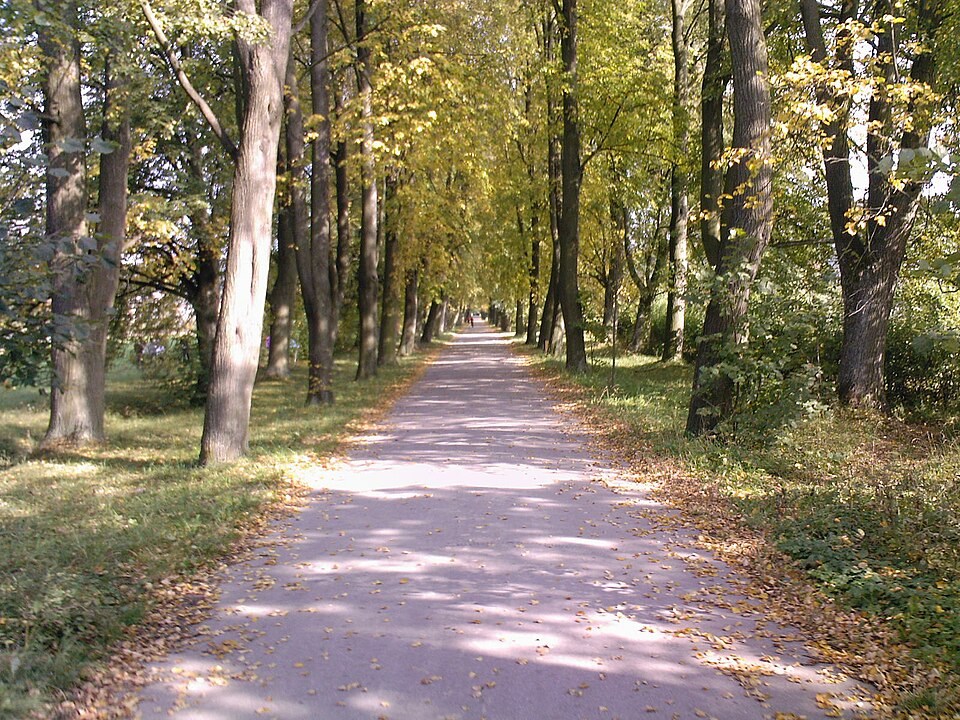
The approach from parking is part of the visit
The branch address is Aleja Lipowa 24, 26-067 Strawczyn, in the village of Oblęgorek, around eighteen kilometres from Kielce according to the museum's access information. Do not substitute the National Museum's central office at Plac Zamkowy in Kielce. That address appears in the website footer but is not the mansion's entrance.
The museum's access declaration places the main car park approximately 800 metres from the main entrance. Allow for that approach when planning last entry, particularly with children, slower walkers or poor weather. A regional tourism description rounds the distance to about a kilometre. For practical planning, treat this as a substantial walk rather than doorstep parking, and follow the museum's own access directions for your vehicle.
The declaration mentions private buses and minibuses from Kielce, but that is not a current timetable or a guaranteed return connection. Check an actual service for your date before choosing public transport. A museum opening until 16:00 does not mean that a convenient bus leaves immediately afterwards. If the connection is uncertain, settle the return journey before entering rather than discovering the problem at closing time.
Step-free access is limited to the ground floor
The museum's detailed access statement is more useful than a general accessible-facilities symbol. It says visitors with disabilities can park about twenty metres from the entrance. Two steps lead into the building, and staff can set out a portable platform when needed. The approach includes stone paving. Contact the branch beforehand if the surface, platform or vehicle access is important to your visit.
Once inside, the ground floor can be used by wheelchair visitors, but the house has no lift to the first floor. The upstairs exhibition should therefore not be treated as independently step-free. This is a meaningful limit even though the main domestic rooms are downstairs. Ask which rooms you can reach and how staff will assist at the entrance, rather than relying on a broad promise that the whole museum is accessible.
The declaration also lists an adapted ground-floor toilet suitable for disabled visitors and parents with children, places to rest, and permission to enter exhibition rooms with pushchairs. These facilities help, but they do not remove the entrance steps or provide a lift. Families should think separately about getting into the house, moving around the ground floor and whether everyone can use the staircase.
A simple plan that avoids the common mistakes
Choose an ordinary Tuesday-Sunday opening unless you have checked a holiday exception. Aim to reach the property with time for the walk from parking and admission before 15:00 in winter. Have headphones and the English audio option ready if you need them. Start with the domestic rooms, then add the upstairs biography if the stairs suit your party. Treat any temporary exhibition as a separate decision with its own dates and ticket conditions.
The visitor regulations ask people to leave large bags and outer clothing in the designated place, avoid touching exhibits and furnishings, and keep food out of the galleries. Personal photography is subject to the museum's rules, including no flash or tripod in the exhibitions; commercial or published use has separate conditions. For most visitors, the better preparation is straightforward: confirm the correct seasonal hours, budget for the collection you actually want and resolve any access assistance before setting off.
Frequently asked questions
Is the museum free on Sunday?
The museum lists free Sunday admission to permanent exhibitions. Temporary exhibitions and guide services should be checked separately.
What is the last winter admission?
Last entry is one hour before closing: 15:00 under the November-March Tuesday-Sunday timetable.
Can wheelchair visitors see the whole museum?
No. Staff can deploy a portable entrance platform, and the ground floor is accessible, but there is no lift to the first-floor exhibition. Arrange any assistance with the branch.