Sanniki Palace: Winter Visits, Chopin, Tickets and Access
The essentials: Sanniki lists daily off-season grounds hours of 08:00-17:00, but its Tourist Information Point lists October-April service Monday-Friday, 08:00-15:30. Ordinary visiting is 15/10 PLN; interactive visiting is 20/15 PLN. Confirm winter interiors and language before travelling.
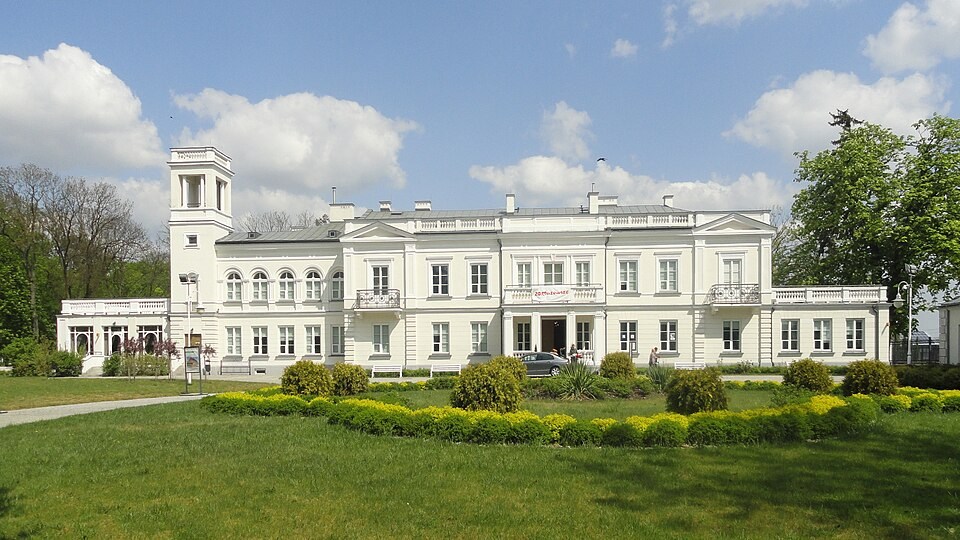
Cover: Sanniki palace, photographed on 30 April 2019. This archival image does not show current winter conditions. Photo: Cybularny / Wikimedia Commons, CC0 1.0. Resized and recompressed.
Sanniki in winter: a park walk is not the same as a palace visit
Sanniki is a useful alternative to a large-city museum trip if you want to follow Fryderyk Chopin's story beyond Warsaw. The composer stayed here as a teenager, and the palace now houses the European Artistic Centre named after him. But a winter visit needs a little planning: the grounds' daily opening hours are longer than the staffed visitor-service hours, and concerts have their own tickets and dates.
The clearest winter planning combination comes from two official pages. The visitor page lists the complex as open daily outside the May-September season from 08:00 to 17:00. The Tourist Information Point page specifically lists 1 October-30 April service Monday to Friday, 08:00-15:30. Do not read the daily grounds hours as a guarantee that you can walk into the palace exhibitions on a winter weekend.
When to come for the interiors
The visitor page gives off-season guided visiting hours of 08:00-15:30 but does not repeat the weekdays in that row. The information point's seasonal timetable supplies the missing distinction: winter staffing is listed Monday to Friday, whereas Saturday, Sunday and holiday service is expressly listed for May-September. Plan an ordinary winter interior visit around the weekday staffed window and contact the centre before travelling.
That does not mean the palace can never host a winter weekend event. It is a working cultural centre, and the published visitor information invites organised groups to contact the office about guided visits outside normal guide hours. A booked event or agreed group visit is different from routine walk-in access. If you can travel only on Saturday or Sunday, ask whether your intended date has an interior tour and whether it requires an appointment.
No guaranteed last-tour time or tour duration was established from the checked operator pages. Arrive with enough time to speak to staff and complete the route, rather than treating 15:30 as the moment to start. For a concert day, ask separately whether exhibitions are available before or after the performance. The visitor regulations allow some palace rooms to be temporarily unavailable because of the centre's activities.
Tickets: ordinary visiting, interactive visiting and concerts
The centre's published tariff, marked effective from 1 January 2025 and still displayed when checked on 28 November 2026, lists ordinary visiting at 15 PLN standard or 10 PLN reduced. Interactive visiting is a separate line at 20 PLN standard or 15 PLN reduced. These are different products; ask which route and exhibition are included rather than assuming the cheaper ticket covers every activity.
The same tariff lists Chopin-concert admission at 42 PLN for the concert hall and 22 PLN for the mirror hall. Those figures are useful orientation, not confirmation that an event is on sale, has seats or uses those exact arrangements. The regulations permit event-specific charges, and a sightseeing ticket is not a concert booking. Read the individual event listing before choosing a date around music.
Tickets and souvenirs are sold at the Tourist Information Point. The regulations also provide for online ticket sales and say the cash desk accepts Polish złoty and listed payment cards. Anyone needing a business invoice should tell the seller and provide the relevant NIP before the receipt is issued, as the tariff page requests. Do not wait until after a ticket purchase to raise that requirement.
For an international resident, discount eligibility deserves a closer look than the words "reduced ticket". The posted rules attach EU-citizenship conditions to several categories, including students and some pensioner or disability-related concessions. A foreign student card or Polish residence address alone should not be treated as proof that every concession applies. Bring supporting documents and ask the desk about your exact category. Children under three and holders of Karta Polaka are among the listed fee-exempt groups.
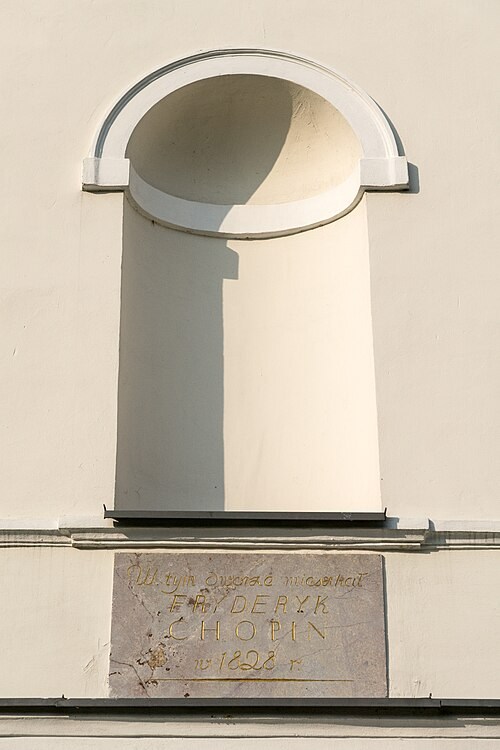
Why Chopin belongs in the Sanniki story
The centre's history of the palace places the connection in 1828, when eighteen-year-old Chopin spent two summer months with the Pruszak family. His friend Konstanty Pruszak had attended the Warsaw Lyceum with him. This is a documented visit associated with friendship and composition, not the composer's birthplace and not a claim that he lived here throughout his career.
According to the centre, Chopin worked here on the C-major Rondo and parts of the G-minor Trio. The story helps explain why the building is now used for performances as well as displays. You can approach Sanniki through the music, but the surrounding household and its later history also matter. The palace was built in 1793-1796 for Tomasz Tadeusz Pruszak and later enlarged, including the northern wing and tower.
One object needs careful wording. The centre describes a piano bought by the Pruszak family around 1820 from the Warsaw maker Antoni Zakrzewski. It says Chopin most probably played it during visits to the family's Warsaw residence. The instrument's association is therefore presented as probable, not proven beyond doubt, and it should not be described as the keyboard on which a named work was certainly composed at Sanniki.
The piano later entered the musical-instrument collection in Poznań and came to Sanniki in 2013, according to the same history. Ask what is currently displayed on your route. A historical account of an object's journey is not a guarantee that every room or object is accessible during a performance or a temporary exhibition change.
Look beyond the composer's visit
The palace has had uses very different from its original summer-residence role. After the Second World War, the estate passed to the state and parts were used by a state agricultural enterprise. Palace rooms served as offices and homes, and the building also accommodated a kindergarten and cinema space. That later history explains why restoration here was more than repainting a decorative facade.
The centre records a major palace-and-park renovation in 2011-2013, with the formal reopening in September 2014. Work uncovered original wall paintings in seven upstairs rooms, dating from the late eighteenth and early nineteenth centuries. If decorative interiors interest you more than musical biography, ask staff which restored rooms form part of the current route.
There is also an archaeological strand. The centre describes an attic exhibition about what stood on the site before the palace, developed with the State Archaeological Museum in Warsaw using findings from the 2017 excavations. It combines excavated objects with multimedia and elements aimed at younger visitors. Check whether this is the interactive ticket you are being offered and whether the attic forms part of your accessible route. The general lift information does not by itself establish access to every exhibition level.
Mobility access and the correct entrance
The access declaration, reviewed in August 2026, is more useful than a blanket statement that the complex is adapted. The entrance from Warszawska involves three steps. An alternative approach from Parkowa, associated with gate 3 and visitor parking, has a ramp. There are designated parking arrangements for visitors with disabilities beside the palace.
The declaration lists ground-floor and first-floor exhibitions, with a lift near the office entrance for reaching the first floor. Because its route description refers to both the ramp and nearby steps, visitors who need a fully step-free approach should ask staff to identify the precise entrance and lift route before arrival. Explain your chair or walking-aid needs rather than relying on the address alone.
An adapted toilet and baby-changing space are listed on the ground floor. The centre also says one wheelchair and one walker can be borrowed; with only one of each mentioned, availability should be checked rather than assumed. Seats in the hall provide resting places. Assistance dogs and guide dogs are allowed, while ordinary pets are not part of the general visitor offer.
The declaration lists audio guides but does not establish the available languages. It also notes a lack of English information on the main hall's information board. If English interpretation is important, ask about the language of the audio guide and whether an English-speaking guide can be arranged. Do not assume that an English tourism article means English is provided on every palace route.
Park, cafe and family expectations
The grounds can make sense as a shorter outing even without an interior appointment. Follow the daily off-season 08:00-17:00 window, but check current notices and weather before travelling. The centre describes a playground, outdoor displays and recreational areas; that description is not a promise of winter sports equipment, working fountains or a programme of outdoor performances.
A separate orangery-cafe page lists Thursday-Sunday hours of 12:30-20:00. Treat it as a separate service and confirm before making it the reason for your trip. Cafe opening does not establish exhibition access, and an evening cafe closing time does not override the published winter grounds hours. Ask which entrance to use if combining a late cafe visit with a walk.
For families, the access page lists a drawing corner at the information point and a changing table, while the archaeology exhibition offers a more structured indoor interest. These do not turn the palace into an unsupervised play space. The regulations require children under ten to visit exhibitions with an adult and allow rooms to close for cultural activity.
Before leaving for Sanniki
The destination is the palace at Warszawska 142, 09-540 Sanniki. The Tourist Information Point can be reached on +48 24 268 11 08. Ask for the visit date, interior route, language and entrance you need in one enquiry. No live public-transport timetable or journey time was established for this guide, so arrange the return journey separately if you are not driving.
Finally, check the centre's current news and the event's actual venue. Its programme can include performances away from Sanniki, so a concert advertised by the centre is not automatically a concert at the palace. For a dependable winter plan, choose either a confirmed interior visit or a grounds-only outing, then add music or the cafe only when their own details fit.
Checked on 28 November 2026. Tariffs, staffing, room access and event arrangements can change; confirm the details that determine your visit.
Frequently asked questions
Can I visit the palace interiors every winter weekend?
Do not assume so. The grounds have daily off-season hours, but the information point lists October-April service Monday-Friday. Confirm any winter weekend tour or event separately.
Are concert tickets included in ordinary admission?
The centre lists sightseeing and concert tickets separately. Check the individual event for its price, venue and availability.
Is there a lift?
The August2026access declaration lists a lift to first-floor exhibitions and a Parkowa-side ramp. Ask staff for the precise step-free route and access to any attic exhibition.