Osiek Museum in Winter: Weekday Visits, Tickets and Access
The essentials: Osiek lists November-April visits Monday-Friday 09:00-15:00, with last entry at 14:00. Winter weekends require prior phone arrangements for organised groups of more than 20. Standard admission is PLN 25, reduced PLN 20 and family PLN 55; confirm the route and any guide charges.
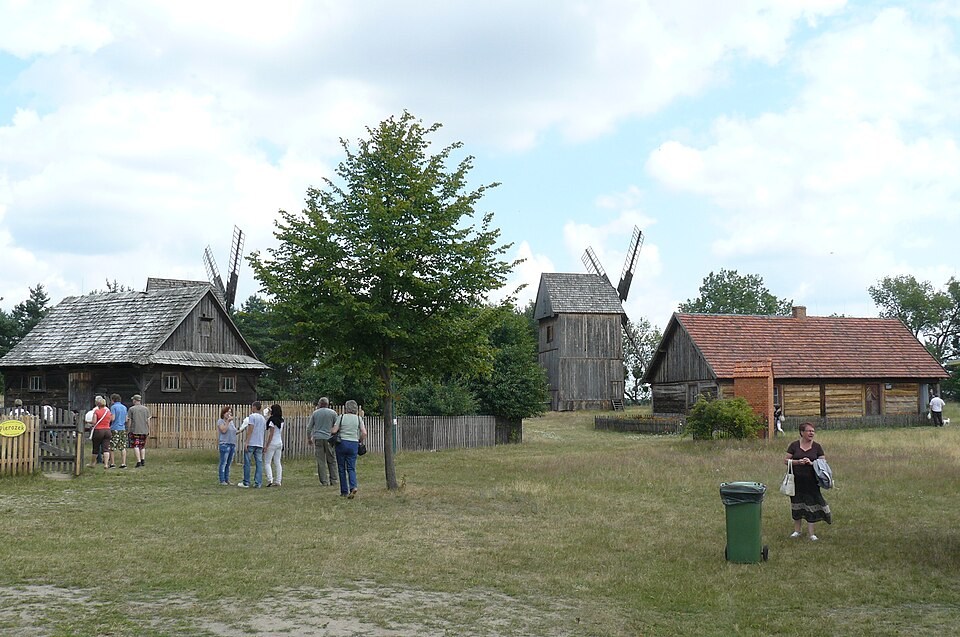
Cover: cottages and windmills at the Osiek museum, an archival photograph with camera metadata dated 26 June 2011, uploaded on 27 June 2011. Not current winter conditions or a promise of windmill access. Photo: MOs810 / Wikimedia Commons, CC BY-SA 4.0. Resized and recompressed under the same licence.
A winter weekday is the simplest starting point
The Museum of Folk Culture in Osiek nad Notecią is a year-round open-air museum, but that does not mean it runs a normal individual-visitor weekend throughout winter. Its detailed opening page lists November-April hours as Monday-Friday 09:00-15:00. Saturdays and Sundays in those months are available only by prior telephone arrangement for organised groups of more than 20 people.
That qualification matters because the same site also advertises free Saturday entry without cottage interiors. Read together, the pages do not establish a free, walk-up winter Saturday for a couple or family. If you want a straightforward independent winter visit, start with a weekday. If only a weekend works, ask the museum whether your specific party and date can be accommodated before making the journey.
There is another reason to use the detailed hours page: the homepage still displays a September-October timetable. That shorter homepage summary is not a reliable substitute for the explicit November-April arrangements. The museum is at ul. Dworcowa 12, Osiek nad Notecią, not at its parent museum's address in Piła.
Last admission and Christmas closures
The visitor rules put last entry one hour before closing and require everyone to leave by closing time. Combined with the 15:00 winter finish, that gives a 14:00 last-admission limit on an ordinary listed winter weekday. Do not interpret it as a promise that every route, interior or organised activity can begin at 14:00.
The dated 2026 opening page lists closure on 24, 25 and 26 December, alongside 1 and 6 January, Easter Sunday and Monday, Corpus Christi, 15 August, 1 November and 11 November. Its explicit inclusion of Christmas Eve is useful because the general visitor regulations give an older-looking holiday list that omits 24 December. For a 2026 visit, use the dated opening notice and recheck for any later special announcement.
A holiday closure list is not a booking confirmation for the days around it. Check the intended date, start time and route, particularly for a group arriving during school holiday periods. The published contact numbers are +48 67 286 60 90 and +48 574 084 635. Calling also settles any uncertainty created by an old seasonal summary still visible elsewhere on the site.
Admission prices and the separate guide fee
The museum's 2026 group offer lists admission at PLN 25 standard, PLN 20 reduced and PLN 55 for a family ticket. It gives a separate PLN 50 guide fee for an organised group of up to 30 people. These figures match the parent museum's notice introducing prices from 2 January 2026.
The parent notice also lists prices for the museum in Piła, which are different. Make sure you are reading the Osiek section rather than transferring the Piła ticket or its Sunday free-entry rule to the skansen. The Osiek Saturday offer has its own exterior-only condition and, in winter, must also be read alongside the arranged-group weekend restriction.
The cited tariff does not define the family ticket's precise adult-and-child combination. Ask if your party fits before relying on PLN 55 as its total. Reduced or free statutory categories require the relevant proof under the visitor rules. For a group, confirm the total admission, guide charges and any activity supplements in one booking rather than treating the guide fee as an all-inclusive group ticket.
How visits are organised
The visitor rules say individual visitors are accompanied around the grounds by a museum employee. Organised groups visit with a paid guide, and a group may contain no more than 30 people including accompanying adults. A larger party should ask how it will be split and how guide charges apply; the group size limit is not permission to bring a larger group on the same booking.
This is also not a place where an unlocked door means every building is available to enter. Follow the designated routes and the employee's instructions. The museum can close individual sections for operational reasons. Low lintels, dark or confined spaces and historic fittings require particular care, and children need supervision throughout.
Language is a separate question to settle in advance. None of the cited operational pages establishes an English-speaking guide for every visit. Give the museum your party size, language needs, preferred date and whether you want the archaeology pavilions, cottage interiors or a particular building. A clear answer before travel is more useful than discovering that a general opening time did not cover the experience you had in mind.
Why archaeology belongs in this village museum
Osiek's collection has an unusual starting point. The museum's history describes an accidental discovery in 1972, when sand extraction uncovered a multi-chamber stone-box grave containing cremation urns. Excavations continued until 1977, documenting 581 burials and finds from the early Iron Age through the Roman-influence period.
Three pavilions were built to present the prehistoric material after the excavations. Examples of threatened rural architecture began arriving later in the 1970s, and the developing museum became part of the district museum in Piła in 1978. The present name, Museum of Folk Culture, dates from 1992.
That history makes the archaeology more than an unrelated rainy-day addition. The museum grew around discoveries at this location, then added buildings and objects from Krajna, Pałuki and the Noteć Forest region. Ask whether the pavilions are included in your planned route. An indoor archaeological display is not a guarantee that a winter visit can be kept entirely indoors.
Look beyond the windmills
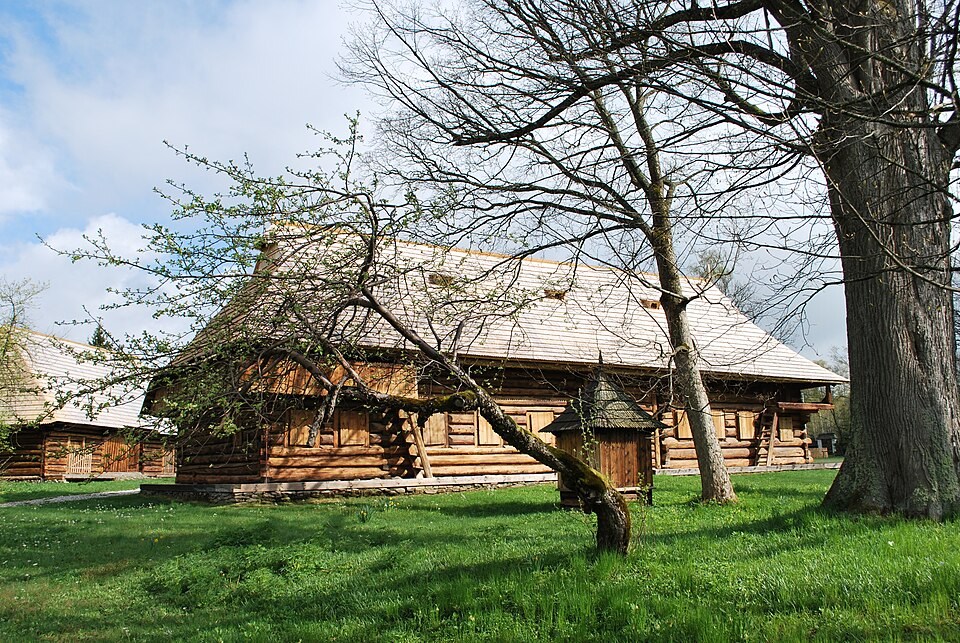
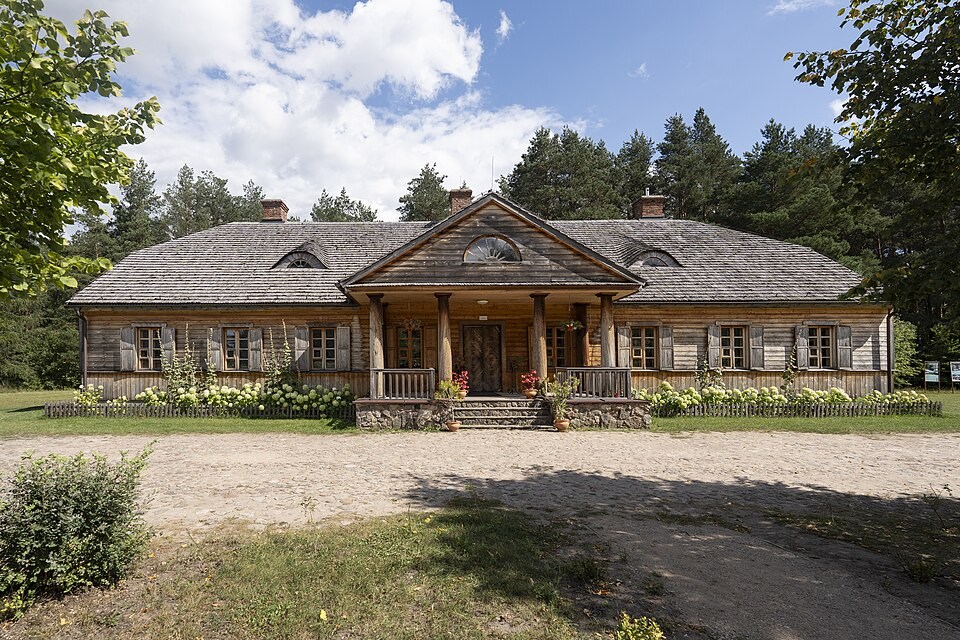
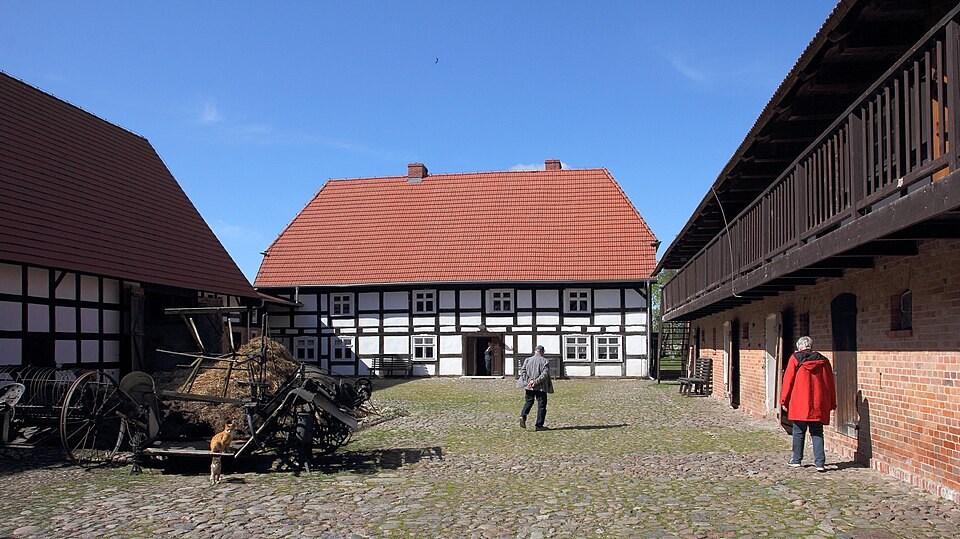
The museum describes 28 large architectural objects, including cottages, farm buildings, a church, a forge, a sawmill and three windmill types: koźlak, paltrak and holender. These are collection descriptions, not a live count of interiors available on your chosen date. In particular, a July 2026 notice describes a conservation project for the holender windmill. It does not by itself establish the project's completion or today's visitor access.
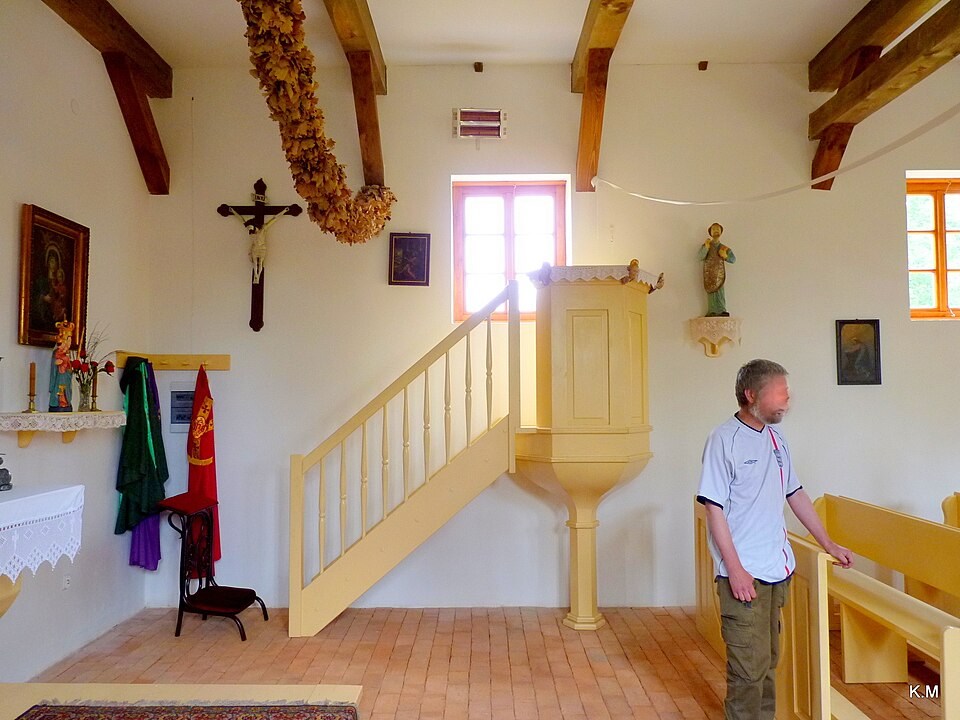
The collection overview offers a good way to give a shorter visit some focus. It describes decorated Krajna dowry chests dated 1824 and 1839, household vessels, textiles, beds and cradles, plus fittings from a village shop of the 1930s. The historic interiors can be read as workplaces and households, rather than simply as rooms filled with old furniture.
Tools extend that story into farming, flax processing, weaving, shoemaking, blacksmithing and other trades. Figurative beehives represent more recent folk art. Pick one or two themes to ask the accompanying employee about instead of trying to turn a short winter afternoon into a race past every exhibit. The collection list does not promise live craft demonstrations during an ordinary visit.
Workshops are booked products, not daily extras
The 2026 organised-group offer separates demonstrations, workshops and scheduled educational events. Demonstrations carry supplements to admission and the guide fee: examples include flax processing, butter-making with tasting and wafer baking. Their appearance on the offer page is not a promise that a walk-up visitor can join them at any time.
The page lists December gingerbread workshops and says workshop prices include visiting the skansen and a carriage ride. Confirm the specific programme, final price, participant requirements and any weather-related changes directly. Do not assume the full programme or carriage element operates for every winter booking just because it appears in the general package description.
Access needs a route-specific conversation
The museum's accessibility report records conditions as of 1 January 2025, so it is a planning aid rather than a fresh inspection. It describes a hard-surfaced parking area without a designated accessible space, then a sloping earth approach where a wheelchair user needs another person's help. Paths around the grounds are unpaved, field-road-style routes.
The combined ticket-office and cafe building is single-storey without steps but has a threshold. Visitor toilets are in a separate building reached along an earth route, with an adapted room and a sloping approach for which assistance is needed. The report describes staff help for entering cottages and archaeology pavilions, while acknowledging barriers and size limits in historic buildings. Do not turn that offer of help into a claim that all interiors are independently wheelchair accessible.
The report permits assistance and guide dogs, which should not be confused with the general pet rules. Ordinary animals must be on a lead, are excluded from interiors, and are prohibited at organised events under the visitor regulations. If travelling with an assistance dog, discuss your route with staff rather than treating an ordinary-pet restriction as the full access policy.
Amateur photography and filming during a normal visit are free under the rules, but interiors prohibit flash, extra lighting and tripods. Commercial work and separate photographic sessions need arrangements. For a first winter trip, the main checks are simpler: choose a listed weekday, arrive before last admission, confirm the route and language, and arrange any physical assistance ahead of time. Save a weekend journey for a visit the museum has actually agreed to host.
Frequently asked questions
Can a couple visit free on a winter Saturday?
The general Saturday exterior-only free offer does not override the November-April rule limiting weekends to prior telephone arrangements for organised groups of more than 20. Confirm any exception directly before travel.
What is the winter last-admission time?
The ordinary listed winter weekday closes at 15:00, and visitor rules require entry at least an hour before closing. That gives a 14:00 cutoff, not a guaranteed start for every activity.
Are the cottages independently wheelchair accessible?
The January 2025 access report describes unpaved routes, slopes, thresholds and historic-building barriers. Staff assistance is available, but visitors should arrange the particular route and support they need.
Sources
- Osiek: detailed seasonal hours and dated 2026 holiday closures
- Osiek: visitor rules, last admission and photography
- Osiek: 2026 organised-group tickets and activities
- Parent museum: prices effective 2 January 2026
- Osiek: archaeology and museum history
- Osiek: collection and furnishings
- Osiek: July 2026 holender conservation project
- Osiek: access report, conditions as of 1 January 2025