Słowiński National Park Weekend Guide: The Moving Dunes
The essentials: Słowiński National Park on the Baltic coast protects Poland's moving dunes, best visited from Łeba. Entry costs 10 PLN (5 PLN reduced) as of 22 October 2026. Plan two days: the Łącka dune loop from Rąbka, lakeside viewpoints, and the Kluki open-air museum.
On the Baltic coast about two hours west of Gdansk, the wind is slowly pushing a small desert across the forest. Slowinski National Park protects a narrow strip of shore where sand dunes creep inland year after year, burying pines and leaving bleached trunks sticking out of the slopes. It is one of the strangest landscapes in Poland, and one of the easiest to visit: the resort town of Leba sits at the park's western gate, with guesthouses, fish smokehouses and a wide sandy beach of its own. This guide plans a weekend here: how to reach the park, what entry costs, which trails to walk, where to take children, and what to do when the weather turns.
Getting there and where to stay
Leba is the natural base for the park. The town lies about 110 km northwest of Gdansk, roughly two hours by car along the S6 expressway and local roads through Lebork. Drivers from Warsaw should plan on around five hours. Without a car, the practical route is a train from Gdansk or Gdynia to Lebork, then the local line to Leba; with the change the journey takes about two and a half hours. Regional buses also link Leba with Lebork and Slupsk, which is useful if you are combining the park with the wider Central Pomerania area.
Leba itself is a classic Polish seaside resort: a long promenade, a fishing port, a wide beach and more beds than anywhere else near the park. Book well ahead for July and August, when prices climb and the town fills up. Outside the school holidays the same rooms cost noticeably less, and the dunes are at their quietest. Smaller villages around the park, such as Smoldzino and Rabka, have guesthouses and campsites if you prefer to sleep closer to the trails. Wherever you stay, try the local smoked fish from the port stalls; it is the region's signature snack and an easy picnic for the trail.
Data source: Slowinski National Park tourist portal (slowinskipn.pl), checked 22 October 2026.
Park tickets and the moving dunes
The park charges one entry fee that covers all marked trails. As of the official price list checked on 22 October 2026, a normal ticket costs 10 PLN and a reduced ticket 5 PLN. If you plan to return over several days, multi-entry passes are better value: 23 PLN normal and 11.50 PLN reduced for three days, 45 PLN and 22.50 PLN for seven days, and 70 PLN and 35 PLN for fourteen days. An annual pass costs 140 PLN, or 70 PLN reduced. Tickets are sold at the park entrances, including Rabka and Smoldzino, and the park's regulations require visitors to keep to marked trails, which matters on the fragile dune slopes.
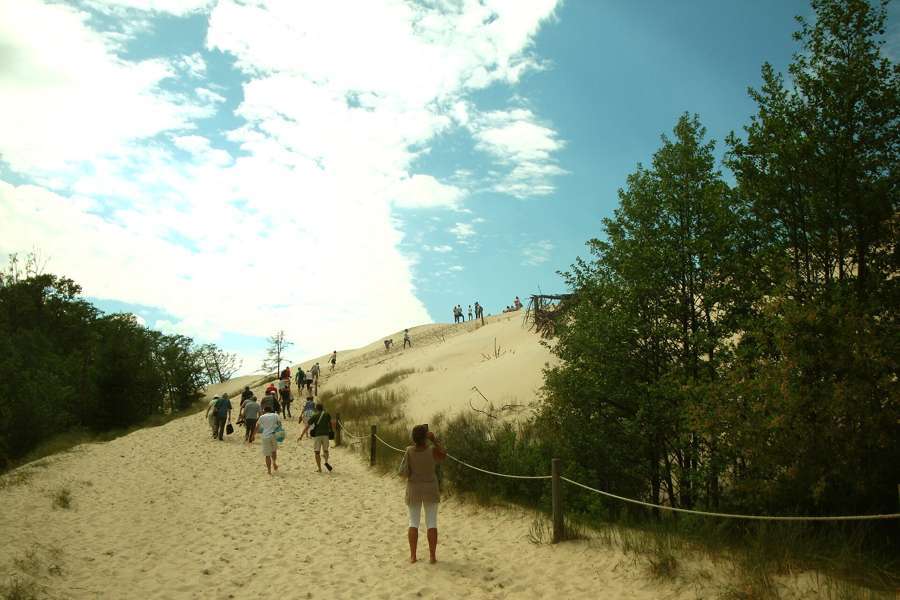
The famous dunes begin at Rabka, about 7 km west of central Leba. From the entrance, a forest track runs about 5.5 km to the open sand. You can walk it, cycle it (there are racks where the bikes must stop), or in season ride one of the electric carts that shuttle visitors along the track, which saves small children a long trudge. The marked route then climbs onto the Lacka dune. From the crest, roughly 40 metres above the sea, the view is pure sand in one direction and the Baltic in the other, with the dark line of the forest the dunes are slowly swallowing.
The movement is the whole point. Wind off the sea pushes the sand grain by grain, and over the years the dune field advances inland, burying living forest and exposing the skeletons of trees it buried decades ago. Nothing else in Poland looks like this, and few places in Europe let you walk across an active dune field so easily. Go early in the morning or late in the afternoon in summer: the open sand has no shade and midday heat reflects hard off the surface.
Data source: Slowinski National Park, official ticket information (spn.gov.pl/informacje-o-biletach), checked 22 October 2026.
Lakes, forest and the Czolpino museum
The park is much more than its dunes. Two large coastal lakes, Lebsko and Gardno, fill its interior, ringed by reed beds and wet forest that draw birdwatchers for the migration seasons. The classic panorama is from Rowokol hill above Smoldzino village, where a marked climb rewards you with a view over both lakes to the dune ridge and the sea. On a clear day it is the single best place to understand the park's whole geography at once.
The park also runs its own museum in Czolpino, on the eastern side, with exhibits on the nature and history of the coast. Czolpino pairs well with a stop at the nearby historic lighthouse, one of the oldest on this stretch of the Baltic, which opens to visitors in season. Together they make a good half-day away from the busiest part of the park, especially if the Rabka track is crowded.
Data source: Slowinski National Park tourist portal (slowinskipn.pl), checked 22 October 2026.
Kluki and the Slovincians
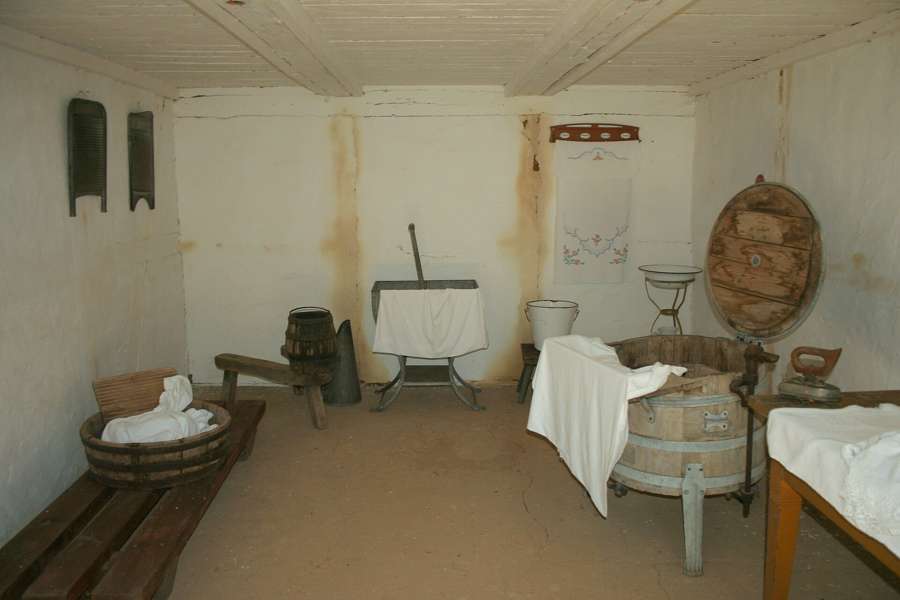
For a rainy afternoon, drive about 10 km south of Leba to Kluki, where an open-air museum preserves a village of the Slovincians, the people who fished these lakes and this coast for centuries. Thatched cottages, boats, nets and household tools are laid out as a working settlement, and in season the museum runs demonstrations and workshops. The Slovincian language died out in the twentieth century, so the museum is the best place left to meet this vanished corner of Slavic Europe. Opening days and tickets change with the season, so confirm the details on the museum's own website before you set out; in the low season hours are shorter and some buildings stay closed.
Data source: Slowinski National Park tourist portal (slowinskipn.pl), checked 22 October 2026.
Visiting with children
The dunes are a natural playground: soft sand to climb, room to run, and the sea at the far side. A few practical notes make the day much smoother. Take more water than you think you need, because there is no shade and no shop once you leave Rabka. Bring a windproof layer even on warm days; the ridge is exposed and the Baltic wind is constant. Pushchairs and strollers do not work on the sand, so carry small children in a sling or backpack, or use the seasonal electric carts to shorten the walk. Older children usually love the climb itself and the run down the lee slope. Finish with an hour on Leba's town beach and an ice cream on the promenade, and nobody will remember the walking.
Data source: Slowinski National Park tourist portal (slowinskipn.pl), checked 22 October 2026.
A two-day plan
Day one: arrive in Leba by midday, walk the promenade and the port, then take an early dinner of smoked fish. Day two: be at the Rabka entrance when it opens, walk or ride to the dunes, do the full loop over the Lacka dune and back along the beach, and spend the late afternoon on Leba's beach. Day three, if you have it: Rowokol viewpoint in the morning, the Czolpino museum and lighthouse after lunch, and Kluki on the way home. If the forecast is wet, swap the order and keep the dunes for the clearer day; the sand is far less fun in driving rain, and the museums cover exactly that gap.
Frequently asked questions
How much does entry to Slowinski National Park cost?
A single entry costs 10 PLN normal and 5 PLN reduced, as of the official price list checked on 22 October 2026. Multi-entry passes run from 23 PLN for three days up to 140 PLN for an annual pass, with reduced tickets at half price.
How do I get from Leba to the moving dunes?
The dunes start at the Rabka entrance, about 7 km west of Leba's centre. From there it is roughly 5.5 km on foot or by bike along a forest track to the open sand, and in season electric carts shuttle visitors along the same route.
Is Slowinski National Park suitable for small children?
Yes, with planning. Use the electric carts to skip the long forest track, carry toddlers in a sling rather than a pushchair, and bring water and wind layers for the exposed ridge. The sand itself is the attraction and children tend to love it.
When is the best time to visit?
Late spring and early autumn give the best balance of weather, light and smaller crowds. July and August are warm but busy, so book accommodation in Leba well ahead and visit the dunes early or late in the day. * Photos: Cover - M Z Wojalski, CC BY 3.0, via Wikimedia Commons (the moving dunes near Leba). Body - Yarl, CC BY-SA 3.0, via Wikimedia Commons (interior at the Kluki open-air museum).