Fake 'No Ticket' SMS Scam Targets Warsaw Passengers: What to Do
The essentials: Warsaw operator WTP warned on 16 October 2026 that passengers are getting fake SMS texts claiming a tram inspection found them without a ticket, demanding payment via a link. ZTM never sends these. Do not click or pay; forward the text to 8080 and report the site to incydent.cert.pl.
If a text message lands on your phone claiming you were caught without a ticket on a Warsaw tram and now owe a fine, do not pay anything and do not tap the link. Warsaw Public Transport (WTP) has issued an official warning: passengers are receiving fake SMS messages about alleged ticket inspections, and none of them come from the city's transport authority.
What WTP announced
On 16 October 2026, Warszawski Transport Publiczny published a warning titled "Uwaga na fałszywe SMS-y o braku biletu!" (Watch out for fake no-ticket text messages). According to the notice, passengers reported receiving suspicious SMS messages whose sender impersonates WTP. The message claims that during a ticket inspection on a tram, the passenger was found without a valid ticket and that a payment demand (wezwanie do zapłaty) was issued. The text contains a link to a website where the supposed fine can be paid.
WTP's statement is blunt: "To próba oszustwa! Nie wysyłaliśmy takich wiadomości" - this is an attempted scam, and the transport authority (ZTM) did not send these messages. The city's official Warsaw 19115 portal has amplified the same warning, telling residents not to click the links and not to enter payment details.
How the scam works
This is a classic "smishing" (SMS phishing) pattern, and it is engineered to hit people who use public transport occasionally - which makes expats and newcomers prime targets:
1. The hook. A text arrives out of the blue referencing a plausible everyday situation: a tram ride, an inspection, a fine. If you rode a tram recently, the timing feels believable. 2. The authority costume. The sender name or wording borrows the WTP/ZTM identity so the message looks official. 3. The urgency. A payment demand with a short deadline pressures you into acting before thinking. 4. The link. The link leads to a cloned payment page. Whatever you enter there - card number, expiry, CVC, or online banking credentials - goes to the scammers. The "fine" itself is usually small enough to feel not worth questioning, which is the point: the card data is worth far more than the fake charge.
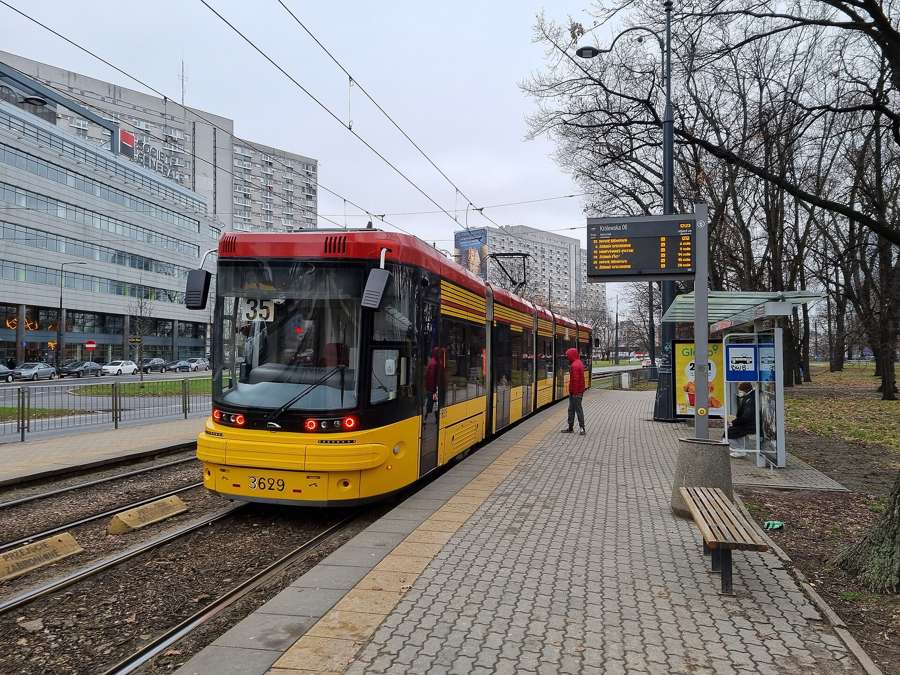
New arrivals are disproportionately exposed to this kind of message for simple reasons. The ticket rules feel unfamiliar, the vocabulary of a fine (wezwanie do zapłaty, dodatkowa opłata) is hard to judge in a foreign language, and many expats genuinely do ride trams and buses daily - so a message saying "you were inspected and owe money" lands on fertile ground. Scammers do not need to know you rode line 35 yesterday; they send the same text to thousands of numbers and wait for the fraction for whom it feels plausible.
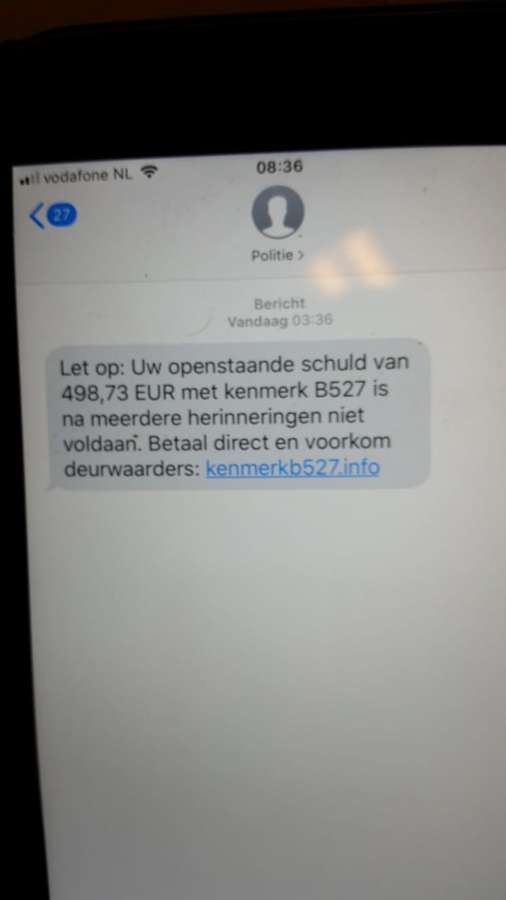
The cover photo of this article shows the same trick in another country: a text impersonating the Dutch police demanding payment of an invented debt through a link. The Warsaw variant follows the identical script, translated into a tram-ticket setting.
How to recognise it: red flags
- Any SMS demanding payment for a transit fine is fake. ZTM states it does not send such messages at all.
- A link to pay. Genuine Warsaw transport payment demands are not settled through links in text messages.
- A fine you never received on paper. A real additional-fare charge in Warsaw starts with a physical inspection and a document issued by the inspector - not with a text message arriving days later.
- Payment by card on an unfamiliar page. The page may carry the WTP logo or the "tetka" mascot; scammers copy branding freely. WTP itself has warned about fake social-media posts misusing its logos since at least 2024.
- Odd sender details. Random phone numbers, misspellings, or links to domains that are not wtp.waw.pl or ztm.waw.pl.
How a real ticket fine works in Warsaw
Understanding the genuine process makes the fake one obvious. Ticket inspections in Warsaw happen physically, on board or at stops: inspectors identify themselves, check your ticket or app, and if you cannot show a valid ticket they issue a paper document on the spot recording the additional fare. Follow-up correspondence about an unpaid charge then goes through formal channels - not through an SMS containing a payment link. If you are ever unsure whether a demand is genuine, contact ZTM through its official channels (the wtp.waw.pl website or a ZTM passenger service point) using contact details you look up yourself, never the ones supplied in the message.
What to do if you receive the text
WTP's official advice:
- Do not click the link in the message.
- Do not enter personal data, payment card details, or online banking credentials on the page it leads to.
- Do not pay anything on the basis of such a message.
- Forward the SMS, unchanged, to the free number 8080. This is CERT Polska's reporting channel for suspicious text messages.
- Report the website the link points to via the form at incydent.cert.pl, or email [email protected].
- If you have doubts about a genuine payment demand, contact ZTM through its official contact channels directly.
Forwarding to 8080 takes seconds and genuinely helps: CERT Polska uses these reports to get phishing pages added to blocklists used by Polish telecoms and browsers.
If you already clicked or paid
Act fast, in this order:
1. Call your bank immediately and say you entered card details on a phishing page. Block the card. Most Polish banking apps let you freeze the card yourself in seconds - do that first, then call. 2. Change your online banking password if you entered banking credentials, and watch for transactions you do not recognise. 3. Dispute any charges. Under Polish and EU payment-services rules, unauthorised card transactions are generally refundable - see our guide to getting your money back after an unauthorised transaction in Poland. 4. Report the incident to CERT Polska (incydent.cert.pl) and to the police, especially if money was taken. A police report also helps with the bank dispute.
Part of a wider wave
This is not an isolated campaign. WTP has been fighting impersonation for years: in October 2024 it warned about sponsored social-media posts from fake profiles offering discounted or free long-term WTP tickets - promotions that do not exist, since Warsaw ticket prices are set by city council resolution and sold only at official tariff rates. And on 20 October 2026, Poland's General Inspectorate of Road Transport (GITD) warned about a parallel wave of fake SMS messages about road tolls and fines aimed at drivers. The same handful of habits protects you against all of them: distrust unsolicited payment demands, never pay through a link in a message, and verify through official channels you find yourself.
Buying Warsaw tickets safely
The legitimate ways to pay for Warsaw public transport: ticket machines at stops and stations, ZTM passenger service points, the official ticket apps and validated mobile channels listed on wtp.waw.pl, and contactless validators on board many vehicles. If a "promotion" or a "fine" asks you to pay anywhere else, it is not real.
Frequently asked questions
I got an SMS saying I was caught without a ticket on a Warsaw tram. Is it real?
No. WTP confirmed on 16 October 2026 that these messages are fake and that ZTM does not send SMS messages about ticket inspections or payment demands. Do not click the link or pay.
Does ZTM ever send text messages about fines?
According to WTP's official warning, the messages about alleged inspections and payment demands currently circulating are not sent by ZTM. Real additional-fare charges begin with a physical inspection and a paper document, and follow-up happens through formal channels, not SMS payment links.
What should I do with the fake SMS?
Forward it unchanged to the free number 8080 (CERT Polska's SMS reporting line), then delete it. Report the linked website at incydent.cert.pl or by email to [email protected].
Can I check somewhere whether I really owe ZTM money?
There is no public online database of Warsaw transit fines you can look up by phone number - which is exactly why the SMS route is fake. If you were genuinely issued an additional fare, you hold a paper document from the inspector. For any doubt, contact ZTM directly through the official channels on wtp.waw.pl.
I entered my card details on the linked page. What now?
Freeze or block the card in your banking app immediately, call your bank, change your online banking password if you entered it, dispute any charges, and report the incident to CERT Polska and the police.
Are there other scams impersonating Warsaw transport?
Yes. WTP has also warned about fake social-media promotions offering discounted long-term tickets (October 2024), and Poland's road-transport inspectorate warned in October 2026 about fake SMS toll and fine demands aimed at drivers. The defence is the same: never pay through links in unsolicited messages.
Where can I safely buy Warsaw public transport tickets?
Use ticket machines, ZTM passenger service points, on-board contactless validators, or the official sales channels listed on wtp.waw.pl. Ticket prices are fixed by city council resolution, so any special "discount" offer is a red flag by itself. --- *Photos: CC BY-SA 4.0 by Vysotsky via Wikimedia Commons: [scam SMS impersonating police](https://commons.wikimedia.org/wiki/File:Scam_SMS_in_the_Netherlands,_March_2020.jpg) (cover); CC BY-SA 4.0 by Maksym Kozlenko via Wikimedia Commons: [Warsaw tram on line 35](https://commons.wikimedia.org/wiki/File:2023-01-06_Warsaw_Tram_3629_on_Line_35.jpg) (above). Warning details verified against WTP's official notice of 16 October 2026 and the Warsaw 19115 city portal on 24 October 2026.*