Andrzejki in Poland: St Andrew's Eve Traditions and Party Guide
The essentials: Andrzejki falls on the night of 29 to 30 November, the eve of St Andrew's Day. In 2026 that is a Sunday night, so big parties land on 27-28 November. The core game: pour melted candle wax through a keyhole into cold water and read its shadow on the wall. Once for unmarried women only, today everyone joins.

What Andrzejki is
Andrzejki is Poland's night of fortune-telling, celebrated late on 29 November, the eve of St Andrew's name day on 30 November. It mixes party night with playful divination, and it is one of the most widely observed informal dates on the Polish calendar: according to the Foreign Language Centre of the Bialystok University of Technology, it is an extremely popular occasion, with most Poles, especially younger people, marking it with parties and fortune-telling games. In 2026 the night itself falls from Sunday 29 to Monday 30 November, so expect the bigger parties to land on the Friday and Saturday before it, 27 and 28 November.
For expats, Andrzejki is the easiest Polish tradition to join: there is no church service, no family obligation and no meal to cook, just games, candles and friends. If Polish colleagues or neighbours invite you to an Andrzejki evening in late November, say yes.
* Data source: Bialystok University of Technology Foreign Language Centre, Andrzejki explainer, checked 23 October 2026; calendar dates verified against the 2026 calendar.
The classic divinations
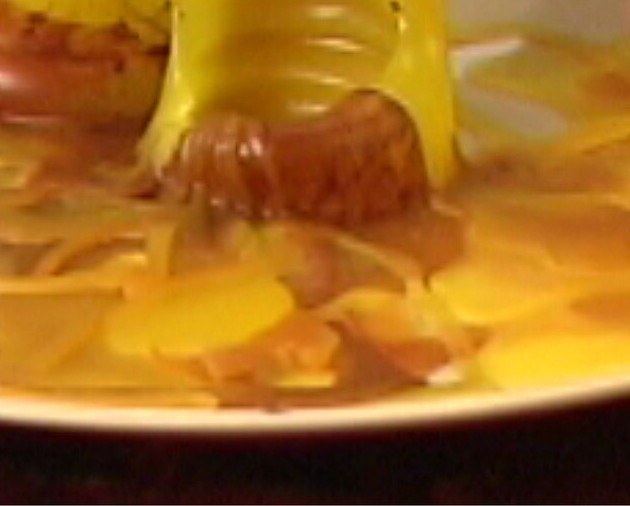
The main attraction is pouring wax, lanie wosku. Wax from a candle is melted and poured, traditionally through the hole of an old-fashioned key, into a bowl of cold water. The shape that hardens is lifted out and held in front of a light so its shadow falls on the wall, and the shadow is what you interpret: a windmill once meant a miller husband, and today a shape might be read as a car, a house, a dog or money. The ambiguity is the fun; everyone at the table gets an opinion.
The second classic is the shoe race. Everyone takes off one shoe and lines them up against the wall opposite the door. One at a time, each shoe is moved from the back of the row to the front, and the shoes travel, turn by turn, towards the door. The owner of the shoe that crosses the threshold first will, the game says, be the first to marry. Both games work for any group size and need nothing you do not already have at home.
Older sources describe more elaborate versions: fortune-telling with a rooster, dog or cat choosing between plates of bait, and dream rituals where an item of menswear under the pillow was supposed to summon a vision of the future husband. You are unlikely to meet these at a modern party, but they explain why the evening was once taken so seriously.
* Data source: Bialystok University of Technology Foreign Language Centre game descriptions; Polish History portal (polishhistory.pl) historical overview, both checked 23 October 2026.
A night that belonged to unmarried women
The modern anything-goes party is a recent relaxation. As the Polish History portal describes, in old Poland the night before St Andrew's Day was treated as a moment when predictions actually came true, and the seances belonged to unmarried women hoping to learn who and when they would marry. Married women could only assist with preparations and interpretation, and men were strictly excluded from the divinations. Bachelors had their own slot a few days earlier, on St Catherine's Day, 24 November.
The setting fitted the mood. November in old Polish belief was a month when spirits drew close, All Souls' Day had just passed, and St Andrew himself was the patron of marriage and of women preparing to wed, so the eve of his feast became the natural date for matrimonial fortune-telling. Girls fasted and prayed to St Andrew for a prophetic dream, placed a bowl of water with a tiny bridge of sticks by the bed, and asked for very specific details: the future husband's name, looks, character and profession.
What survives of that seriousness today is mostly atmosphere: candles, dimmed lights and the theatre of reading shadows on the wall. The questions have broadened too. Modern Andrzejki fortune-telling covers work, health, money and the future generally, not only marriage.
* Data source: Polish History portal (polishhistory.pl), "Fortune-telling seances on St. Andrew's Day in Old Poland", checked 23 October 2026.
Andrzejki today: parties, schools and workplaces
Contemporary Andrzejki is democratic: the university language centre notes that everyone fortune-tells now, regardless of gender or age or marital status, and that the games have spread into schools and kindergartens. In practice the last weekend of November becomes a party weekend: clubs and bars run Andrzejki nights, workplaces with a social culture melt wax at Friday drinks, and families with children pour wax at the kitchen table because it is one of those traditions children instantly love.
Nothing is closed and nothing is obligatory. St Andrew's Day on 30 November is an ordinary working day, not a public holiday, so the celebration is entirely private and social. That makes it low-stakes for a newcomer: you can join a party, host your own wax-pouring evening, or simply ask Polish friends what shape they saw in their wax.
What to expect at a Polish Andrzejki party
The rhythm of the evening is predictable once you have seen it. People arrive, eat and drink, and at some point the lights go down and candles appear. The wax station draws a queue, because everyone wants their own shape, and each new shadow gets a committee reading: one person sees a bird, another a car, a third declares it obviously means travel. Nobody is a real believer and nobody is entirely immune, which is exactly the tone the night aims for. Cards, apple peels and other improvised divinations sometimes join the wax, and towards midnight the games give way to ordinary partying.
Hosts appreciate a guest who plays along. Take your turn at the keyhole, offer a confident reading of someone else's shadow, and you have done Andrzejki correctly. Dress code is ordinary house-party; the only preparation worth doing is learning the word wrozby so you recognise the moment the games begin.
How to pour wax at home, safely
You need a candle, a metal spoon or small metal cup, a large bowl of cold water, an old key with a round hole, and a plain wall. Light the candle and let a pool of wax build, or melt wax gently in the spoon over the flame. Pour the liquid wax through the keyhole into the cold water in one steady movement. Wait a few seconds, fish out the hardened shape, then dim the room and hold it between a lamp or phone torch and the wall. Read the shadow, not the shape itself; turn it slowly and let the table argue about what it is.
A few sensible rules keep it fun: an adult handles the hot wax, the bowl goes on a heatproof surface, sleeves stay rolled up, and the candle is never left unattended. Wax washes off most surfaces with hot water, but tablecloths and carpets tell a different story, so work over the bowl. Children can hold the torch and read shadows while an adult pours.
Words that unlock the evening
A handful of terms will carry you through any Andrzejki party. Wrozby are fortune-tellings or divinations, the word you will hear all evening. Lanie wosku is the wax pouring itself. A wróżbita or wróżka is a fortune-teller, a title everyone at the table takes turns holding. And when someone squints at your shadow and announces your future, the right response is zobaczymy: we will see.
* Photos: CC BY-SA 3.0 (beeswax) and CC BY-SA 4.0 (ceromancy wax figure, cropped), via Wikimedia Commons.
Frequently asked questions
When is Andrzejki in 2026?
On the night of Sunday 29 to Monday 30 November 2026, the eve of St Andrew's Day. Because that is a Sunday night, most parties and club events will happen on Friday 27 and Saturday 28 November.
Is Andrzejki a public holiday in Poland?
No. St Andrew's Day on 30 November is a normal working day. Andrzejki is a social tradition: parties, games and fortune-telling with friends, family or colleagues.
Can men and children join Andrzejki fortune-telling?
Yes today. Historically the seances were reserved for unmarried women and men were excluded, but modern Andrzejki is for everyone, and the games are common in schools and kindergartens.
What does Andrzejki mean?
The word simply means "Andrew's", the celebration of St Andrew. The fortune-telling attached itself to the night before his 30 November feast day because he was the patron saint of marriage, and old Polish belief held that late-November nights were when predictions came true.
How does the wax fortune-telling work?
Melt candle wax and pour it through the hole of an old key into cold water. The hardened shape is held in front of a light and its shadow on the wall is interpreted as a sign of your future. The shadow reading is the heart of the game.