Epiphany in Poland: Three Kings Day, Orszak Parades and K+M+B Chalk
The essentials: Epiphany (Trzech Kroli), 6 January, is a statutory public holiday in Poland: shops close and cities hold Orszak Trzech Kroli, free costumed street parades open to everyone, with paper crowns and carol songbooks. Chalk like K+M+B above doors is a household blessing from the three kings. In 2027 it falls on a Wednesday.
What Epiphany is in Poland
On 6 January, twelve days after Christmas, Poland marks Epiphany: Objawienie Panskie, the Manifestation of the Lord, better known in everyday speech as Trzech Kroli, Three Kings' Day. It celebrates the visit of the Magi to the infant Jesus, and it closes the Christmas season in the Polish calendar. The three gift-bearers, traditionally named Kacper, Melchior and Baltazar in Polish, show up everywhere on the day: in the processions, in church cribs and in the chalk initials written above doors. In 2027 it falls on Wednesday 6 January.
For expats, the day is visible in three ways: nearly everything is closed because it is a statutory public holiday, city centres fill with costumed processions called Orszak Trzech Kroli, and mysterious chalk inscriptions like "K+M+B 2027" appear above doorways. All three are explained below.
* Data source: date checked against the 2027 calendar; public-holiday status from the consolidated Act on Days Off Work (Dz.U. 2025, item 296), checked 23 October 2026.
A day off by law, restored only recently
Epiphany is one of the statutory public holidays listed in Poland's Act on Days Off Work, which means a day off for most workers and, under the separate retail trading law, closed shops. Plan groceries for 5 January, because supermarkets do not open on the day itself, although small owner-run convenience stores and petrol stations usually trade.
The holiday's modern history says a lot about Poland. It was a public holiday before the Second World War, dropped from the calendar under the communist authorities, and restored only in 2011, which makes it the newest addition to Poland's list of days off. Many people now alive remember when 6 January was an ordinary working day, and the giant street processions are newer still, which helps explain the energy around them: this is a tradition being rebuilt in real time rather than merely maintained.
* Data source: consolidated text of the Act on Days Off Work, Sejm publication Dz.U. 2025 poz. 296, checked 23 October 2026; retail closure under the trading-Sundays-and-holidays law.
The Orszak: what you actually see on the street
The Orszak Trzech Kroli, the Three Kings Parade, is a theatrical street procession that re-enacts the journey of the Magi. According to the Orszak Trzech Kroli Foundation, which coordinates the event, it is deliberately a cultural, religious and apolitical occasion open to everybody regardless of belief, and it keeps the cast faithful to the Gospel story: no fairytale characters, no Santa, no commercial mascots.
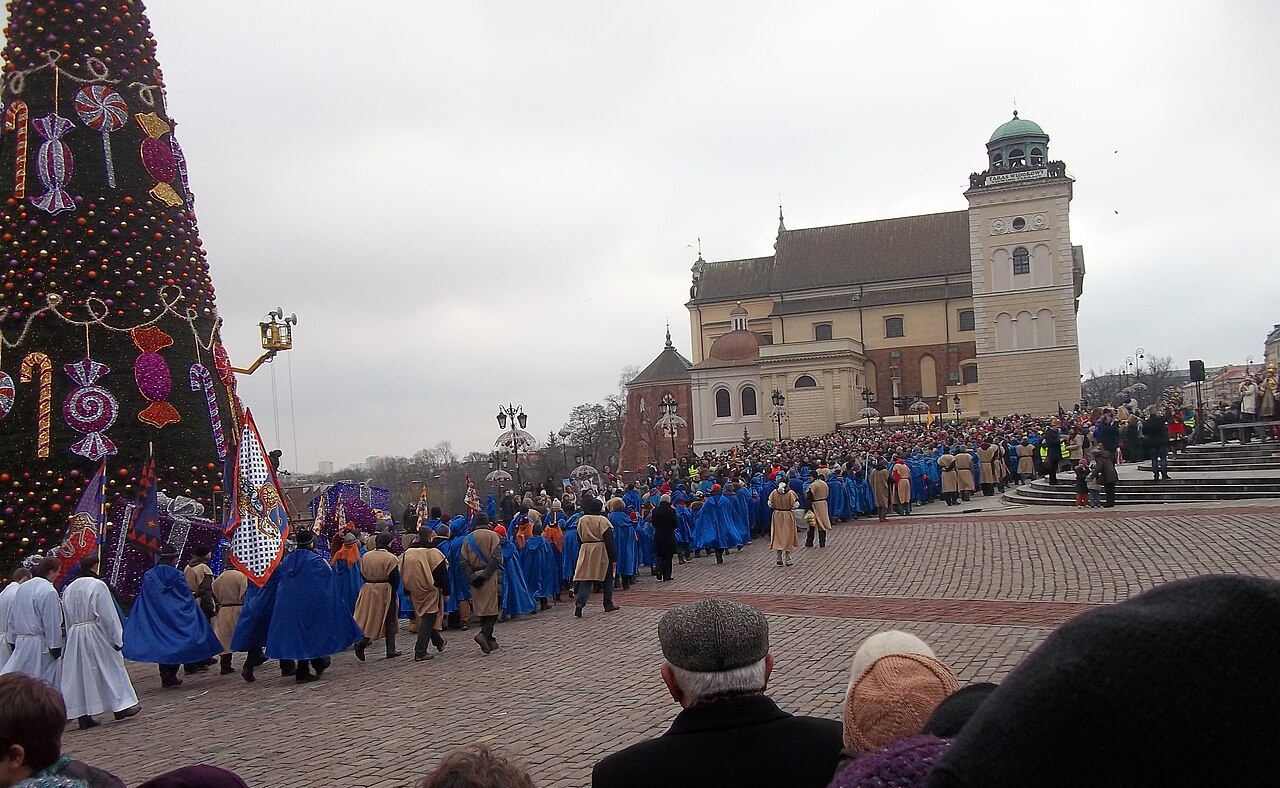
Each parade is led by a star-bearer, followed by the three Kings representing Asia, Africa and Europe on horseback, with children dressed as knights and ladies-in-waiting alongside amateur actors playing the Holy Family. Everyone else joins behind them. Volunteers hand out free paper crowns and printed songbooks, and the whole crowd walks to the nativity scene singing kolędy, Polish Christmas carols. The atmosphere is closer to a friendly carnival than to a church service: children on shoulders, brass bands, cameras everywhere.
The movement is younger than it looks. The Foundation's own history says it began in 2009, when students of one Warsaw school performed a live nativity on the city streets; other towns joined from 2011, and the first parade abroad was organised in Ukraine in 2013. Today parades also take place in Polish communities across Europe, Africa, Asia and the Americas, which means expats who later move on from Poland may well meet the Orszak again somewhere else.
* Data source: Orszak Trzech Kroli Foundation, orszak.org, history and event format pages, checked 23 October 2026.
How big it is, and where to find one
The scale is remarkable for an event that did not exist twenty years ago. The Foundation reports that in 2019 parades took place in 752 localities in Poland and 22 places abroad, and its counters describe 18 years of tradition, 941 localities and around 3 million participants in total, as of October 2026. Warsaw's parade is the flagship: it traditionally moves through the Old Town area around Castle Square, and Krakow, Gdansk, Poznan, Wroclaw and hundreds of smaller towns run their own versions on the same day.
Routes and start times are published by the Foundation and city offices closer to the date, so for 6 January 2027 check orszak.org and your city's website in late December 2026. As of 23 October 2026 the 2027 city routes had not yet been posted. Practical advice that holds every year: parades usually start late morning, the Old Town routes get crowded early, and the whole event is free and outdoors, so dress for standing in January cold.
* Data source: Orszak Trzech Kroli Foundation statistics and map pages, orszak.org, checked 23 October 2026; 2027 route status as of that date.
K+M+B: the chalk inscriptions above doors
In the days around Epiphany you will start noticing chalk writing above apartment and house doors: K+M+B, flanked by crosses, with the year, for example 20+K+M+B+27. The letters stand for the traditional names of the three kings, Kacper, Melchior and Baltazar, and the inscription is a blessing for the household for the coming year. The chalk is typically blessed at church on Epiphany itself, and in many parishes volunteer carollers, often children in king costumes, go door to door singing, collecting for charity and chalking the inscription for residents.
If someone offers to chalk your door, the custom is friendly and inclusive, and a small donation to their collection box is the usual response. The markings stay up for months and nobody considers them graffiti; washing them off immediately would puzzle your neighbours more than leaving them.
* Data source: custom described in the Orszak Trzech Kroli Foundation's Christmas customs materials, orszak.org, checked 23 October 2026.
The Christmas season is not over yet
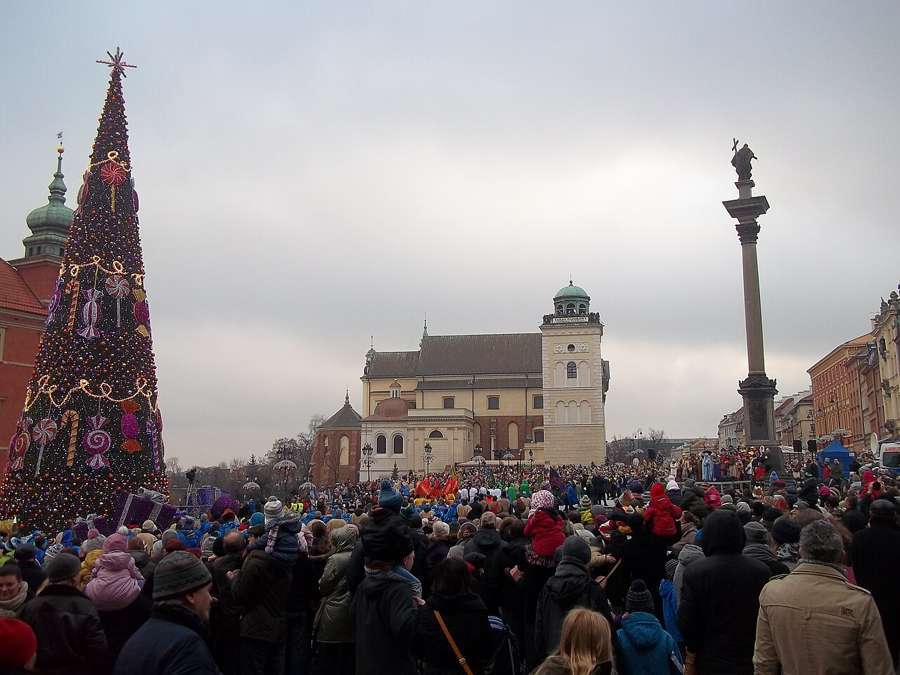
One more surprise for newcomers: Polish Christmas does not end on 26 December, or even on Epiphany. Kolędy keep playing, trees stay up, and the festive season, okres bożonarodzeniowy, traditionally runs until Candlemas on 2 February. Epiphany sits in the middle of that stretch as its last big public moment, which is why the decorations are still up for the parades and why the Christmas tree on Warsaw's Castle Square appears in every parade photograph.
The day after Epiphany, ordinary winter begins in earnest: children go back to school, the sales start, and the next fixed point in the festive calendar is Fat Thursday and the paczki queues of February.
* Data source: Christmas-season timing per the Polish liturgical calendar, cross-checked with the Orszak Trzech Kroli Foundation's seasonal materials, checked 23 October 2026.
How to join in as an expat
There is nothing to organise and no ticket to buy. Pick a city parade, arrive early, take a paper crown from the volunteers and a songbook, and walk. The songbooks carry the lyrics, and humming along is entirely acceptable. Children love the horses and costumes, so it works well as a family morning out, and because the event is explicitly open to people of every belief, nobody will read your presence as a statement of faith.
Treat the rest of the day like a Polish Sunday: shops are closed, museums and attractions mostly take the day off, and restaurants in tourist areas open as usual. It is a good day for a long walk through an Old Town full of crowned families rather than for errands.
* Photos: CC BY-SA 4.0 by Simon Burchell via Wikimedia Commons: Three Kings' Day crowd on Castle Square, Warsaw (cover); costumed parade participants on Castle Square (body, cropped).
Frequently asked questions
Is Epiphany a day off work in Poland?
Yes. 6 January is a statutory public holiday, so most workplaces and all shops covered by the retail trading ban are closed. In 2027 it falls on a Wednesday.
Do I have to be religious to join the Orszak?
No. The organising foundation describes the parade as a cultural, religious and apolitical event open to everybody regardless of beliefs. Crowns and songbooks are handed out free.
What does K+M+B above a doorway mean?
It is an Epiphany blessing: the initials of the three kings, Kacper, Melchior and Baltazar, chalked above the door with the year to bless the household for the coming year.
Where is the biggest Three Kings parade?
Warsaw's parade through the Old Town is the flagship event, but Krakow, Gdansk, Poznan, Wroclaw and hundreds of smaller towns hold their own. Routes for 6 January 2027 will be published on orszak.org in December 2026.