Biskupin in Winter: English Guides, Pavilion Tickets and Access
The essentials: Biskupin lists November–March hours of 09:00–16:00 and admission at PLN 28/19. English guiding costs PLN 310 extra and needs at least five days' notice. Check Christmas closures and do not assume seasonal exhibitions are open.
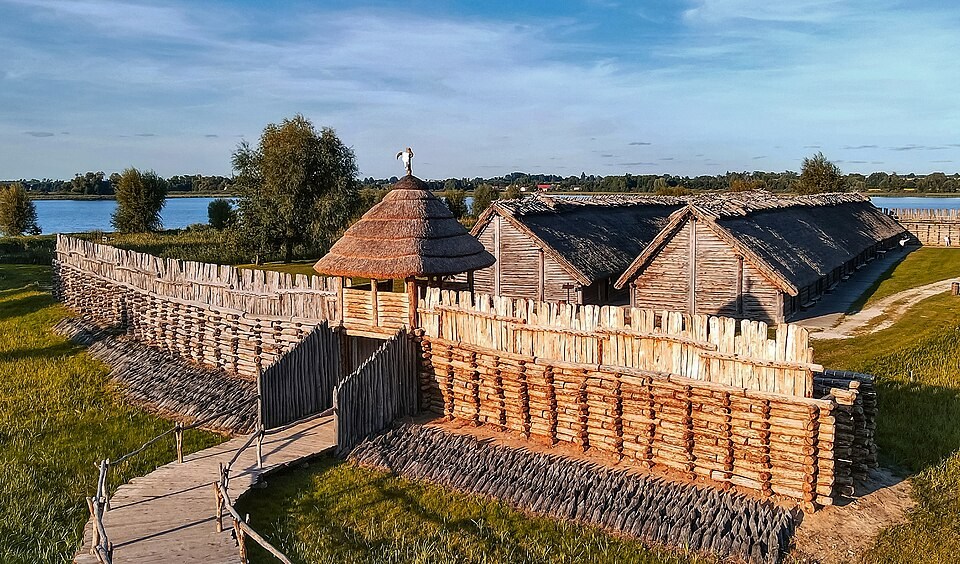
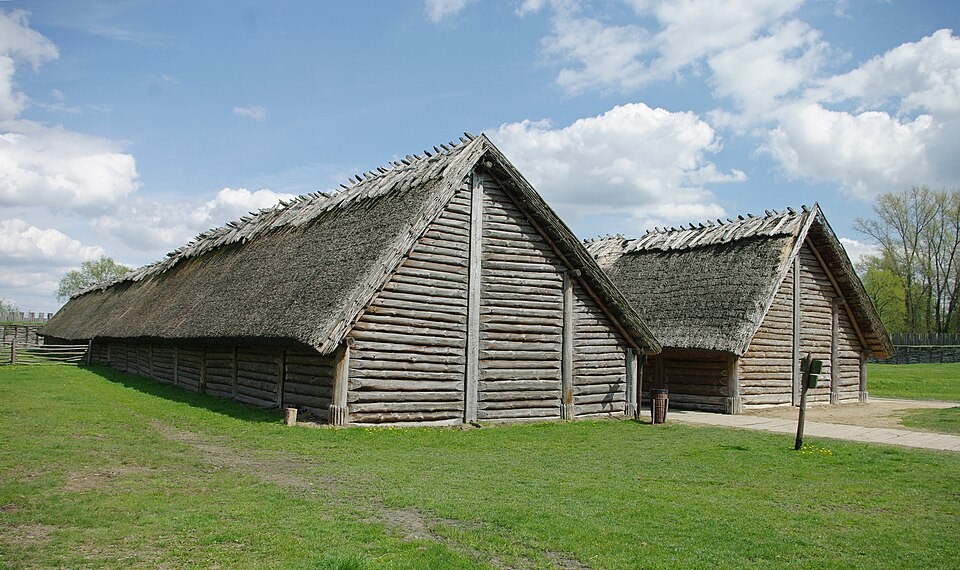
Cover: reconstructed fortified settlement at Biskupin. Archival photograph by MazAgnieszki, cropped version uploaded in September 2022; the linked original records September 2021. Not a current winter-condition check. Photo: MazAgnieszki / Wikimedia Commons, CC BY-SA 4.0. Existing crop resized and recompressed under the same licence.
Winter Biskupin is a reserve visit, not the summer festival
Biskupin remains open in winter, but the visit is different from the busy craft demonstrations often shown in summer photographs. The museum's visitor information lists November to March opening from 09:00 to 16:00. Admission covers the archaeological reserve and the museum pavilion with its exhibitions. That gives you an outdoor landscape of reconstructed settlements alongside an indoor collection, rather than an entirely indoor attraction.
The museum says educators and historical craftspeople can normally be encountered in the reserve from May to September. From October to April the reserve is quieter. Do not buy a winter admission ticket expecting a scheduled potter, smith or weaving demonstration at every building. Booked lessons are a separate product, and any advertised special event needs its own date and registration check.
This guide was checked on 28 November 2026 against the museum's visitor page, homepage, contact details and descriptions of the reserve and exhibitions. The important winter distinctions are the shorter day, conflicting Christmas closure lists, a seasonal exhibition that is not advertised for winter, and the need to arrange English-language guiding ahead of time.
Use 16:00 as the winter finish, and check Christmas separately
The seasonal timetable is 09:00–18:00 from May to September, 09:00–17:00 in April and October, and 09:00–16:00 from November to March. Do not carry the summer evening access rule into December: the visiting regulations limit the special outdoor extension until sunset to 21 June–31 August, excluding exhibition pavilions even then.
Holiday information needs more care. The museum homepage lists closure on 1 January, Easter Sunday, 1 November and 24, 25 and 26 December. The shorter list on the visitor page mentions 25 December but omits 24 and 26 December. For a Christmas trip, treat the homepage's additional closures as a reason to choose another day or obtain direct confirmation, not as permission to assume those dates are open.
A guided visit lasts approximately 105 minutes, and the regulations say the last guided visitors enter two hours before closing. Under the winter timetable, that means a latest guided entry of 14:00. Visitors with a reservation should arrive at least fifteen minutes before its start. An earlier visit leaves more time for the pavilion, comfort stops and moving between areas without turning the closing time into a target to race.
Admission, family tickets and what the guide costs extra
The current published admission price is PLN 28 standard or PLN 19 reduced. Listed reduced categories include schoolchildren, students, pensioners, cultural-institution employees, and visitors with disabilities and their carers. Check which proof of entitlement is accepted for your category before relying on a reduction, especially if your document was issued outside Poland.
Children under seven enter free but still need a free admission ticket, collected at the ticket office or reserve entrance. The PLN 75 family ticket is specifically for two adults and two children under eighteen. It is not a general household pass for any family size. The national Karta Dużej Rodziny prices are PLN 22 for adults and PLN 16 for children and young people under eighteen.
A Polish-language guide is listed at PLN 210 and an English-language guide at PLN 310. These are guide-service prices, not replacements for admission: the regulations separately require payment of the entrance fee. German-language guiding is also mentioned as a service, but the visible price table does not give a German price. Ask for the total for your language and party rather than transferring the English figure automatically.
One guide can take no more than forty people in total, including teachers, carers and children of every age. Larger groups need enough guides to meet that limit. Reduced group admission has a separate minimum of ten people and its own conditions; a private family does not become eligible merely because it hires a guide.
Arrange an English guide before you travel
For Polish guiding, the museum directs visitors to its booking service, linked from the official visitor page. English or German availability should be arranged by emailing [email protected] at least five days before the planned visit. The regulations also give the booking telephone number, +48 453 071 403. The contact page lists information hours Monday–Friday, 09:00–16:00.
Send the date, preferred language, party size including children, and any access needs. Ask which areas the guide covers. The formal regulations describe guiding around the archaeological reserve, so do not assume the 105 minutes automatically include a guided tour of the indoor pavilion as well. A general admission ticket covering both places does not settle the scope of the guide service.
The museum does not guarantee an unchanged reservation when an unreported delay exceeds fifteen minutes. Contact the booking team if your journey goes wrong. Walk-up guiding is possible only when a service is available; it is not an English-language departure guaranteed throughout every opening day.
Understand what is reconstructed, and what the evidence shows
The reserve description covers about 38 hectares with traces of settlement from the Stone Age to the early Middle Ages. Its best-known feature is the reconstructed fortified settlement associated with the Lusatian archaeological culture. This is much earlier than the Piast village elsewhere on the site. Treating everything as one medieval Polish village misses the point of the different areas.
At the fortified settlement, look at the relationship between the entrance, timber streets, house rows, rampart and angled lakeside piles. The museum describes the original settlement as containing 106 houses in thirteen rows; today's reconstruction presents only part of that arrangement. The piles outside the rampart helped protect against water and ice. They are part of the engineering story, not simply a decorative fence.
Tree-ring analysis dated construction timber to 747–722 BC, with more than half from the winter of 738/737 BC. That is stronger evidence than a broad visual resemblance to another ancient site. Conversely, the museum explicitly calls the familiar gate tower hypothetical and says the original roof covering is unknown. A useful visit separates excavated evidence from the choices needed to make a full-size reconstruction understandable.
The first-farmers area represents a much earlier Neolithic settlement, with a reconstructed longhouse and a second longhouse-shaped adaptation containing an exhibition. The Piast village represents tenth- and eleventh-century life. Compare their building plans and household spaces rather than expecting identical huts with different labels.
Keep the indoor pavilion separate from the seasonal longhouse exhibition
The museum's description of its new permanent exhibition presents around 1,400 archaeological objects from the Lake Biskupin area and related regional discoveries. The story spans hunters and gatherers, early farmers and the early Middle Ages, with particular attention to the famous fortified settlement. Tools, weapons, ornaments and everyday vessels give context to the outdoor buildings.
That pavilion is different from Epoka pierwszych rolników, the exhibition in the reconstructed longhouse. Despite its page heading calling it a permanent exhibition, the text explicitly describes it as seasonal and open May–October. Do not promise that exhibition as an indoor winter stop.
The eighteenth-/nineteenth-century Chata Pałucka is another separate case. The reserve page says its interior is closed and has no exhibition function. Its exterior and setting can explain regional building traditions, but it should not be counted as another guaranteed room to enter on a cold day.
Access: ask about the railway crossing, not only the entrance
The museum says most paths are hardened, and it identifies facilities in the pavilion and toilets. It also warns about uneven timber streets, round-log floors and wooden thresholds in reconstructed buildings. A mostly surfaced outdoor route is therefore not the same as step-free access to every interior. Low lintels, narrow passages and steps also appear in the safety rules.
The stairs over the narrow-gauge railway on the way to the first-farmers area have an alternative crossing. Ask the porter at the entrance or the staff supervising the Neolithic exhibition to arrange it. The museum says older visitors and families with pushchairs may use this route too. Ask how it is accessed on the day rather than treating an apparently closed crossing as a route to improvise.
Explain the assistance you need in advance: distance you can manage, wheelchair or pushchair dimensions where relevant, threshold concerns and whether an alternative entrance is needed. The museum allows guide dogs for blind visitors and describes pre-arranged tactile sessions using replica objects for groups. Those sessions require prior contact; they are not a promise that every displayed original can be touched.
Arrival, dogs and a workable winter plan
Use Biskupin 3, 88-410 Gąsawa for the reserve and ticket offices. The contact page separately lists Biskupin 17 for the administration, which is an easy address to copy by mistake. Visitor parking is listed as free and unguarded. Overnight parking has separate charges and conditions, so daytime free parking should not be read as a free camper stay.
The museum mentions buses from Żnin or Gąsawa and a stop in Biskupin or on request near the museum parking. It does not provide a verified winter departure in the text used here. Check a current outward and return timetable before choosing a car-free visit. The narrow-gauge railway is described as a tourist-season service, while the boat's published season ends in September. Neither should be assumed to solve a November or December journey.
Ordinary dogs need a lead and muzzle and cannot enter the pavilion, reconstruction buildings or visitor service centre. That matters if your wet-weather fallback depends on going indoors. Assistance-dog rules are separate. Follow the marked routes and do not feed the museum animals.
A practical winter visit starts early enough to enjoy both the reserve and pavilion, with warm layers and footwear suited to uneven outdoor surfaces. Confirm any guide first, check the Christmas closure list, and leave seasonal demonstrations out of the basic promise. Biskupin rewards looking carefully at how archaeologists turned surviving timber and objects into an explanation of past lives.
Frequently asked questions
Is Biskupin open in winter?
The published November–March timetable is 09:00–16:00, subject to holiday closures. The reserve and pavilion are included in admission, but summer craft demonstrations should not be assumed.
Does a Biskupin admission ticket include an English guide?
No. Admission is listed at PLN 28 standard or PLN 19 reduced. English guiding is a separate PLN 310 service, with availability to arrange at least five days before visiting.
Is the first-farmers exhibition open in December?
Its own page describes the longhouse exhibition as seasonal, May–October. Keep it separate from the museum pavilion's permanent exhibition when planning a winter visit.
Sources
- Biskupin museum: visitor hours, tariff, guiding and access rules
- Biskupin museum homepage: fuller Christmas closure list
- Biskupin museum: reserve and ticket-office address, booking contacts
- Biskupin museum: reserve archaeology and reconstruction evidence
- Biskupin museum: new permanent pavilion exhibition
- Biskupin museum: first-farmers longhouse exhibition, May–October
- Biskupin museum: institution and archaeological context
- Ancient and Medieval Architecture: independent settlement interpretation, not current hours