Sierpc Skansen in Winter: Guides, Walking Tickets and Access
The essentials: Sierpc skansen opens Tuesday–Sunday 09:00–15:00 in winter. ZIMA tickets cost PLN 30/20 with a scheduled guide; outdoor walking tickets cost PLN 10/7. Use Narutowicza 64 because the road-10 ticket desk is closed. Ordinary free Mondays are 10:00–14:00, without interiors.
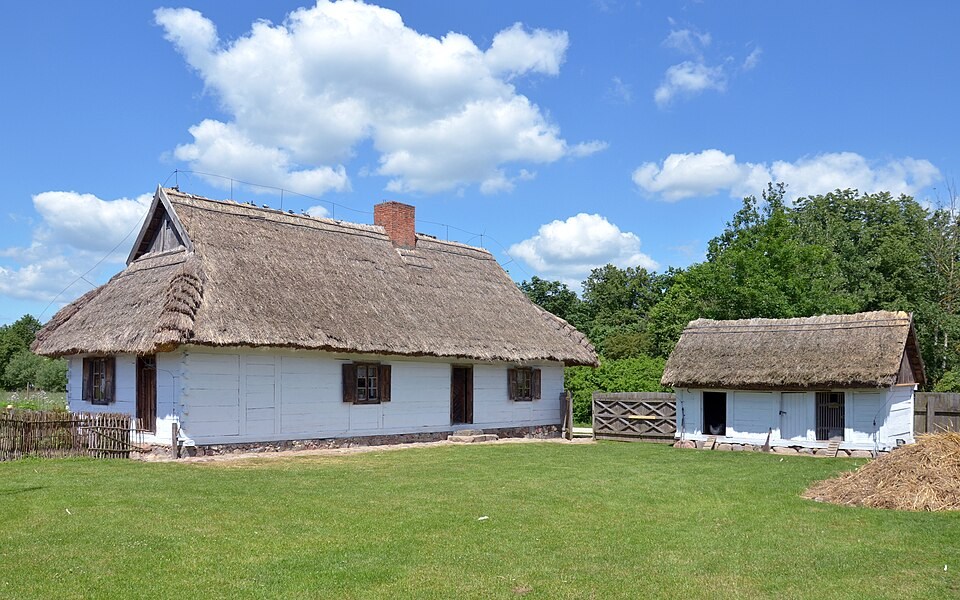
Cover: the farmstead from Rębowo at Sierpc museum on 11 June 2017. An archival exterior, not a winter-condition or current-interior check. Photo: 1bumer / Wikimedia Commons, CC BY-SA 4.0. Resized and recompressed under the same licence.
Choose a guided winter visit or an outdoor walk
Sierpc's Museum of the Mazovian Countryside has two different winter visits. The ZIMA ticket includes a scheduled guide through selected interiors. The cheaper spacerowy ZIMA ticket is for an outdoor walk without that guide. Paying less does not buy the same route with optional commentary: winter interiors are normally closed unless you are with the museum's guide.
That is the main decision to make before travelling. If you want to see furnished rooms and understand how households lived, plan around a guided departure. If your aim is a shorter landscape walk among farmhouses, a walking ticket or the ordinary free Monday may suit you, provided you are comfortable staying outside.
This guide was checked on 28 November 2026 against the current winter notice, tariff, practical visitor page, opening hours and visiting rules. It also uses the operator's access information and 2025 accessibility report, while keeping unresolved differences between those sources visible.
Use the Narutowicza entrance this winter
The skansen's main address is Gabriela Narutowicza 64, 09-200 Sierpc. The current winter notice says the ticket desk on the national-road-10 side is closed from 2 November 2026 through March 2027. Visitors are directed to cash desk number one at Narutowicza 64.
This matters even if a navigation app shows another gate. A gate near the road is not proof that you can buy a ticket there. Give the Narutowicza address to a taxi driver and check the entrance before planning a meeting point.
The access page also recommends Narutowicza. It describes a straight approach from the cash-desk building towards the exhibition entrance, surfaced with split-granite setts. Tickets are checked at the gate beyond the administration and maintenance buildings. The route is straightforward to describe, but its paving is not the same as a smooth indoor floor.
The museum's general telephone is +48 24 275 28 83. Group reservations are handled through that number, including extensions 217 and 234 in the visiting rules, and through [email protected]. The current winter notice also lists +48 24 275 28 26 for organised groups.
Winter hours, Monday limits and the ticket-sales cutoff
The current winter pattern is Tuesday to Sunday, 09:00–15:00. The separate regular-hours page gives ordinary Mondays as the free day, 10:00–14:00, without interior visits. A holiday falling on Monday is charged under the tariff rather than automatically becoming free.
The museum lists closures on Holy Saturday, Easter Sunday, 1 November, 24, 25 and 31 December, and New Year's Day. Do not treat the weekly timetable as an opening promise on one of those dates. Check dated notices for a special arrangement before making a holiday journey.
Ticket sales and exchanges stop an hour before the museum closes. On an ordinary Tuesday–Sunday winter day, that means 14:00, even though visitors already inside have until 15:00. The last scheduled interior tour starts earlier, at 13:30. Arriving at 14:00 does not give you a late interior departure.
One sentence in the November winter announcement contains an inconsistent ending year. The same notice explicitly describes the gate arrangement into March 2027, and the practical visitor page says guided winter interiors continue through March 2027. For a late-March journey, recheck the actual transition dates rather than relying on that stray year or a general seasonal rule.
What the winter ticket includes
The individual ZIMA ticket costs PLN 30 standard or PLN 20 reduced and includes the guide at the published departure times. The winter walking ticket costs PLN 10 standard or PLN 7 reduced and does not include the guide. Choose the ticket by the visit you want, not by assuming all admission products unlock the same rooms.
The tariff says a scheduled guide takes a maximum of twenty-five visitors. That capacity is a limit, not a guarantee that your preferred departure has space when you arrive. If the tour is the reason for your journey, ask how individual places are handled and how early to be at the meeting point.
The current listed departures are 10:30, 11:30, 12:30 and 13:30. Each is shown as a ninety-minute visit, ending at 12:00, 13:00, 14:00 and 15:00 respectively. The practical page describes selected buildings agreed with the guide, not every room in every building.
The tariff also contains different products for themed Sundays, evening visits, half-price events and combined museum admission. Those prices are not automatic discounts on any winter day. Confirm the date, branch and event before combining a special offer with the ordinary ZIMA product.
English audio is different from an English-speaking guide
The tariff offers foreign visitors an audio guide with headphones without an extra charge when joining a scheduled winter departure. Visitors accompany a Polish-speaking guide while listening to information in another language. This is not the same as booking a guide who conducts the whole visit and answers questions in English.
The museum's 2025 accessibility report describes a browser-based mobile guide in Polish, English and German, with thematic versions. It says access follows activation of a QR code and lasts twenty-four hours. Ask at the desk which audio option applies to your winter ticket and whether it uses a borrowed device or your phone.
There is a source-maintenance problem worth knowing about: an older access page still carries epidemic-era notices suspending some audio equipment, while the tariff and 2025 report describe it as part of the offer. The current tariff supports asking for the service, but not promising a particular headset or hearing loop is available without checking.
If English is essential, settle it before travelling. Ask about the language, device, headphones, collection point and scheduled departure together. For a private group needing discussion rather than recorded commentary, request a specific language arrangement and a written total instead of assuming the individual-ticket offer covers it.
What to look for in the reconstructed village
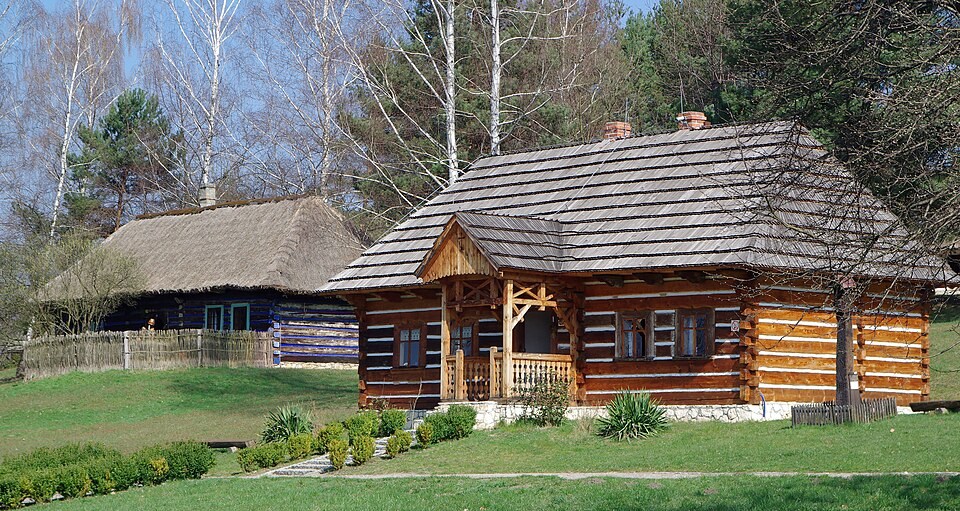
The museum's founding idea treats the village layout and its surroundings as part of the collection, alongside the buildings. Its main reconstructed row village contains eleven peasant farmsteads from north-western Mazovia. Gardens, orchards, fences and small religious structures help explain how the settlements worked.
Look at differences in household means rather than expecting identical cottages. The operator describes wealthier and poorer homes with different amounts and kinds of equipment. A guide can help connect a furnished room to the work, storage and family life around it, instead of treating each object as an isolated antique.
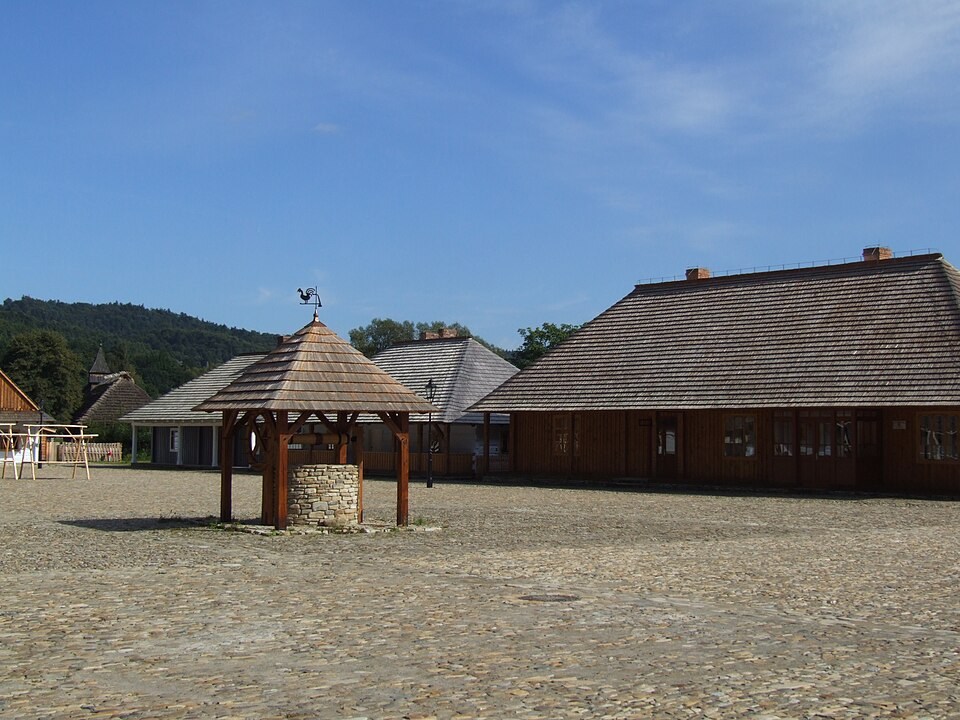
Other groups of buildings broaden the picture. The inn complex includes the inn from Sochocin, the forge from Żuromin and the cottage from Drwały. The Bojanowo manor setting, the manor from Uniszki Zawadzkie and the church from Drążdżewo represent different kinds of household, status and communal life.
These are collection descriptions, not a fixed winter checklist. Ask which interiors your departure includes. The museum can make a shorter selected route meaningful without opening every building, and a photograph of a room does not establish that it will be on your particular tour.
The windmill explains work as well as scenery
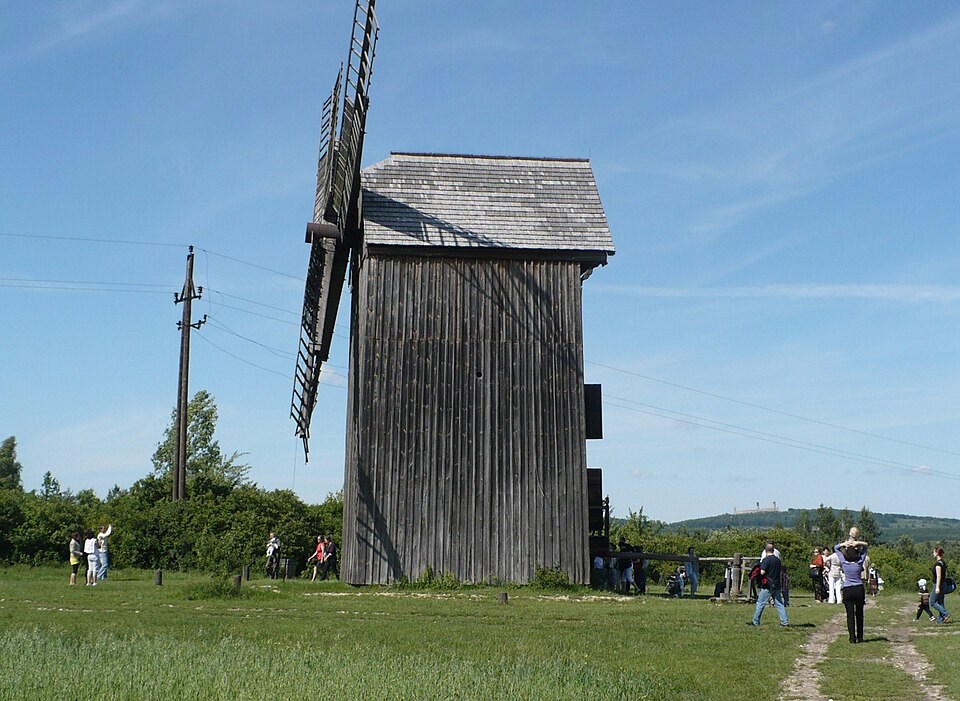
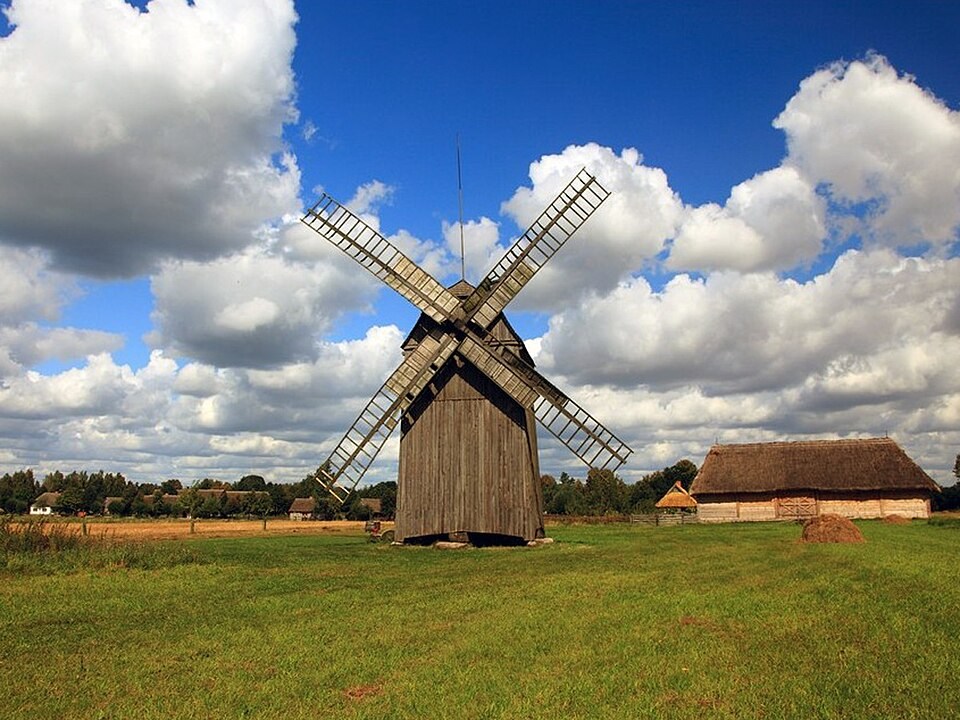
The windmill from Zalesie is a useful focus for understanding the park's industrial heritage. The museum describes it as a koźlak, a post mill whose body can be turned to face the wind. Its wooden structure and working parts explain how milling depended on both machinery and weather.
The operator's account describes the central post, supporting timbers and the turning mechanism. Another museum page records restoration work in 2019–2020 after poor condition had led to removal of the sails and closure. That history does not promise a demonstration on an ordinary winter visit.
Use an exterior view to notice the relationship between the mill, fields and farm buildings. If entering the mill or seeing it move is important, ask explicitly. Neither a restored mechanism nor an archival photograph proves that it operates for visitors every day.
Access is a route-by-route question
The access page estimates a full visit at roughly two hours and two to three kilometres on foot. That is a planning guide, not a required route or a promise that everyone moves at the same pace. Tell the museum if you need a shorter departure, regular rests or a route with fewer thresholds.
Expect sandy tracks, stone-and-grass surfaces in farmyards, uneven stone steps, narrow doors and small entrance halls. The museum's 2025 report confirms continuing architectural barriers and the use of portable ramps for selected buildings. It does not describe every historic interior as independently wheelchair accessible.
The access page lists ramps for selected cottages and the Bojanowo manor, with staff asked to install them after a request at the desk. Confirm the exact buildings on the winter route and whether your equipment can use the proposed arrangement. A ramp at one doorway cannot settle space to turn inside another cottage.
Adapted toilets are listed in the Narutowicza cash-desk building, near the Pohulanka inn and in building G by the Sculpture Gallery. Ask which are available along your chosen route that day. The 2025 report also describes tactile maps and hearing support, but equipment availability should be checked rather than inferred from the number recorded in a report.
Touch access and assistance need specific confirmation
The museum describes a tactile exhibition called Zobaczyć rękoma in the cottage from Drwały. Older access information contains an epidemic-era unavailability notice, while the 2025 report describes the exhibition among its access measures. That conflict was not settled by a live staff confirmation for this guide.
If touch access is the purpose of your visit, ask whether the exhibition is currently open, whether it is included on your winter departure and what assistance is available. Its existence does not give blanket permission to handle objects elsewhere. The visiting rules prohibit touching exhibits without the appropriate arrangement.
Likewise, Polish Sign Language material and induction loops are particular services, not a promise of an interpreter in any sign language. Explain what communication support you use. For all access requests, the useful information is the date, party size, mobility or communication need and the specific part of the museum you want to experience.
Finish the transport and group plan before leaving
The museum places the skansen about four kilometres from the railway station and about three kilometres from the former bus-station stop. Those distances leave an onward journey. No current train, bus or taxi availability was verified for this guide, so check both the outward and return connection for your date.
The access page describes free public parking by Narutowicza, while the separate tariff lists a parking product with the first hour free and PLN 2 for each further started hour. Do not assume every parking area has identical charging rules. Follow the signs at the actual area you use and ask the desk if the distinction is unclear.
Organised groups need advance arrangements. The visiting rules require confirmation no later than five days before arrival and allow a late group to have its services shortened or cancelled. Set the guide, language, route, access support and total with the reservations team rather than treating an enquiry as a confirmed visit.
For an individual winter outing, the simplest plan is to choose interiors or an outdoor walk first, arrive through Narutowicza, and leave time before the relevant guide departure and ticket-sales cutoff. Sierpc's winter offer is substantial when its limits are part of the plan, rather than a surprise at a closed cottage door.
Frequently asked questions
Can I enter cottages with a walking ticket?
Winter interiors are normally accessible only with the museum guide. The cheaper spacerowy ZIMA ticket is for an outdoor walk, not the same interior visit without commentary.
Which entrance should I use in winter?
The current winter notice closes the road-10 ticket desk from 2 November 2026 through March 2027 and directs visitors to cash desk number one at Narutowicza 64.
Does the winter ticket include a live English guide?
The tariff describes joining a Polish-speaking scheduled guide with foreign-language audio and headphones. That is different from a live English-led visit. Ask about the actual language, device and availability before travelling.
Sources
- Museum: November 2026 winter entrance and guide notice
- Museum: current admission tariff and winter audio footnotes
- Museum: seasonal hours, Monday and closures
- Museum: current practical visit and March 2027 guide arrangements
- Museum: visiting and group-confirmation rules
- Museum: access information with older equipment notices
- Museum: 2025 accessibility report
- Museum: village layout and collection history
- Museum: windmill construction and operation
- Museum: 2019–2020 windmill restoration