Sanok Skansen in Winter: Monday Hours, Tickets and Guided Visits
The essentials: Sanok skansen opens 09:00–14:00 Tuesday–Sunday in November–March. Its July 2026 regulations give free winter Monday entry 09:00–12:00, despite the older website showing 08:00. Admission is listed at PLN 32 or PLN 20 reduced; foreign-language guiding costs PLN 190 separately for up to 25 people.
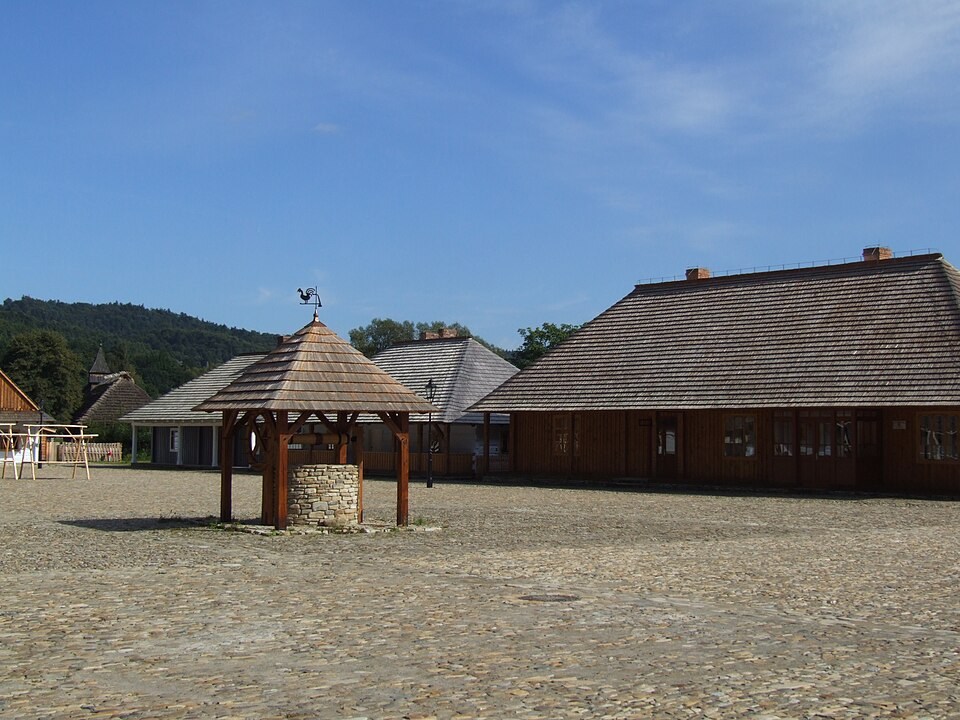
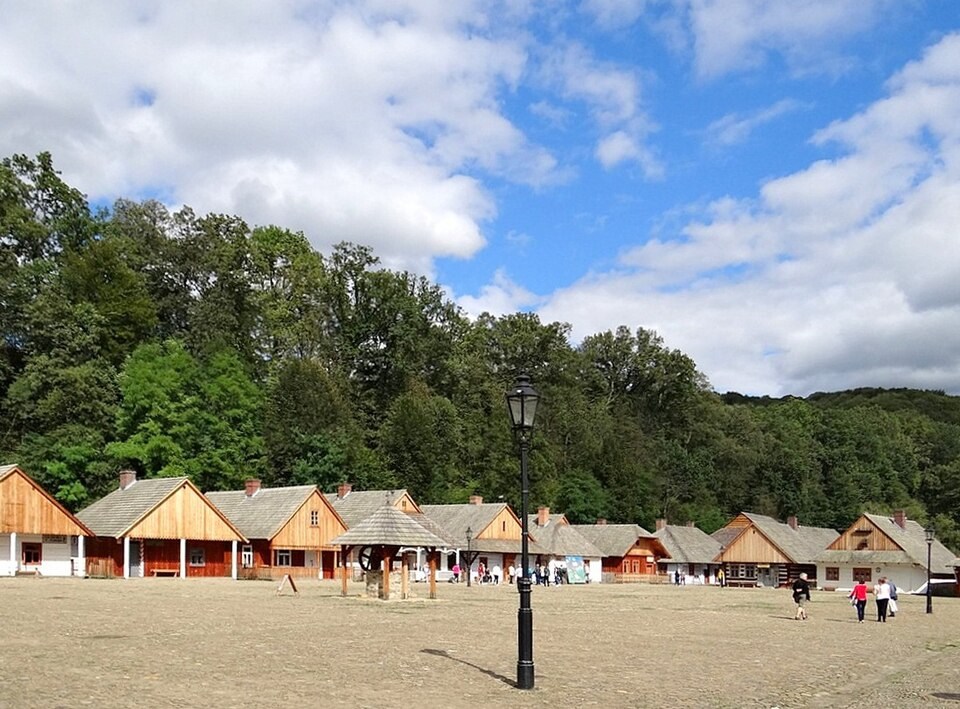
Cover: the Galician market square at Sanok skansen in September 2011. An archival exterior, not a winter-condition or current-access check. Photo: Pudelek (Marcin Szala) / Wikimedia Commons, CC BY-SA 3.0. Resized and recompressed under the same licence.
A short winter day needs a deliberate route
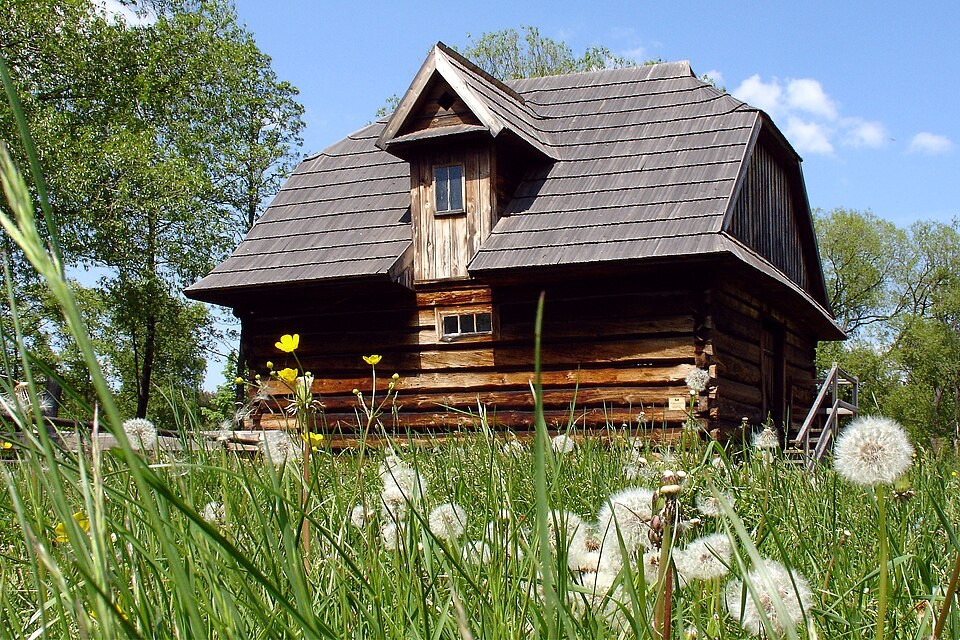
Sanok's Museum of Folk Architecture is a large outdoor ethnographic park, not another name for the castle museum in the town centre. Its reconstructed Galician market, rural buildings and different regional sectors make it a substantial visit. In winter, however, short opening hours, limited independent access to interiors and uneven ground matter more than the number of buildings on a map.
This guide was checked on 28 November 2026 against the museum's current website, its July 2026 visiting regulations, the March 2026 ticket order and its accessibility declaration. Those documents do not agree on every detail. The differences are explained below so that an old Monday opening time or an unverified winter discount does not become the basis of your trip.
There is also an important distinction between the park's general offer and the area affected by the August 2026 fire. Do not use an old photograph or a standard sector description as evidence that every building is currently accessible. Choose a route with the ticket desk, particularly if a particular church, exhibition or interior is your main reason for visiting.
Go to Rybickiego 3, not the administrative offices
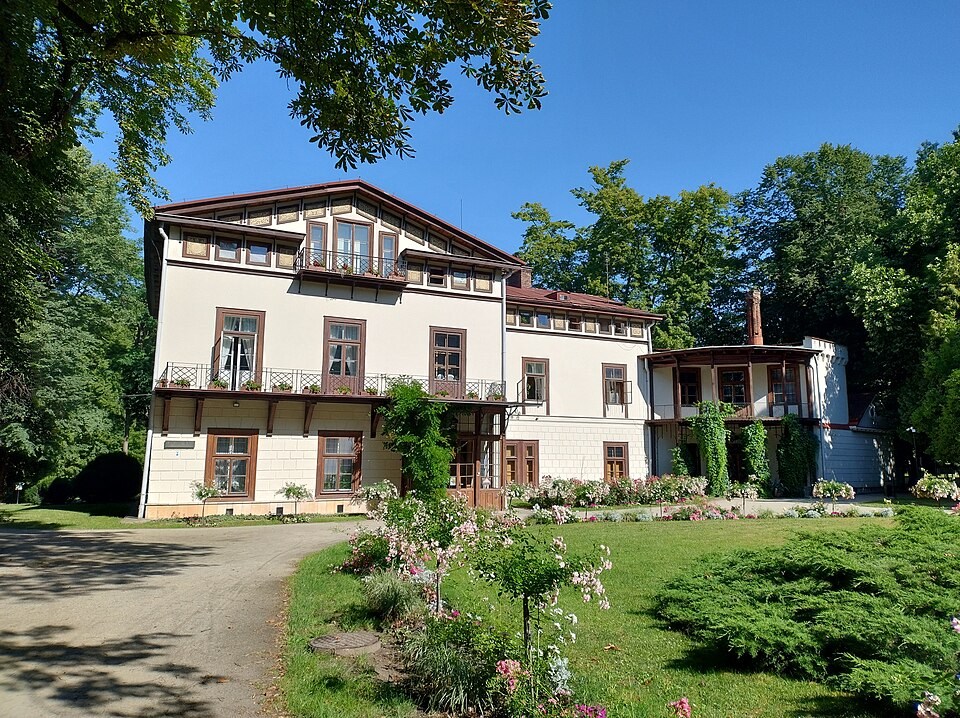
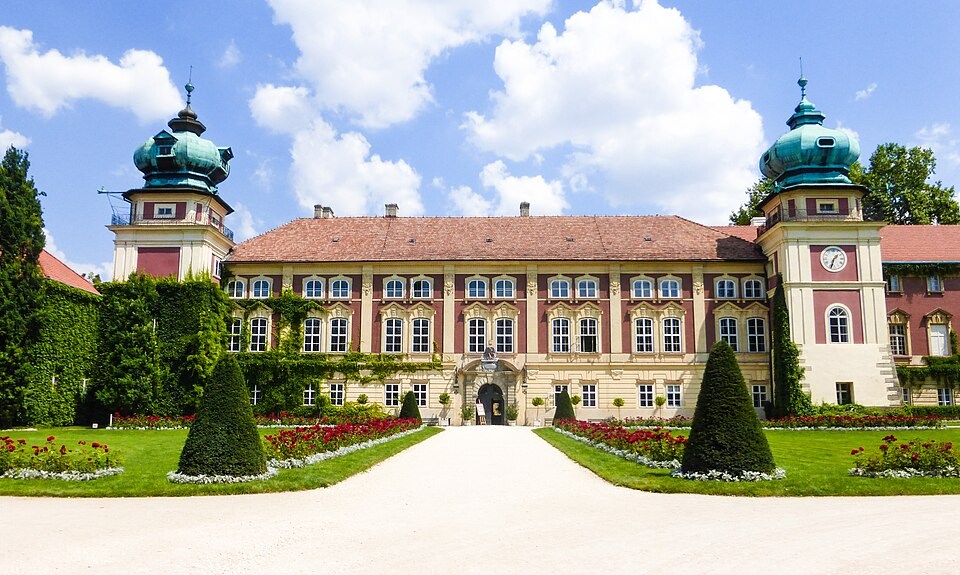
The ethnographic park entrance and ticket operation are at Rybickiego 3, Sanok. The museum also uses Traugutta 3 for its administration, library, archive and conservation departments. Entering the office address into a taxi or navigation app will not bring you to the skansen ticket gates.
The published park ticket number is +48 13 463 09 34. The guide-booking information also lists +48 13 493 01 77 and +48 13 463 16 72. Ask specifically about a visit to the Park Etnograficzny, your language and the interiors you hope to see. A museum telephone number is a way to arrange those details, not evidence that a guide has already been reserved.
The accessibility declaration describes parking opposite the museum, across the same road, with designated spaces for disabled visitors and pedestrian crossings towards the two entrance gates. It describes the parking as free and surfaced with stone aggregate. That is published provision, not a live guarantee of an empty space or suitable winter surface conditions.
Use the newer winter Monday hours
The visiting regulations dated 24 July 2026 give November–March opening from 09:00 to 14:00 Tuesday to Sunday. Winter Mondays run from 09:00 to 12:00, with free admission. The final entry is fifteen minutes before the ticket office closes, so the ordinary winter cutoffs work out as 13:45 Tuesday to Sunday and 11:45 on Monday.
The main website still displays a general Monday schedule of 08:00–12:00. That conflicts with the newer regulation's seasonal Monday table. For a winter plan, use 09:00 rather than expecting an 08:00 entry, and confirm with the ticket desk if your arrival depends on that first hour.
A last-entry time is not a sensible start time for a full visit. The museum says a guided visit can take up to two and a half hours. Arriving shortly before the gate cutoff leaves very little useful time before the park closes. An early arrival also gives you time to discuss closures, buy the appropriate tickets and find the guide meeting point without rushing.
The park describes itself as open year-round, but that is not a date-specific promise for every holiday or severe-weather day. Check current notices before a Christmas or New Year trip. Do not apply the summer exhibition timetable to a November afternoon simply because the park itself is open.
Tickets: what is verified, and what is not
The museum's published tariff and its director's order dated 10 March 2026, effective from 1 April, list adult admission at PLN 32 and reduced admission at PLN 20. Children under seven enter free. The current pages also give a twenty-five-percent discount for Karta Dużej Rodziny holders.
Some travel listings quote PLN 18 for all tickets from December through March. That figure was not established by the current tariff page or the checked March 2026 order. Do not budget on it as a confirmed winter offer. Ask the museum whether a later seasonal price applies to your visit rather than treating a third-party listing as the cash-desk price.
Reduced admission requires the appropriate entitlement and documents. The visiting rules say to show the relevant proof before buying. If you are visiting from abroad with a student, senior or disability document, ask whether that document qualifies instead of assuming every foreign card is accepted under the Polish concession rules.
Monday's free entry still requires a free ticket. Under the July regulations, that zero-price ticket is available only at the ticket office. Walking straight to the gates because no payment is due is not the same as having the admission document required for entry.
Admission and a guide are separate products
The guide fee is PLN 140 in Polish or PLN 190 in a foreign language for a group of one to twenty-five people. It is a group service, separate from admission tickets. The museum says one guide can lead no more than twenty-five visitors and that the visit lasts up to two and a half hours.
The tariff does not turn every foreign-language slot into a guaranteed English departure. Request English explicitly and agree the time, group size and route. A solo visitor or couple can ask about the same published one-to-twenty-five-person service, but should not assume they will automatically be added to a scheduled public tour.
Independent visiting is allowed, but the July regulations do not permit independent entry to ordinary historic interiors. Their exception concerns exhibitions opened by attendants during their working hours from May to October. In winter, plan primarily for outdoor viewing unless a guide and the relevant interiors have been agreed.
The older accessibility declaration mentions off-season assistance from the pharmacy attendant around the Galician market. The newer visiting rules narrow the staffed independent-interior exception to May–October. Treat that older description as something to ask about, not a promise of a free winter interior tour included with admission.
A reconstructed town, not one preserved town square
The Galician market is an interpretive reconstruction of an early-twentieth-century small-town centre. The museum explicitly says it does not reproduce one particular urban layout. Its value lies in showing the buildings, trades and domestic surroundings of the region's small towns together.
That makes details worth slowing down for: the relationship between shopfronts and homes, the well in the open square, and the different trades represented around it. The museum's explanation connects the setting with Polish, Jewish and Rusyn or Ukrainian communities and with the profound changes brought by war and the destruction of those communities.
A pharmacy, post office or workshop shown in a standard description is not necessarily operating as a visitor service on your winter date. Do not plan lunch, shopping or a demonstration around a photograph. Ask what is staffed and open, then build the route around the answer.
Check the route after the August fire
A fire on the night of 15–16 August 2026 destroyed the historic wooden church from Bączal Dolny and damaged neighbouring museum buildings. An October update from the Krosno prosecutor confirms the investigation and says an electrical-installation fault was excluded by one expert opinion. It does not establish the cause of the fire.
Local reporting of the museum's reopening statement says the park resumed visits on 20 August, excluding the directly affected part of the Eastern Pogórzan sector and the neighbouring presbytery from Ropa. That is a published reopening account, not a fresh day-by-day map of barriers on 28 November.
Before setting off for a specific building in that area, ask the museum which paths remain available. Follow the marked route and staff directions. A general statement that most of the park reopened does not mean the damaged church can be visited, nor does it justify guessing a reconstruction timetable.
Large grounds and historic surfaces
The accessibility declaration describes roughly thirty-eight hectares and about one hundred and eighty architectural objects. Its sectors include small-town, Boyko, Lemko, Pogórzan, Dolinian, pastoral, oil-industry, manor and archaeological settings. That scale is a reason to choose a focus, not an obligation to reach every corner on a short winter day.
The Galician market uses rounded natural stone paving, which the museum says can make wheelchair movement difficult. Elsewhere, paths include earth, gravel and grass approaches. Several sectors occupy hilly ground. Wet leaves, ice or snow can change the practical route, so check weather and current surfaces separately.
Many rural buildings have high thresholds, narrow entrances and two or three stone steps. Floors may be timber or beaten earth. A guide opening a door does not remove those barriers. Discuss the visitor's equipment and the actual buildings on the proposed route before paying for a tour intended to provide interior access.
Ticket access, toilets and sensory support
The declaration describes three steps and no wheelchair ramp at the main ticket-office building. It also records an outdoor ticket machine and a marked accessible passage beside the ticket-control turnstiles. Those are different parts of arrival: an accessible gate does not mean the cash-desk building is step-free.
This matters on free Mondays, when the newer rules require a zero-price ticket from the desk rather than online or at the machine. Contact staff about assistance if the steps prevent you from collecting it. Ask how to meet your guide and enter without having to improvise at the turnstiles.
Adapted toilets are listed both in the Galician market and elsewhere in the ethnographic park. Confirm their current opening and the easiest route to them. The declaration also describes a portable ramp in the market, but it does not establish that every building can be entered with that ramp.
A tactile map near the approach to the ticket office and TOTUPOINT navigation markers provide additional orientation. The declaration lists another marker at the reception entrance and sixteen around market buildings, along with tactile information at selected locations. A guide with sign-language knowledge can be requested in advance through the ticket desk. Assistance dogs are welcomed.
Simple rules that prevent an awkward visit
Individual tickets may be bought online, at the ticket machine or at the desk under the July regulations. An online PDF can be printed or shown on a mobile device. Keep the ticket for checks. Free-day tickets remain the cash-desk exception, and entry for shopping inside the market also needs an admission document or the museum's individual permission.
Use only marked visitor routes. The rules prohibit smoking, including electronic cigarettes, open flames, touching exhibits and entering closed rooms or gardens. Ordinary personal photographs are free, but the museum distinguishes them from publication or commercial use, which needs separate permission. Do not assume a visitor ticket authorizes a drone flight or a commercial shoot.
The strongest winter plan is a modest one: arrive early at Rybickiego 3, collect the correct ticket, and choose either an outdoor walk or an agreed guided route. Confirm English, essential interiors and mobility arrangements before travelling. Sanok's skansen offers much more than a backdrop, but its current rules should shape the visit rather than be discovered at the gate.
Frequently asked questions
What time does Sanok skansen open on winter Mondays?
The July 2026 visiting regulations give 09:00–12:00 from November through March. The older website still shows a general 08:00 start. Use the newer seasonal rule and confirm if your arrival depends on opening time.
Is there a confirmed PLN 18 winter ticket?
Some third-party listings quote that price, but the checked current tariff and March 2026 order list PLN 32 adult and PLN 20 reduced without establishing the PLN 18 offer. Ask the museum about any later seasonal tariff.
Can I enter all buildings without a guide?
No. The July regulations limit independent interior access to staffed exhibitions during their working hours in May–October. Agree the winter route and any interiors with the museum in advance.
Sources
- Museum: July 2026 visiting regulations
- Museum: current tariff and guide fees
- Museum: March 2026 ticket order
- Museum: accessibility declaration, November 2025
- Museum: Galician market interpretation
- Museum: current news and projects
- Krosno prosecutor: October 2026 fire investigation update
- eSanok: reported museum reopening statement after the fire
- Museum: park plan