Bytom Upper Silesian Museum: Relocation, Tickets and Access
The essentials: Exhibitions are at Wojciecha Korfantego 34, not the closed main building. Tue/Fri 09-15, Wed/Thu 12-18, Sat 11-16, Sun 12-17; Monday closed. Desk stops 30 min before close. Temporary admission 10/5 zł; Sunday free rule is for permanent displays. Operating branch has stairs and no adapted WC.
Generated editorial still life of modern acrylic, wood and pebble props, not the Bytom museum or an exhibit.
Go to the operating branch, not the closed main building
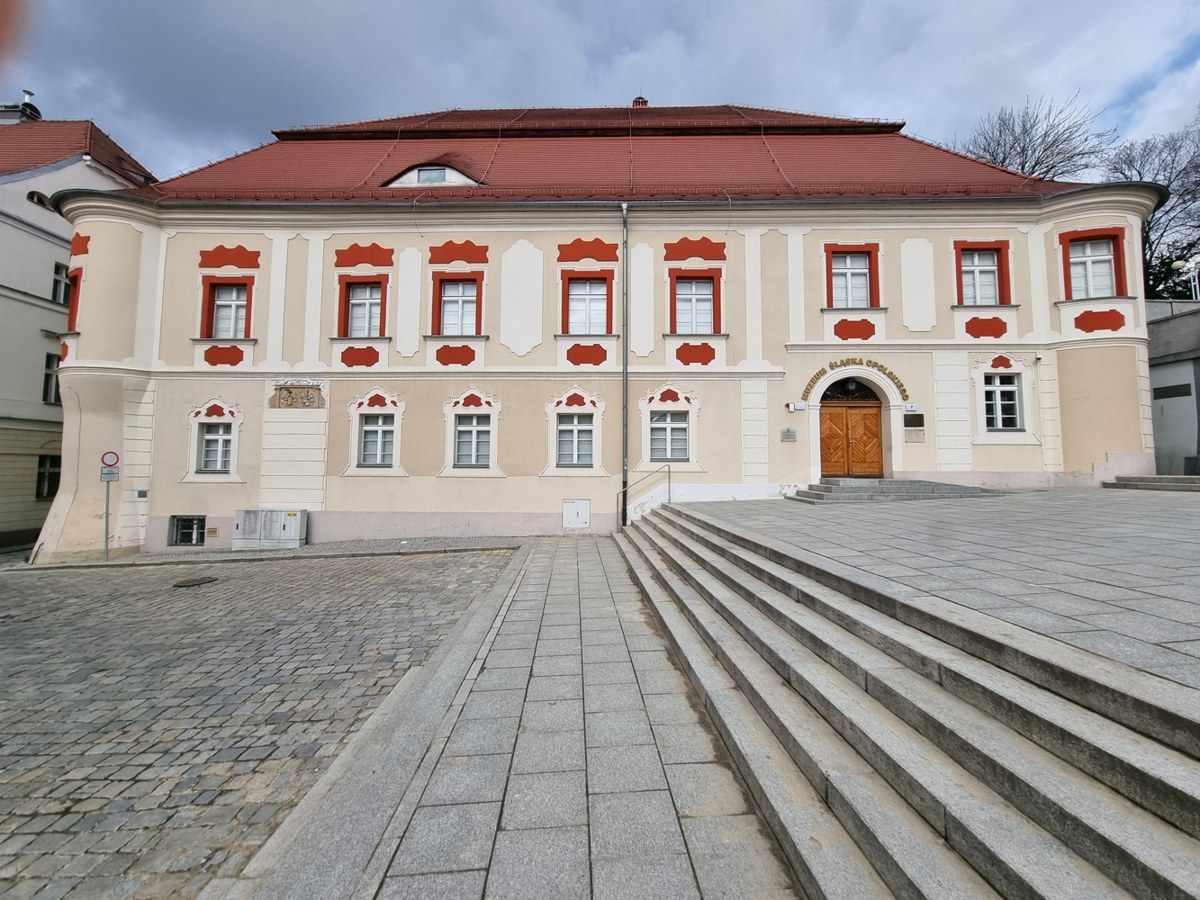
Muzeum Górnośląskie in Bytom is still receiving visitors, but its main building is not the place to start an ordinary exhibition visit. The museum's relocation notice says the building at plac Jana III Sobieskiego 2 is closed for modernisation, with work planned through December 2027. Current exhibitions are at Wojciecha Korfantego 34. That is the address to use when planning the visit described here, rather than the main address repeated in the website footer.
This is a change of location and available programme, not a statement that the museum has closed altogether. It is equally important not to assume that every former main-building gallery has moved intact. Choose from the exhibitions currently advertised at Korfantego, then check the opening notice for your date. A photograph, old review or collection description can explain what the museum owns without proving that those objects are now on public display in its operating branch.
Build the visit around the current displays
One clearly dated option is “Od dinozaurów do człowieka. Historia życia na Ziemi”, running from 19 September 2025 to 31 December 2026 at Korfantego 34. Its subject is the evolution of mammals against changing natural environments, rather than simply a room of dinosaurs. The description follows problems such as warm-bloodedness, hearing, fur and brain development. That gives a family or an interested adult a more useful expectation than treating the title as a promise of an outdoor dinosaur attraction.
The museum explicitly distinguishes original fossil remains from reconstructions. It describes remains associated with animals including a mammoth and cave bear, alongside reconstructed animals, skulls and an early-human campsite scene. Look at the labels with that difference in mind. A reconstruction can help explain an animal or a stage of evolution without being an original skeleton. The exhibition is a temporary product, so its published end date and ticket category matter when choosing a day to visit.
“Ślad pokoleń. Od synagogi do Żydowskiego Domu Modlitwy w Bytomiu” offers a different subject at the same address. It follows the history of Bytom's Jewish community before, during and after the Second World War, using objects, documents and personal histories. The museum describes religious and everyday material, books with owners' inscriptions, and a related documentary and publication. This is a display about a community and its changing place in the city, not a visit to an operating synagogue.
Check the day and the cashdesk cutoff
The ordinary timetable is Tuesday and Friday 09:00-15:00, Wednesday and Thursday 12:00-18:00, Saturday 11:00-16:00 and Sunday 12:00-17:00. Monday is closed. Ticket sales end thirty minutes before the exhibitions close. These details make a difference to an after-work plan: Wednesday and Thursday have later closing times, while Friday is not a late-opening day. Work backwards from the ticket cutoff, rather than assuming that arriving a few minutes before closing will get you inside.
These are normal hours, not a guarantee of entry to a workshop, lecture or separately organised event. Check dated notices for holidays and activities, and leave enough time for the exhibition you have chosen. The museum's programme can list individual events at a particular hour without extending the entire day's exhibition opening. Likewise, a date appearing in an exhibition calendar should not override the Monday closure or another explicit visitor notice. Use the timetable and event details together.
Understand which admission category you need
The visitor tariff lists permanent-exhibition admission at 10 zł standard or 5 zł reduced, with a 20 zł family ticket from three people. Temporary exhibitions have the same listed 10/5 zł and 20 zł family rates. Special exhibitions have a separate 12/6 zł tariff and a 24 zł family product. A shared price does not make the categories interchangeable. Tell the cashdesk which exhibition you want and ask what the ticket covers before treating one payment as access to every display.
The dinosaur-to-human exhibition specifically says entry is included in the price of a temporary-exhibition ticket. This matters for Sunday planning because the free-admission rule on the visitor page applies to permanent exhibitions. Do not promise a free dinosaur visit simply because you are going on Sunday. The safe question is whether the particular show is covered that day. The museum's workshops, lectures and other activities also have their own prices rather than becoming free automatically with ordinary exhibition admission.
Reduced admission and card discounts depend on the relevant conditions and documents. The museum lists a large-family-card reduction, but says promotions do not combine. Its older eligibility wording also refers to specific categories and evidence, so a foreign visitor should not assume that every student or senior card gives an identical result. Bring the document you intend to use and ask the cashdesk. Avoid budgeting from the lowest column without checking who that column is for.
Groups and activities need their own plan
The group tariff lists 5 zł per person for a permanent or temporary exhibition for groups of more than ten people. That is not the same threshold as a group of exactly ten. Educational group leaders have a stated exemption, while organised lessons and workshops use other products. The preschool group price of 80 zł should not be mistaken for an individual admission price. Explain the number and ages of participants when asking what service and ticket apply.
The visitor page gives the education contact as +48 32 281 82 94, extension 127, for arranging excursions. A listed workshop price does not prove an available date, an English-language session or a place for every member of a group. Ask about the actual activity, language, duration and booking conditions before inviting others to a fixed plan. If a group has access needs, describe those at the same time so the proposed exhibition route and activity can be considered together.

Ask about access at Korfantego 34 specifically
The March 2026 access declaration describes both museum buildings. Its main-building section includes a lift and an adapted toilet, but those facilities must not be transferred in your planning to Korfantego 34. The operating branch has a different account: steps before the entrance, manually opened doors, further stairs to the exhibitions and movement between two floors by stairs. Staff assistance is described as something to arrange before the visit, not a promise of independent step-free entry on arrival.
The same declaration says some corridors are inaccessible to wheelchair users and that the ground-floor toilet is not adapted, with no support rails. It also contains a later broad sentence saying all rooms are accessible to wheelchair users. Those statements do not establish a clear step-free route. Give staff your requirements and ask which spaces you can actually reach, what assistance involves and whether it suits you. Do not rely on the most reassuring sentence while ignoring the detailed barriers.
The museum's accessibility page describes alternative access at the Korfantego building and asks visitors to contact its secretariat, with arrangements to be made within three working days. That is a reason to plan ahead, not an assurance that any requested form of help will be available immediately. If carrying, stairs or toilet access would make a visit unsuitable, settle those questions before travelling. An alternative arrangement may be useful, but it is not automatically equivalent to unrestricted access to every gallery.
The Korfantego cashdesk is described as having an induction loop. This is a specific communication aid at the service point, not evidence of interpreted tours or sound support throughout every exhibition. Ask about the help you need for the chosen display, including any available written material. Assistance and guide dogs are addressed in the museum's access information and visitor rules; confirm the practical route if it affects your visit rather than treating an animal exception as an answer to the building's physical barriers.
Leave large bags and follow the gallery rules
The linked visitor rules require outerwear, umbrellas and bags or backpacks larger than 35 by 30 by 15 centimetres to be left in the free cloakroom. Plan what you carry accordingly, especially if you are combining the museum with shopping or a longer journey. The rules prohibit eating and drinking in exhibitions, touching exhibits and interior fittings, and making telephone calls there. An ordinary admission ticket does not give permission to handle a reconstruction or an object that looks sturdy.
Parents and group leaders remain responsible for children in their care. The museum may temporarily close part of an exhibition, and staff instructions take priority while visiting. For a family interested in the evolution display, looking together at the difference between a fossil and a reconstruction can give the visit a clear focus without requiring children to touch anything. Check the actual education offer if you want a handling activity rather than assuming it is included in a general ticket.
Check photography before taking equipment
The visitor page permits amateur photography and filming without extra lighting or a tripod after agreeing it with exhibition staff. The rules also prohibit flash, additional lighting, tripods and equipment associated with professional photography or filming in the galleries. Ask before setting up rather than treating a quiet room as a studio. A casual photograph and an organised content shoot have different practical effects, and permission for the former should not be stretched into permission for the latter.
Confirm the final address and route
The operating Korfantego branch does not have its own parking, according to the access declaration. Paid street spaces are described along Korfantego. Do not read the main museum's address or a nearby parking reference as a reserved space, a free parking entitlement or proof of a level route into the exhibition. If a vehicle drop-off affects whether the trip will work, ask the branch about the current approach and the help available before making firm arrangements.
A sound plan is to choose the current exhibition, use Wojciecha Korfantego 34 as the destination, check the day's hours and allow for the thirty-minute ticket cutoff. Add a workshop or a group activity only after arranging it, and settle access questions with that building specifically. The renovation is a reason to visit differently, not a reason to repeat an old main-building itinerary. Keeping the address, available displays and physical route together avoids the most consequential mistakes.
Frequently asked questions
Is the whole museum closed for renovation?
No. Exhibitions are operating at Wojciecha Korfantego 34 while the main building is closed.
Is the temporary dinosaur exhibition automatically free on Sunday?
No. The visitor page limits the Sunday free rule to permanent exhibitions.
Sources
- Official visitor location, hours and tariff (checked 8 November 2026)
- Main-building closure and relocation notice (checked 8 November 2026)
- Branch-specific access declaration, March 2026 (checked 8 November 2026)
- Alternative access arrangements (checked 8 November 2026)
- Official visitor rules (checked 8 November 2026)
- Current evolution exhibition and ticket category (checked 8 November 2026)
- Current Jewish-heritage exhibition (checked 8 November 2026)