Elbląg and its Canal: A Weekend with Ships that Travel Over Grass
The essentials: Elbląg pairs two unusual sights: its canal, where 19th-century inclined planes carry boats overland on rails (three-hour cruises from Buczyniec, 125 zł, late April to September), and an old town rebuilt brick-by-brick after 1945. An easy weekend from Gdańsk.
Some places you visit for the headline attraction and stay for the unexpected one. Elbląg, an hour from Gdańsk, is that kind of weekend: you come for a canal where boats travel overland on rails, and you leave talking about an old town that was rebuilt from rubble, brick by brick, in our own lifetime. 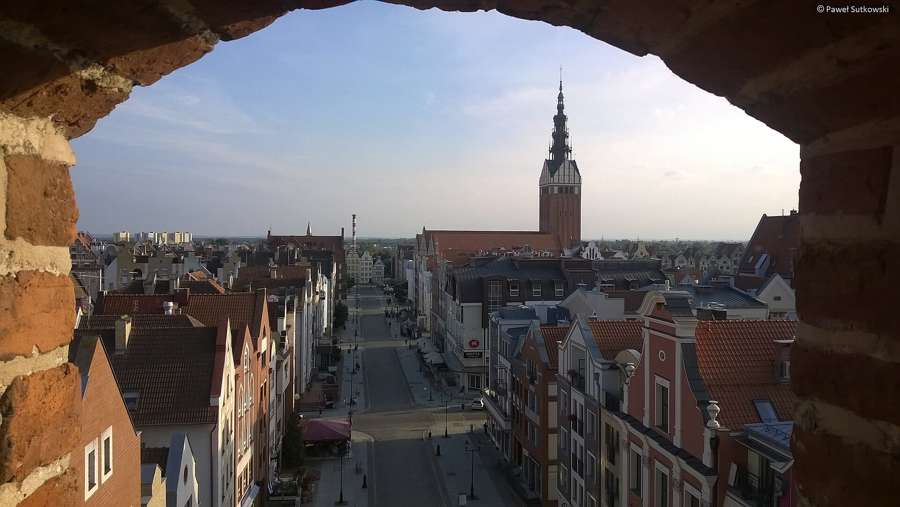
Getting there
Elbląg sits about 65 km southeast of Gdańsk. Trains from Gdańsk Główny run regularly and the journey takes around an hour, which makes the city an easy day trip and an even better slow weekend. From Warsaw the trip is around three hours with a change or on direct services from Warsaw Gdańska. If you are based in the Tricity, treat Elbląg as the second city of your region: close, cheap to reach and almost always skipped by visitors heading straight for Malbork Castle.
The canal itself does not start in the city centre. The most famous stretch, with the inclined planes, lies between Elbląg and Ostróda, about 20 km from Elbląg at the Buczyniec incline near Miłomłyn. In season the cruise operator runs its ships from Buczyniec, so plan for a short drive, taxi or local bus from Elbląg. There is free parking at the Buczyniec incline.
Data source: Elbląg tourism information and the cruise operator's route description, checked 22 October 2026.
A canal where the boats go over the grass
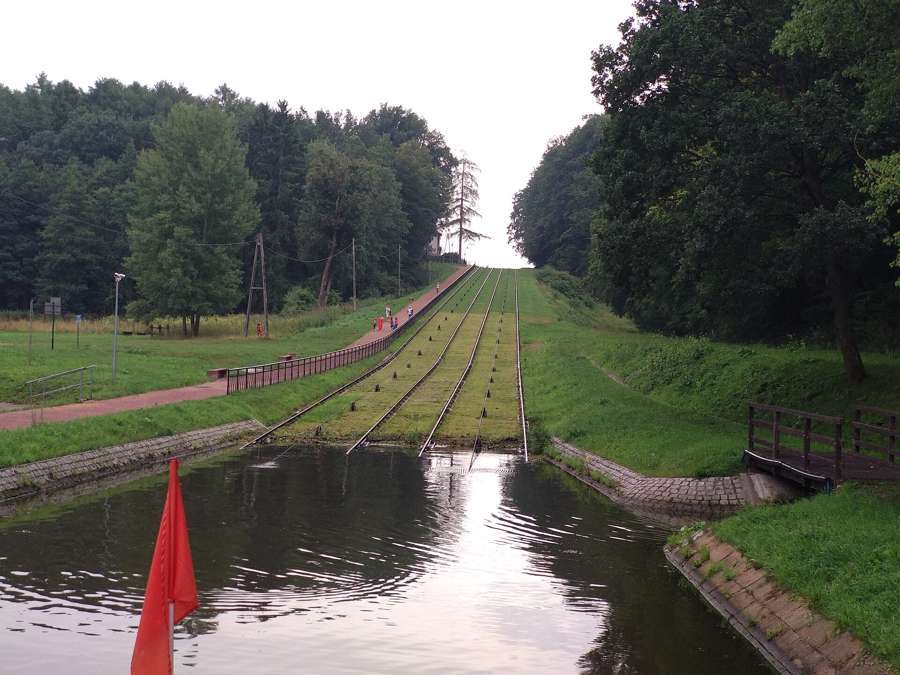
The Elbląg Canal, opened in 1860, is a Prussian-era engineering work designed by Georg Jakob Steenke. The linked waterways between Elbląg and Ostróda climb roughly 100 metres of elevation, and Steenke solved the climb in a way nobody had tried before in Europe: where the locks would have needed too much water, he built inclined planes instead. A boat floats onto a rail-mounted cradle, the water drains away, and a system of winches and rails hauls the whole thing, boat and passengers, up or down a grass slope and back into the water on the other side. Five of these inclines survive and still work, and the canal is protected as a national Monument of History. Watching a ship slide past you on rails, a metre above the meadow, is genuinely strange and genuinely lovely.
The scale sneaks up on you. The whole system was designed for the grain barges and cargo boats of a Prussian province, pulled by horsepower and water power long before diesel engines existed. The machinery was later converted and modernised, but the working principle is exactly the one from 1860, and that continuity is the point: this is not a museum reconstruction but a waterway that never stopped working. Cyclists can follow the canal towpath on the marked Green Velo trail, and walkers can trace the whole chain of inclines on foot, reading the small memorial plaques that the region has placed along the route.
One note for planning: the waterway operator announced renovation works at the Kąty incline in 2026, with its opening date communicated separately, so check the current situation before you go. The navigation season on the inclines in 2026 runs from 25 April to 4 October.
Data source: Wody Polskie Gdańsk, official navigation-season announcement for 2026, checked 22 October 2026.
The "ship on grass" cruise
The easiest way to experience the inclines is from the deck. The cruise operator's most popular offering is a three-hour return trip from the Buczyniec incline that crosses three of the five planes: Buczyniec, Kąty and Oleśnica. The Buczyniec plane alone lowers the ship by almost 21 metres. On the way back you go through the same machinery in reverse, so you see the haul uphill as well as the descent. The captain comments on the history along the way, and there is a small buffet on board with drinks and snacks.
For 2026 the operator lists the cruise at 125 zł normal and 115 zł reduced or group, with children aged four to seven at 50 zł. Departures in May, June, July and August run at 08:15, 11:15 and 14:30; in April and September at 09:45 and 13:00. The season runs from late April to the end of September. Book ahead in July and August: the ships are small and the middle-of-the-day departure sells out first.
Data source: cruise operator's 2026 timetable and price list, checked 22 October 2026.
Elbląg's impossible old town
Back in the city, Elbląg's old town is one of the strangest and most interesting urban projects in Poland. The medieval centre, a wealthy Hanseatic trading quarter, was almost entirely destroyed in the fighting of 1945. Instead of rebuilding facades in the Warsaw style, Elbląg's planners took a different road: archaeologists excavated the buried street grid, and from the 1990s onward the centre was reconstructed using salvaged historic bricks, on the medieval lot lines, but with new architecture that only nods to the old. Critics call it "retroversion"; locals simply call it the old town. Whatever the verdict, walking it is a lesson in what a city can decide to do with its own past.
The anchor is St Nicholas Cathedral, a 13th-century Gothic giant whose tower survived the war and now looks down on the rebuilt rooftops. Climb the Market Gate, the one original tenement fragment to survive 1945, for the classic view down the old-town street, and duck into the small Elbląg Museum nearby. Then do the simple thing: coffee on the rebuilt street, a walk along the Elbląg river, and dinner somewhere with a view of the water. The city is quiet in the best way.
Two smaller stops round out the centre. The Elbląg Museum, housed partly in the surviving post-Dominican complex, covers the Hanseatic city and the archaeology that made the reconstruction possible, and the Galeria EL in the former church of St Mary hosts one of the more adventurous contemporary-art programmes in this part of Poland. Neither takes long; both explain the city's temperament better than any monument.
Data source: Elbląg city tourism materials and the Elbląg Museum, checked 22 October 2026.
With children
This is one of the best family weekends in northern Poland, and it is not even close. The inclines are the hook: children who could not care less about a cathedral will stand open-mouthed while a boat is lifted out of the water and rolled past them on rails. The Buczyniec incline has walkways along the tracks, so even without a cruise ticket you can watch the machinery work from the bank. The cruise itself is three gentle hours with no waves, a snack bar and plenty to look at.
In Elbląg itself, the compact rebuilt centre is stroller-friendly, the riverside promenade gives children space to run, and the city has the usual Polish weekend furniture: ice cream, pancakes, playgrounds. For older children, frame the old town as a puzzle: which buildings are really old, and which only look it? The honest answer, that almost all of it is younger than their grandparents, tends to land well.
Data source: cruise operator's offer and Elbląg city information, checked 22 October 2026.
A simple weekend plan
Saturday: train to Elbląg, old town, cathedral, Market Gate, riverside dinner. Sunday: morning departure for Buczyniec, the three-hour cruise over the inclines, a slow lunch near the canal, home by evening. If you have a car and a third day, add Malbork Castle half an hour away and you have one of the strongest three-day loops in the north.
Practical notes: in season, the middle cruise departure is the family favourite, so book it first and build the rest of the day around it. Buczyniec is rural; bring water and sun protection for the wait between arrivals. Elbląg's centre is compact enough that you never need local transport inside the city, and the station is a short walk from the old town.
Frequently asked questions
How much does the Elbląg Canal cruise cost?
For 2026 the operator lists the three-hour cruise from Buczyniec at 125 zł normal, 115 zł reduced or group, and 50 zł for children aged four to seven. The season runs from late April to the end of September, with three daily departures in the summer months.
Can you see the inclined planes without taking the cruise?
Yes. The Buczyniec incline has public walkways alongside the tracks, so you can watch ships being hauled overland from the bank while a cruise passes through. Seeing the mechanism from a moving ship is better, but the view from land is free.
Is Elbląg a day trip or a weekend?
Both work. From Gdańsk the city is about an hour by train, so the old town alone makes a relaxed day trip. Add the canal cruise and it naturally becomes a weekend: one day for the city, one for the canal.
When does the canal operate?
The navigation season on the inclines in 2026 runs from 25 April to 4 October. Outside the season the ships do not run, though the inclines and the canal towpaths can still be visited on foot. * Photos: Buczyniec incline of the Elbląg Canal by Zala, CC BY-SA 4.0; Elbląg old town by Paweł Sutkowski, CC BY-SA 4.0, both via Wikimedia Commons.