Old electronics in Poland: free take-back and PSZOK disposal
The essentials: Keep electrical equipment separate from household rubbish. Sellers take back equivalent household equipment when you buy replacements, including at delivery. Qualifying large electronics shops also accept devices with no dimension above 25 cm without a purchase. Check local PSZOK rules for other items.
A broken kettle is not packaging, an old laptop is not ordinary mixed rubbish, and a washing machine should not simply be left beside the building's bins. In Poland, household electrical and electronic waste has separate collection routes. The useful question is which route fits your item: a retailer taking back an equivalent appliance, a large shop accepting a small device without a purchase, or a municipal collection point.
The distinction matters when you move into a furnished flat or replace something large. Paying for a new appliance does not mean you must also find an unrelated private collector for the old equivalent one. Conversely, a small-electronics box is not a free collection service for every fridge, dismantled computer or damaged battery.
This guide was checked on 27 October 2026, Poland time. It concerns household waste. Business equipment, contaminated items and devices with damaged batteries can require different arrangements. Confirm the receiving point's instructions before transporting anything unusual.
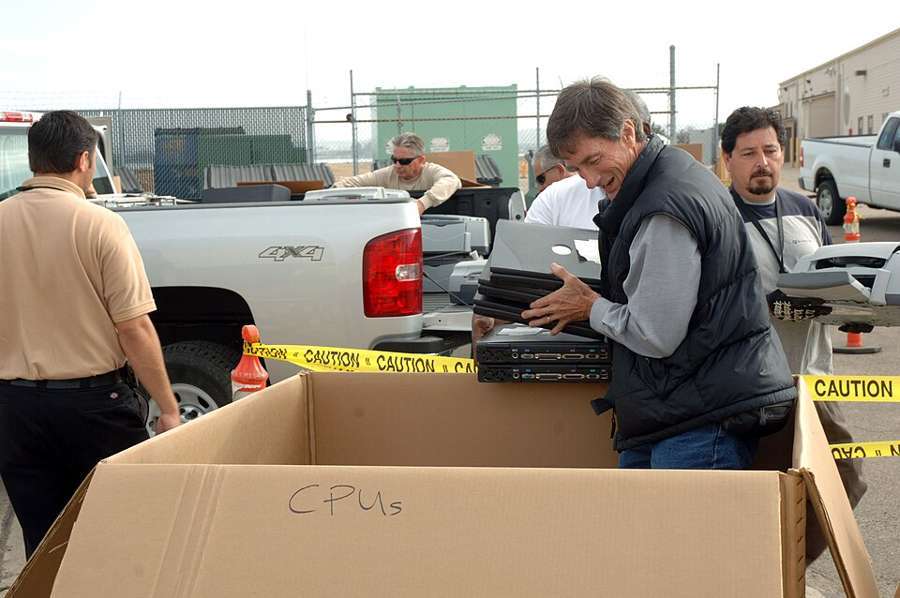
Cover photograph: electronics at a collection event in San Diego, United States, 13 May 2010. Stephen Votaw / U.S. Navy, Wikimedia Commons, public domain. Resized. Illustrative, not a Polish collection point.
Start with the item, not the colour of the bin
The Polish terms are elektroodpady, elektrośmieci and zużyty sprzęt elektryczny i elektroniczny. The last phrase means waste electrical and electronic equipment, often shortened to ZSEE. A crossed-out wheeled-bin symbol is a reminder that the equipment should be collected separately.
UOKiK's guidance says worn-out or broken electrical equipment should not go into an ordinary rubbish bin. The legislation prohibits putting waste equipment together with other waste. Do not interpret a plastic casing as permission to use the yellow packaging bin, or a metal body as permission to treat an appliance as a drinks can.
Describe the whole device when checking a collection route. A phone, hairdryer, television and fridge are not interchangeable for size limits or retailer replacement duties. If the item belongs to your landlord, confirm ownership and permission before disposing of it. A malfunctioning furnished-flat appliance may need a repair decision rather than immediate disposal.
Buying a replacement: the equivalent-item route
A seller must take back household waste equipment free of charge at the point of sale when it is of the same kind and performs the same functions as the equipment being sold. The practical example is an old iron when buying a new iron. This is not permission to bring a bag of unrelated devices in exchange for one small purchase.
For a new household appliance delivered to you, the seller must arrange free take-back of an equivalent old item at the place of delivery. Municipal guidance from Knurów gives the straightforward example of replacing a fridge with home delivery: collection of the old equivalent fridge is free.
Tell the seller before delivery that you want to use take-back. Read its instructions and keep confirmation with your order. Ask how to prepare the old appliance and what access the crew needs. Do not wait until the vehicle arrives to explain that the old item is still installed, full of food or in a different building.
Keep take-back separate from other services. Dismantling cabinetry, disconnecting utilities, moving unrelated furniture or installing the new appliance can involve different work. Ask the seller to explain any quoted charge and which service it covers. A separate installation service does not erase the underlying free equivalent-equipment take-back rule.
Not buying anything: the 25 cm and 400 m² rule
There is also a no-purchase route for very small household equipment. The relevant retail unit must have at least 400 m² of sales area devoted to household electrical and electronic equipment, and none of the waste item's external dimensions may exceed 25 cm. The qualifying shop must accept it free in the unit or its immediate vicinity without requiring a new purchase.
Both conditions matter. A large shopping centre is not automatically a qualifying electronics retail unit, and a device does not qualify just because its screen is smaller than 25 cm. Check the complete external dimensions of the item, not its diagonal display measurement.
A compact charger or small phone may fit; a long hairdryer or a larger tablet may not. Measure rather than argue from the product category. For an item outside the limit, use a confirmed collection point or the equivalent-purchase route instead.
Some short official summaries say "over 400 m²", while municipal explanations quoting the statutory condition say "at least 400 m²". This guide uses the latter wording. Do not turn the threshold into a claim that every convenience shop or every branch of an electronics chain must operate the same collection facility.
Use your municipality when the shop routes do not fit
A PSZOK, or Punkt Selektywnego Zbierania Odpadów Komunalnych, is a municipal selective collection point. Your city or gmina should publish its locations, accepted categories and conditions. Search the official waste website for PSZOK and elektroodpady, then check the actual receiving point before leaving home.
Ask what establishes eligibility for your household, whether the specific appliance is accepted, how to bring it and what happens with incomplete or damaged equipment. Do not assume a point in a neighbouring municipality serves everyone without conditions. If your landlord handles the waste fee, ask which document you may need.
Mobile services are not simply smaller versions of every fixed site. Warsaw's official page lists large electrical equipment such as washing machines, televisions and fridges at PSZOK sites, while its MPSZOK mobile service excludes large electrical equipment and accepts small devices such as kettles, hairdryers and speakers.
Opole's municipal guide illustrates another local distinction: it says household e-waste is not collected directly from properties through its general direct-collection arrangement, and its mobile point has its own size limit. That is why a neighbour's bulky-waste calendar is not enough evidence that electronics can be left beside the bins.
A repair shop can sometimes take the item
Official municipal guidance also describes free acceptance by a service point when an item brought there for repair cannot be repaired for technical reasons, or its owner considers repair uneconomic. This concerns the device involved in that repair process, not an unlimited right to unload other appliances at any repair counter.
If an assessment ends with that decision, ask the service point about handing over the equipment and request confirmation where useful. First settle whether it is your property to discard and whether you need files or accessories from it. Do not abandon a landlord's appliance or a computer containing the only copy of important documents.
Keep appliances intact and disclose problems
Do not strip a fridge, break a screen or dismantle a device to make a collection bin accept it. Rules restrict which operators may collect incomplete equipment and parts. The Knurów guidance identifies authorised routes for incomplete equipment, including PSZOK operators and treatment facilities, rather than saying every collector must take it.
Tell the receiving point if the appliance is incomplete, leaking, contaminated or otherwise damaged. Opole's official guidance notes that retail and service points can refuse equipment whose contamination threatens the health or life of the people receiving it. Free collection is not a promise that staff must handle every hazardous item in any condition.
For a swollen, damaged or leaking battery, ask the collection operator for specific handling instructions. Do not improvise a repair, puncture it or force it into a box designed for intact small devices. This article is not a hazardous-battery transport guide. When in doubt, describe the condition before moving the item.
Protect your data before handing over electronics
Recycling a device and securely removing its data are different tasks. Dell's Polish guidance says users should back up their data, remove confidential or personal information and remove removable storage before sending equipment for reuse or recycling. Do not assume the collection crew will do this for you.
For a phone or computer that still works, follow the manufacturer's current instructions for your model and operating system. Make sure your backup is usable before erasing anything. Account removal and secure erasure need care; a quick deletion of visible documents is not a reliable privacy plan.
If the device no longer starts or contains sensitive work information, ask the manufacturer, your employer's IT team or a suitable data-erasure specialist how to proceed. Do not hand over a company laptop as household rubbish. Do not physically dismantle a hazardous appliance to reach storage without competent advice.
Useful Polish and a final checklist
For a shop, ask: Czy mogę bezpłatnie oddać zużyty sprzęt przy zakupie nowego? This means, "Can I return the old equipment free when buying a new one?"
For a delivery, say: Chcę zgłosić odbiór starej lodówki przy dostawie nowej. This means, "I want to arrange collection of the old fridge when the new one is delivered." Replace lodówki with the correct appliance.
Before the handover, confirm the route, item type, size and condition; obtain the owner's permission; protect any data; and follow the receiving operator's preparation instructions. If a shop refuses qualifying take-back, ask for its reason and published collection information. Keep the order and correspondence and seek consumer advice rather than leaving the item outside.
Frequently asked questions
Can I put a broken kettle in the yellow bin?
No. Electrical equipment has a separate collection route. Its plastic or metal casing does not make it ordinary packaging waste.
Must a seller collect my old fridge when delivering a new one?
The free take-back rule covers household equipment of the same kind and function at the delivery location. Notify the seller in advance and confirm preparation and access arrangements.
Can I return any electronics without buying something?
The statutory small-device shop route has two conditions: a qualifying retail sales area of at least 400 m² and no external dimension of the item above 25 cm. Other items need another confirmed route.
Can I leave a television out with bulky furniture?
Do not assume so. Check your municipality's specific electronics collection rules. A fixed PSZOK and mobile collection service may accept different categories.
Will recycling automatically erase my files?
Do not rely on it. Back up what you need and arrange appropriate data removal before handing over the device. Get specialist advice for broken devices or sensitive information.
Sources
- GIOŚ general e-waste information (checked 27 October 2026)
- Opole municipal e-waste guide (checked 27 October 2026)
- Knurów municipal e-waste rules (checked 27 October 2026)
- UOKiK e-waste consumer inspection guidance (checked 27 October 2026)
- Warsaw PSZOK/MPSZOK, updated 27 January 2026 (checked 27 October 2026)
- Dell Polska data removal before recycling (checked 27 October 2026)