Film Development in Poland: Negatives, Scans and Lab Orders
The essentials: Identify the exact film and ask the lab to confirm its process. Developing, scans and prints may be separate charges. Agree the file specification, total price, turnaround, physical return and collection deadline before handover.
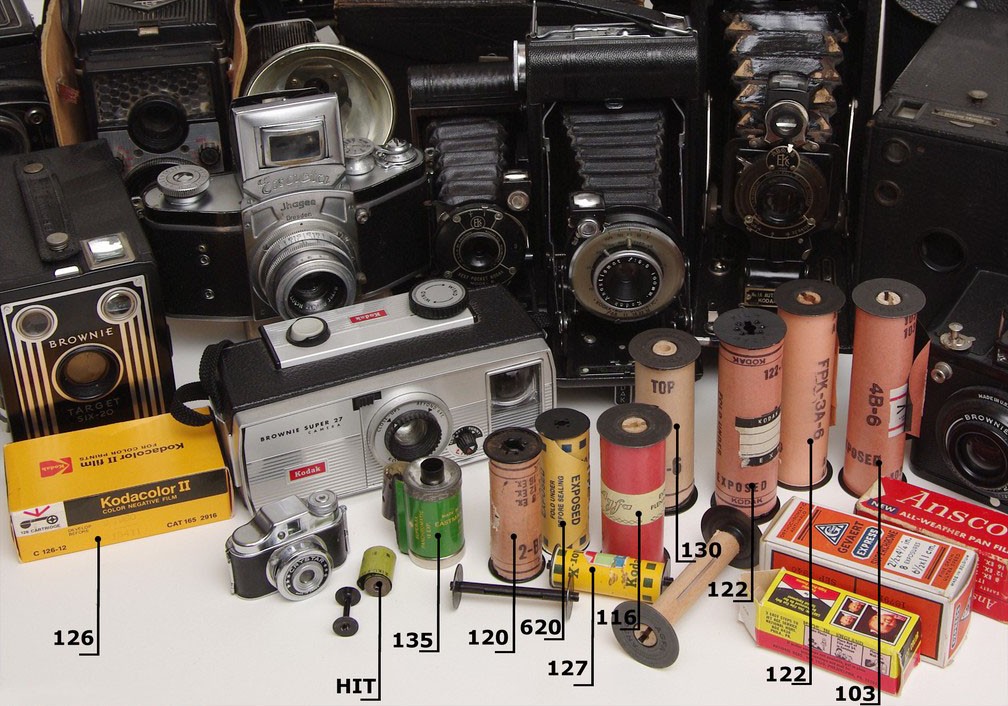
Found film and cameras with formats labelled, June 2009. Illustrative historical image, not a Polish lab or current service offer. Emir Shabashvili / Wikimedia Commons, released into the public domain by the author. Re-encoded.
Taking a finished roll of film to a Polish photo lab sounds simple until the order form asks whether you want wywołanie, skanowanie or odbitki. Those are different services: developing the film, making digital scans and making prints. Ordering only the first may leave you with negatives but no photographs ready to view on your phone.
The useful approach is to identify the film, decide what you want back and confirm the complete handover and return arrangement before leaving or posting it. This guide uses lab and manufacturer pages checked on 28 October 2026. It is not a ranking of labs, a current capacity promise or instructions for chemical processing at home.
Start with the actual film, not just “colour” or “black and white”
Tell the lab the brand, exact film name and format, using the packaging or visible cassette label. If you are uncertain, send a photograph of the outside or take it to the counter without opening the film container. Ask the lab to confirm the required service before processing begins.
Different processes appear on Polish price lists, including C-41, traditional black-and-white processing, E-6 slide processing and ECN-2. A lab offering one does not necessarily accept all the others. Jasna Ciemnia lists several processes but explicitly asks customers to contact it before posting material and to check availability for specialist processes.
Do not decide solely by whether the final pictures are black and white. ILFORD's manufacturer page says XP2 SUPER is a black-and-white film processed in C41 chemicals alongside colour negative films. This is a concrete reason to provide the exact product name rather than selecting a generic black-and-white service.
If the material is unusual, expired, hand-loaded or already partly processed, explain that before ordering. Do not assume the lab can recognise its full history from an unlabelled cassette. Any push, pull or other special processing request should be discussed explicitly rather than inferred from an ISO number scribbled on a bag.
Separate developing, scans and paper prints
Wywołanie filmu means developing the film. Skanowanie negatywu means scanning a negative; odbitki are prints. A package may combine these, but the cheapest line on a price list may refer to only one stage. Ask exactly what the order includes.
INTER-FOTO's FAQ says scanning is a separate service and that customers can collect only the developed negative. Światłoczułe lists individual services and combined developing-and-scanning packages. Read the selected product rather than assuming digital delivery is included because a lab also advertises scanning elsewhere.
If you already have developed negatives from a family archive, tell the lab that they are already developed and ask about scanning or printing, not developing them again. INTER-FOTO makes this distinction explicitly. Do not try to identify an unknown roll by exposing its contents to light.
For a disposable camera or an unfamiliar format, ask whether the lab accepts the complete camera and which service applies. Acceptance should come from the lab, not from the fact that its site mentions ordinary 35mm film. Keep any original packaging that helps identify the material.
Choose scans by the files you need
Ask for the delivered pixel dimensions, file format and whether the price covers a whole roll or individual frames. Labels such as “standard”, “large” or “premium” do not establish that two labs deliver equivalent files.
LP Foto's published table distinguishes several pixel sizes and separate prices for a full 35mm roll, already-cut film and individual frames. Its medium-format entries vary with the frame format. Fotografia Ostrowski likewise distinguishes uncut film, cut strips and other material, and states that JPEG is standard with an extra charge for TIFF.
Explain whether you want convenient viewing files, room to crop, larger prints or files for your own editing. Ask the lab which option suits that purpose and whether colour correction, dust handling or a visible frame border is included. Do not buy solely by a dpi number without understanding the delivered file and service.
If you have a large archive, consider agreeing a small test order before sending everything. That lets you assess the output, filenames and colour treatment before committing all the material. A higher-resolution scan is not a promise to recover detail that was never captured.
Check the complete price before handing over the roll
Get a total for the exact process, scan option, prints, sleeves, special handling and return delivery. Ask whether any charge is per roll, per frame or per order. A quote for developing alone cannot be compared fairly with a developing-and-scanning package.
As a dated illustration, LP Foto's page checked on 28 October 2026 lists C41 developing at 15 zł and its lowest listed whole-roll 35mm scanning option separately at 15 zł. These are individual listed services, not a national rate or a guarantee that they suit your film. Confirm the applicable final quote with the lab.
Other charges may be easy to miss. Fotografia Ostrowski publishes a per-order addition and a TIFF supplement. Jasna Ciemnia describes extra charges for some processing and scan arrangements, but its page is marked as a 2024 update. Treat older figures as a reason to reconfirm, not a current quote.
Ask how payment works and whether an invoice is needed at the order stage. Światłoczułe describes online purchase before posting film within its specified period. Another lab may use counter payment or a different mail-in sequence. Follow the instructions for the service you actually choose.

Agree the cutting and physical return arrangement
Say whether you want the developed film cut into strips, sleeved or returned uncut, and ask which choices the lab supports for your format. This matters if you plan to scan it yourself later or already have a particular storage system. Do not assume “keep my negatives” also specifies how they should be packaged.
Jasna Ciemnia's page describes different arrangements depending on scanning equipment and format, including mandatory cutting and packaging for medium-format scanning. LP Foto's separate cut-film scanning prices also show why the physical condition of the material can affect a later order.
Confirm whether negatives are returned automatically, collected separately or held for a limited time. If posting, ask who arranges and pays for the return shipment and whether a prepaid label is required. Keep the answer with the order receipt, especially when the lab's general page contains several dated shipping instructions.
For mail-in orders, confirm acceptance before posting
Use the lab's current mailing instructions, order reference and packaging guidance. Ask how to send each format without exposing or damaging it. Do not remove film from its protective container just to add identifying details; label the outer order packaging instead.
Include the contact and service information the lab requests, with a clear return arrangement. Jasna Ciemnia says incomplete return and processing details can delay work. Avoid sending several unidentified rolls with a message that simply says “usual scans”, particularly if you have never used that lab before.
Keep a record of the roll labels, number of items and requested services before sealing the parcel. Use a shipping method that lets you retain evidence of dispatch and delivery, while recognising that a carrier's delivery scan is not necessarily the lab's confirmation that every item has been checked in.
If a roll contains irreplaceable photographs, weigh whether local handover is preferable to mailing. Neither route makes processing risk-free. Ask about unusual or damaged material before sending it and do not rely on a general service description as a guarantee of recoverable images.
Confirm turnaround for each stage
Ask when the lab expects to receive the material, complete processing, deliver scans and make physical negatives available. These may be separate dates. A posted order also needs transport time, and a scan email does not necessarily mean the return parcel has been dispatched.
INTER-FOTO says completion timing is confirmed at intake and depends on process and volume. Światłoczułe says times differ by selected service. Neither supports a blanket same-day or one-week promise for every roll.
Tell the lab if you have a deadline before ordering, and ask whether it can meet it for that material. If you need photographs for an event, allow time to check the files and order prints rather than treating a developing estimate as the final delivery deadline for everything.
Download files and collect negatives promptly
Ask how scans arrive, when any download link expires and whether you should bring a suitable storage device. Check the email address on the order and save the files to your own storage. A transfer link should not be treated as a permanent archive.
Physical retention deserves equal attention. Światłoczułe's page says developed film must be collected within 30 days of notification and is permanently removed afterwards. Fotografia Ostrowski's scanning page states that film is kept for two weeks before disposal. These are different published provider conditions, not one Polish legal retention rule.
Ask when the relevant period starts and arrange collection or return shipping before it expires. If you are travelling away, settle that before handing over film. Receiving digital files is not a reason to forget the original negatives.
Check the result while the order is still easy to trace
Open the downloaded files, check that the expected rolls are represented and compare the delivery with your receipt. If something is missing or looks wrong, contact the lab with the order reference and specific examples rather than assuming the cause.
Expired material and an old camera can produce uncertain results; Jasna Ciemnia expressly warns against expecting guaranteed outcomes from expired or hand-loaded film. Equally, a concern about the service should be raised promptly. Keep the negatives, files, packaging information and correspondence until the question is settled.
The simplest successful order is a written agreement about the film, process, files, price and return route. Once those are clear, the Polish terminology stops being an obstacle and becomes a useful checklist for getting the photographs you actually wanted.
Frequently asked questions
Does developing film include digital photos?
Not necessarily. Developing, scanning and paper prints are separate services unless the selected package includes them. Confirm what you will receive.
Is every black-and-white film processed the same way?
No. ILFORD XP2 SUPER is a black-and-white film processed in C41 chemistry. Give the lab the exact product name and ask it to confirm the required process.
Can I post film to a lab in Poland?
Some labs accept mail-in orders. Confirm current acceptance, packaging, order details and the physical return arrangement before posting.
Will the lab keep my negatives indefinitely?
Do not assume so. Reviewed providers publish different collection or retention periods, including disposal afterwards. Confirm the deadline for your order.
Should old developed negatives be developed again?
No. Ask about scanning or printing already-developed negatives. If you do not know what you have, let the lab identify it without exposing unknown film.
Sources
- INTER-FOTO developing and scanning FAQ; checked 28 October 2026
- LP Foto developing and scanning tariff; checked 28 October 2026
- Jasna Ciemnia service instructions; page marked update 2024; checked 28 October 2026
- Światłoczułe film service and collection terms; checked 28 October 2026
- ILFORD XP2 SUPER manufacturer processing information; checked 28 October 2026
- Fotografia Ostrowski scanning and retention terms; checked 28 October 2026