Joining a Choir in Poland: Auditions, Language and Membership
The essentials: Ask the choir about current places in your voice section, audition requirements and rehearsal language. Confirm the actual room, attendance expectations, membership costs and concert or recording commitments before joining.
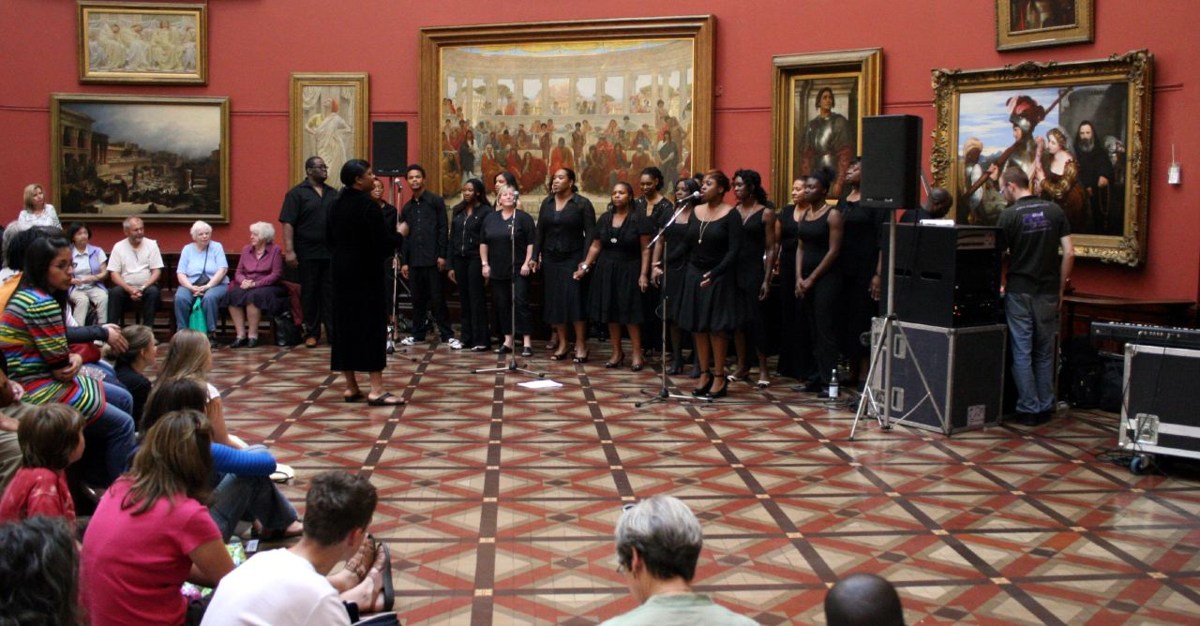
Birmingham Community Gospel Choir at Birmingham Museum & Art Gallery, UK, 15 September 2007. Illustrative historical image, not a Polish choir or recruitment offer. bongo vongo / Wikimedia Commons, CC BY-SA 2.0. Resized and re-encoded; image adaptation under the same licence.
Joining a choir can give life in Poland a regular social rhythm without requiring every conversation to start from scratch. You arrive to work on something together. The practical question is which group suits your musical starting point, language needs and available time, and what membership actually involves.
Search for chór (choir), zespół wokalny (vocal ensemble), nabór (recruitment), przesłuchanie (audition) and próby (rehearsals). A recruitment page is a useful starting point, not proof that a place is available tonight. This guide uses published choir information checked on 28 October 2026 to explain what to ask before joining.
Choose the kind of singing you want
Start with the repertoire and group purpose, rather than choosing only by distance. Ask whether the choir focuses on classical works, pop arrangements, musicals, sacred music, a particular cultural tradition or a mixture. Listen to recent public recordings if available and ask what the group is preparing next.
Vistula University's choir page describes mainly musical, pop and folk repertoire, alongside classical music and gospel. Lira's men's-choir recruitment page describes patriotic, Christmas-carol and sacred-music performances. These are different projects, even though both involve amateur singers in Warsaw.
Consider whether you want a concert-focused ensemble, a learning group or a lower-pressure singing activity. A friendly atmosphere does not necessarily mean casual attendance. Conversely, a university or cultural association name does not automatically mean professional-level entry. Read the joining conditions separately from the promotional description.
Check eligibility rather than judging by the name
An institutional name can be misleading if you assume it restricts membership. Vistula's English page explicitly says you do not need to be a Vistula student to join and directs interested people towards an audition. That statement is specific to this choir; it does not establish the policy of every academic ensemble.
Community identity can matter in another way. Krakofonia describes itself as an LGBTQ+ amateur choir in Kraków and says people are welcome regardless of identity, orientation, age or origin, including allies. Its FAQ also makes clear that membership caps apply to particular voice sections.
Look for age, voice, student-status or other conditions in the actual recruitment notice. Czarno Na Białych's September 2026 recruitment page describes vocal groups for adults and young people aged 16 and over in five cities. Do not transfer that age threshold to other organisations or assume an adult choir accepts younger children.
Ask what an audition involves
An audition need not mean preparing a polished solo performance, but do not arrive without checking. Ask whether you should prepare a song, bring sheet music or a backing track, and whether the meeting is individual or part of a rehearsal. Find out whether an appointment or form is required.
Warszawski Chór Międzyuczelniany invites applicants to auditions and says neither professional musicianship nor the ability to read music is required. Its expectations include commitment and musical sensitivity. Lira likewise says formal musical education is unnecessary for its amateur men's choir while describing an expectation of general musicality and willingness to work.
These examples show that “amateur” does not mean there are no entry decisions. A choir may assess how a voice fits the current ensemble or how readily you follow musical material. Ask how and when you will hear the result, whether there is a trial period and what happens if another section would be a better fit.
Explain your experience honestly
Tell the conductor whether you have sung in a choir before, what kind of music you know and whether you can follow notation. If you do not know your voice part, say so and ask for help placing it. Do not choose a section solely because a friend sings there.
Krakofonia explains the usual soprano, alto, tenor and bass parts and says musical background and music-reading ability are not required, with basic notation taught during rehearsals and occasional additional classes. That is a useful example of a group describing its learning support rather than expecting everyone to arrive with the same skills.
Ask what support your chosen group actually provides: section recordings, pronunciation guides, scores, extra rehearsals or help from experienced members. A choir that welcomes beginners may still move quickly through its current programme. You need to know how much independent preparation is expected between rehearsals.
Confirm teaching language and song languages separately
A choir can sing in several languages while conducting rehearsals mainly in Polish. An English website does not prove that every instruction, group message or audition will be in English. Ask what language the conductor uses and whether someone can explain unfamiliar directions when needed.
Also ask which languages appear in the current repertoire and how pronunciation is taught. Krakofonia describes a multilingual repertoire, but that is not a promise that all rehearsal communication is multilingual. It is better to explain your actual level of Polish than to discover an avoidable communication gap during the first session.
Useful vocabulary includes dyrygent (conductor), nuty (sheet music), głos (voice or part), próba sekcyjna (section rehearsal) and próba wspólna (full rehearsal). You do not have to learn every musical term before making contact; ask which recurring instructions will help you follow the group.
Treat the rehearsal schedule as a real commitment
Check the frequency, duration and expected attendance before agreeing to join. Warszawski Chór Międzyuczelniany publishes both section and full-choir rehearsals and warns that missing even one session can create gaps because of the pace of work. Its conductor decides when a new member is ready for a first concert.
Other published arrangements differ. Lira describes weekly evening rehearsals during a singing year from September to mid-June. Vistula lists Saturday rehearsals. These pages are examples of different workloads, not a verified live timetable for your first visit. Ask the organiser to confirm the next date and any seasonal or project changes.
Think about the journey home, work travel and whether you can attend extra sessions before performances. If you regularly miss part of the week, explain that before joining. Ask how absences should be reported and whether membership or concert participation requires a minimum level of attendance.

Check the actual rehearsal address
Do not assume that the association's postal address, university headquarters and rehearsal room are the same place. Ask for the entrance, room and any access instructions. If accessibility matters, check the complete route and facilities rather than inferring access from the building type.
CLIL's Warsaw joining page is a useful example: it lists rehearsals at Centrum Luteran with an entrance from a different street and says selected Thursday sessions take place at the Jewish Community Center instead. Confirm the location for the specific date rather than saving one address and relying on it indefinitely.
Ask whether a newcomer should arrive early and whom to look for. If you are only observing or trying a rehearsal, get agreement first. A public invitation to make contact is not necessarily permission to walk into every session, especially when auditions or membership caps apply.
Understand fees and the full participation cost
Ask about membership fees, lesson or workshop charges, payment periods and any trial arrangement. A free public concert does not establish that choir membership is free. Krakofonia distinguishes its largely free performances from monthly membership fees supporting its operating costs.
Krakofonia also says fees may be reduced or waived in individual cases after discussion. That is not an automatic entitlement or a policy to assume elsewhere. If cost is a concern, ask privately what support is available before making a commitment.
Check additional costs such as scores, folders, concert clothes, workshops and travel. Warszawski Chór Międzyuczelniany publishes specific concert-dress and black score-folder requirements. Ask what is required, what can be borrowed and when you would need it. Do not buy a complete outfit from a generic choir checklist before confirming your own group's rules.
Ask about performances, travel and photographs
Concert expectations can change the nature of membership. Ask whether performances are required, how dates are agreed and whether trips involve extra cost or overnight stays. Being free for a weekly rehearsal does not mean you can attend every weekend performance.
Krakofonia says members can take part in rehearsals while opting out of performances or recording sessions, and that consent is sought before publishing images of them on social media. Treat that as its stated practice, not a universal choir policy. Ask your chosen group how recordings, photographs and public identification are handled.
If you want a gradual start without appearing on stage immediately, say so early. Equally, if performing is your main goal, ask what preparation and approval are needed. Membership does not always mean joining the next concert automatically.
Read dated recruitment notices carefully
Search results can surface an old open day long after it has happened. Czarno Na Białych's September 2026 notice includes September and early-October 2026 introductory events. Those dates are already past when this guide is checked on 28 October 2026; they are not upcoming opportunities.
The useful next step is to ask about the current intake or waiting list for your city and section. Krakofonia explicitly describes periodic recruitment and section caps. A submitted form or encouraging website paragraph is not the same as an accepted place.
Before your first visit, keep together the confirmed date, room, audition requirements, language arrangement, trial status and payment terms. After trying the group, assess whether the workload and repertoire fit your life. A sustainable choir routine is one you can keep, with its social and musical expectations understood from the beginning.
Frequently asked questions
Do I need musical training to join a choir in Poland?
Not always. Several reviewed choirs say formal training or reading music is not required, but auditions, commitment and section capacity still matter.
Can non-students join university choirs?
Check each choir. Vistula explicitly says applicants do not need to be its students; this does not establish a rule for other academic choirs.
Does an English website mean rehearsals are in English?
No. Confirm the actual rehearsal and audition language, separately from the languages of the repertoire.
Is choir membership free?
Do not assume so. Ask about membership fees and separate costs for scores, clothes, workshops and trips. Free concerts do not mean free participation.
Can I attend rehearsals without performing?
This depends on the group. Krakofonia expressly allows members to opt out of performances or recording sessions. Ask other choirs about their own expectations.
Sources
- CLIL Warsaw joining page; checked 28 October 2026
- Lira men’s choir recruitment; checked 28 October 2026
- Warszawski Chór Międzyuczelniany joining information; checked 28 October 2026
- Vistula University Choir; checked 28 October 2026
- Krakofonia English FAQ; checked 28 October 2026
- Czarno Na Białych September 2026 recruitment, published 15 August 2026; checked 28 October 2026