Weather warnings in Poland: IMGW yellow, orange and red levels
Short answer: IMGW-PIB warns on three levels: yellow (1), orange (2) and red (3). Warnings give the risk for a county, not a guarantee for every address, and storms can be very local.
Poland's national weather service, IMGW-PIB, issues weather warnings on a three-level colour scale: yellow, orange and red. For anyone new to the country, it helps to know what triggers a warning, what the levels mean, and why a warning covers a whole county even when the storm hits only a few villages. This guide follows the IMGW-PIB FAQ page (undated) and an IMGW explainer published in May 2026. Details are as of 17 October 2026. The live warnings are on the IMGW service at meteo.imgw.pl.
The three levels
According to the IMGW FAQ, the danger level is shown by degree and colour:
* degree 1, the lowest, yellow * degree 2, higher, orange * degree 3, the highest, red
The threshold values for each degree are set according to the forecast intensity of the phenomenon or its duration in the given area. The FAQ adds that not every dangerous phenomenon has all three degrees. The criteria are in an annex to the IMGW document, which this guide does not reproduce.
What triggers a warning
The IMGW FAQ lists the phenomena it must warn about, with these thresholds:
* strong wind: average speed above 55 km/h, or gusts above 70 km/h * icing from wet road surfaces freezing after rain at sub-zero air temperature * frosts during the spring growing season * thaw: when snow cover of 10 cm or more is melting because the air temperature rises above 0 degrees, or because of rain * heat: air temperature of 30 degrees or above for at least two consecutive days * severe frost: air temperature of minus 15 degrees or below * heavy rain: more than 30 mm in 24 hours * heavy snowfall: snow cover growth of more than 15 cm in 24 hours * freezing precipitation causing glaze ice * blizzards and snow drifting, with rapid build-up of drifts and reduced visibility * heavy fog, or fog that deposits rime intensively * thunderstorms or thunderstorms with hail, accompanied by gusts above 70 km/h or rain above 20 mm
These thresholds are the minimum for a warning to be issued. They are the figures stated on the FAQ page, and the page may have changed since it was published, so check the current IMGW text.
Probability
The IMGW FAQ says a warning includes the expected probability of the phenomenon occurring at least at one point in the area it covers, or in its immediate vicinity. Probabilities run from 70 to 95 percent, and the lowest is 30 percent.
When a degree 1 or 2 warning is issued and there is a small chance of a higher-degree event in the area, IMGW also states its intensity and gives a probability of 30 percent. For areas next to counties with a higher-probability warning, 30 percent means the location of the event is hard to pin down and it could also occur in neighbouring areas.
Why a warning covers a whole county
IMGW explains in its May 2026 article that a warning is information about the risk of a dangerous phenomenon in a given area and time, not a guarantee of the same weather at every point on the map. It says a warning is not a point forecast for a particular address.
On the meteo.imgw.pl service, warnings are shown on the map by county (powiat) boundaries. IMGW says the county is a practical unit of communication because residents recognise their county and services can link the information to action. Weather does not respect administrative borders, so if there is a risk of a severe storm in part of a county, the whole county may be covered.
IMGW notes that storms are convective phenomena, and can be very local. Heavy rain can fall in one place while a few kilometres away it is dry. Its example: "locally rain up to 40 mm" does not mean 40 mm across the whole county, but that this sum is possible where the strongest storm cell passes. One millimetre of rain is one litre of water per square metre, so 40 mm is 40 litres per square metre.
Thunderstorm warnings and messages
The IMGW FAQ sets these rules for strong storms:
* if a storm is expected with rain under 20 mm and wind not above 70 km/h, there is no warning and the information is in the short-term forecast * a thunderstorm warning issued several hours ahead covers a larger area, and mainly tells of conditions favourable for strong storms * detailed information is in meteorological messages (komunikaty meteorologiczne), issued at shorter notice with a more precise forecast of location and intensity, which IMGW says should be treated with the same attention as a warning
A meteorological message describes observed dangerous phenomena and is issued for a county or group of counties.
Warnings and phone alerts are different
The FAQ on the IMGW site describes IMGW warnings. It does not describe the government security centre's text alerts to phones, so do not assume a yellow or orange warning will trigger a phone alert. Those RCB alerts are issued by a different body.
What the sources do not say
The sources do not give advice on what to do for each type of weather, and do not explain whether warnings are available in English. The IMGW pages used here are in Polish.
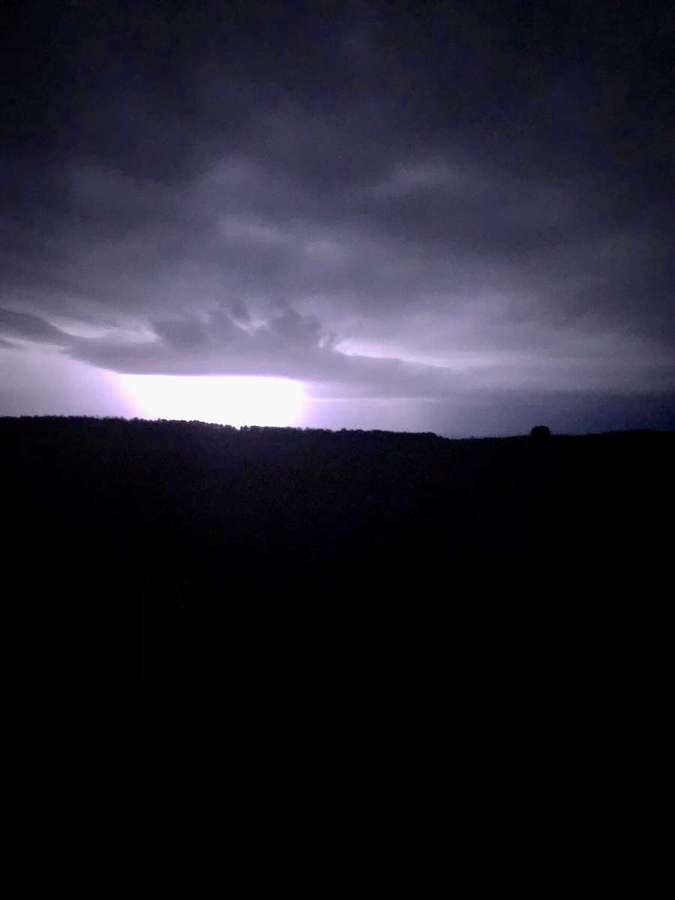
* Photos: cover, thunderstorm with lightning (CC0, Wikimedia Commons); body, road sign and winter scenery (public domain, Wikimedia Commons). Illustrative.
Frequently asked questions
What do the warning colours mean in Poland?
Yellow is degree 1, the lowest. Orange is degree 2. Red is degree 3, the highest, according to IMGW.
Does a warning mean it will storm in my town?
Not necessarily. IMGW says a warning gives the risk in the area, with probability at least at one point or its immediate vicinity, and covers whole counties on the map.
When does IMGW warn about heat?
When the air temperature reaches or exceeds 30 degrees for at least two consecutive days, according to its FAQ.
Where do I see current warnings?
On the IMGW weather service meteo.imgw.pl, which shows warnings by county.