Mountain rescue in Poland: call 985 or 601 100 300, the Ratunek app
Short answer: Call 985 or +48 601 100 300, or use the free Ratunek app, which sends your GPS position. Say where you are, what happened and how many are hurt, and do not hang up first.
If you have an accident in the Polish mountains, you can call mountain rescue on 985 or +48 601 100 300, or use the free app Ratunek. This guide sets out what the official mountain rescue sources say about how to call for help, what to say, the traditional distress signals, and some basic preparation. It draws on the Polish Voluntary Mountain Rescue Service (GOPR) and the Tatra National Park page for TOPR, the Tatra rescue service. The pages are undated, so the details are as of 17 October 2026. Save the numbers on your phone before you set off.
The numbers
The Tatra National Park page for the TOPR alarm number lists three numbers: +48 601 100 300, 985 and 112. It says that 112 is for notifying of threats to health and life, and from mobile phones it also works without a SIM card.
GOPR says that if you cannot install the app, you call 985 or 601 100 300 (+48 601 100 300). GOPR also advises storing the GOPR number 985 in your phone before a trip.
The Ratunek app
GOPR calls the free app Ratunek, for iOS and Android, the best way to call for help in the mountains today. Rescuers get the report of the accident with the exact location and your phone number. GOPR says this shortens the time to call for help because the rescuer does not have to ask more questions, and it helps if giving this information is hard or impossible for the injured person.
The Tatra National Park page says the app makes an automatic phone call to the rescue service (TOPR) and sends the GPS coordinates at the same time.
GOPR advises downloading it before you set off. It adds that in an emergency, if you have network coverage and can operate the phone, you can download and install it on the spot.
What to say on the phone
GOPR lists what you need to give when you call:
* the place of the incident * what happened * the condition of the injured person or persons * the number of injured people * the age and sex of the injured * your first and last name and a number to call you back
GOPR says never to be the first to end the call. After the rescuer has gathered the information, the rescuer decides when to end it.
GOPR also asks you not to abuse the rescuers' readiness. They will go out on every report of an accident or a missing person, and in that time they may be needed by someone else.
If there is no signal or the battery is flat
For those cases GOPR describes the generally accepted international distress signal in the mountains: a sound or light signal sent six times a minute, once every 10 seconds, followed by a minute's pause. A received signal is confirmed by the same method at half the frequency, three times a minute, about every 20 seconds.
GOPR says this works in higher areas where it can be seen or heard, such as the Tatras, Babia Góra, the Bieszczady and the Karkonosze. In forested areas the light signals will not be visible and the sound can be muffled by trees.
For a rescue helicopter team, raise both arms in the shape of a Y, for yes. GOPR warns not to use this signal without need, because raising your arms is a common greeting and it can make the pilot start a rescue even though the helicopter was on its way to a serious accident. If you do not need help from the air, raise your right arm and keep the left slightly down, like the letter N.
If you need help yourself
GOPR gives several rules, including these:
* call in the direction of the probable course of the trail or another well-used route * if you hear voices or see lights, repeat your calls or light signals * if you are in an exposed place, try to find a safe place to shelter while you wait, such as a rock ledge protected from falling stones * on a ski run or a trail, ask someone you meet to pass the information about the accident to a GOPR rescuer or the staff of a mountain hut, cable car or lift
Preparation
GOPR's tips for tourists include:
* take a fully charged phone with the emergency numbers stored, and download the Ratunek app * the maps on a smartphone designed for cities do not show trails or heights, so download an app with offline maps before you go * leave a message at your accommodation with your route and expected return time, and tell them if your plans change * trail colours do not show difficulty: a green trail can be harder than a black one * carry a headlamp, because a phone torch gives too little light and drains the battery, which you need to call for help * set out early, because the weather in the mountains usually turns in the early afternoon
The pages do not mention the cost of rescue or insurance. Ask your insurer, and check the rules of the area you plan to visit.
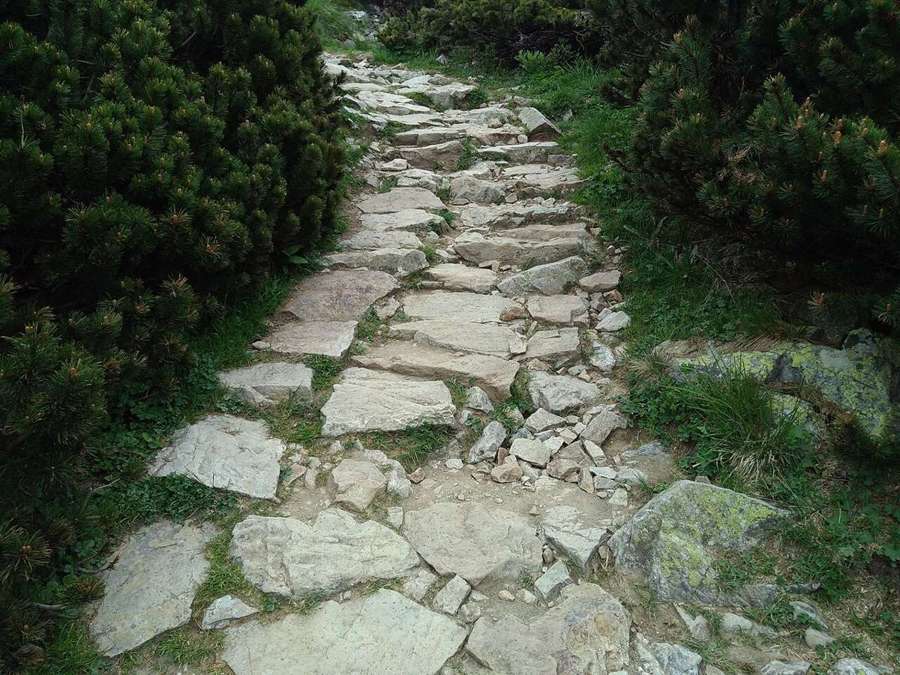
* Photos: cover, trail in the Tatra mountains (CC0, Wikimedia Commons); body, trail sign in the Tatras (public domain, Wikimedia Commons). Illustrative.
Frequently asked questions
What number do I call for mountain rescue in Poland?
985 or +48 601 100 300, according to GOPR and the Tatra National Park. The general number 112 also works.
Is there an app?
Yes, Ratunek, which is free. It calls the rescue service and sends your GPS coordinates, according to the Tatra National Park page.
What is the distress signal without a phone?
A sound or light signal six times a minute, then a minute of pause, according to GOPR.
Should I hang up first?
No. GOPR says never to end the call first. The rescuer decides when to end it.