Self-Service Laundries in Poland: Washing, Drying and Payment
The essentials: Check the branch rules and garment labels, choose a suitable machine, confirm detergent and the complete wash-and-dry cost, then match the machine number before paying. Follow the local instructions rather than assuming every laundromat works alike.
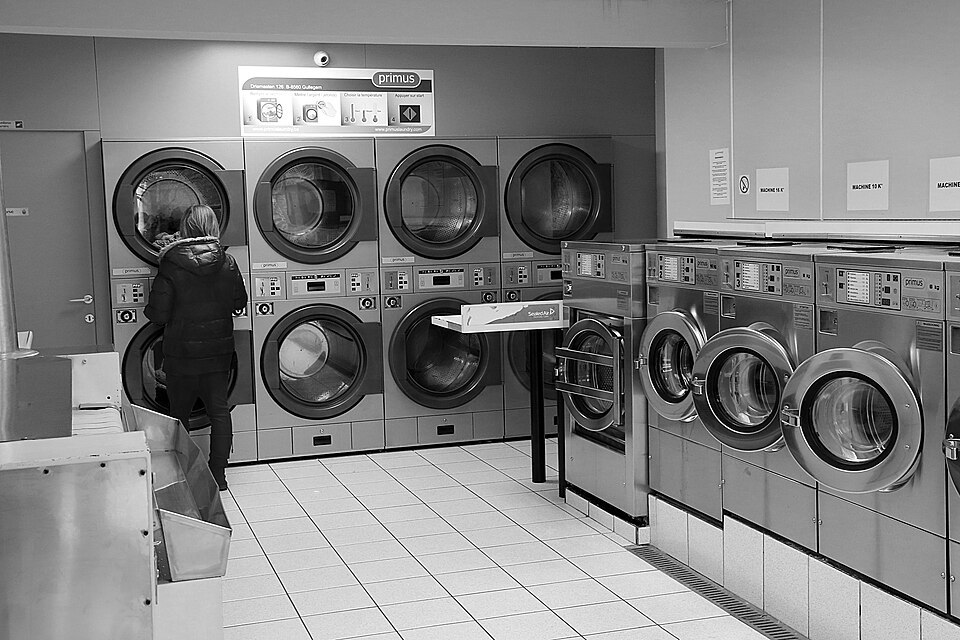
Illustrative historical laundromat in Mouscron, Belgium, March 2019, not a Polish branch. Jamain / Wikimedia Commons, CC BY-SA 4.0. Resized, same licence.
A suitcase of clothes after moving, a broken apartment washing machine or bedding that will not fit in a small drum can make a self-service laundry useful. In Polish, search for pralnia samoobsługowa. The important part is choosing the right machine and understanding what the payment buys before pressing Start.
This is a guide to washing and drying your own items, not handing garments to a dry cleaner. The operators checked on 27 October 2026 have different detergent, payment and pet-item rules. Treat the examples below as evidence of those differences, not as one national instruction sheet. Read the notice at the actual location and follow the garment's care label.
Find the right kind of laundry
A pralnia chemiczna is a dry-cleaning service; a pralnia samoobsługowa is a self-service laundry. Pranie means washing and suszenie means drying. Check that the listing really offers the service you need rather than assuming every business with 'pralnia' in its name has machines you can operate yourself.
Before carrying a heavy bag across town, check the branch's own opening hours, machine capacities, accepted items, payment methods and support contact. Do not infer that a chain's other location has the same equipment. The Warsaw-area operator sampranie.pl lists different hours and specialist-machine availability by address. Its FAQ also says the laundromats are unstaffed, with help available by telephone during opening hours.
If you need step-free access, somewhere to sit or a large folding surface, check those features directly. A photograph of several machines does not establish the entrance layout or whether a suitable machine will be free. For a first visit, leave enough time to read the controls and contact support rather than arriving with a load just before closing.
Sort at home and read the care labels
Empty pockets, check for loose objects and prepare fasteners according to the garment and operator instructions. Sampranie's preparation guide specifically warns against overloading and putting heavily soiled items containing materials such as mud, glue or plaster into ordinary machines. A public washer is not a route around the rules for contaminated or unsuitable textiles.
Sort items by compatible care requirements, not simply by what fits into one bag. GINETEX explains that the number in the wash-tub symbol is the maximum washing temperature, while bars beneath it indicate milder treatment. A garment marked against washing does not become machine-washable because the commercial drum is larger. Hand-wash instructions also need more thought than selecting an ordinary short cycle.
Washing and drying permissions are separate. GINETEX describes the circle inside a square as the tumble-drying symbol, with dots indicating the permitted thermal treatment. A crossed-out tumble-drying instruction must be respected. Do not assume that clothing washed at a particular temperature can automatically go into a dryer at that temperature. Ask a textile-care professional about an unclear label or valuable garment before experimenting.
Choose capacity without cramming the drum
Look for the machine's load limit and the local instructions for the particular programme. Bulky bedding can fill the available space before you reach a headline kilogram capacity. Sampranie advises leaving room for items to move and splitting garments with different care needs. Its general filling guidance is not a replacement for a delicate programme's lower load requirement.
A duvet, sleeping bag or padded coat needs both suitable care instructions and a machine that the operator accepts for that item. Check the filling and outer fabric guidance, plus whether suitable drying is available. It is better to ask before paying than to discover that a washed bulky item cannot be dried safely at that branch.
Do not treat the washer and dryer capacities as interchangeable. You may need to divide a washed load for drying, depending on the equipment and fabric. Leave room for movement according to the dryer instructions. Paying for a larger drum does not authorize prohibited items, and forcing the door against a tightly packed load is a sign to stop and reconsider the choice.
Check detergent before adding anything
This is one of the easiest points to get wrong. Sampranie says its wash price includes automatic detergent dosing and warns against adding your own powder, liquid or pods when the machine doses automatically. Its FAQ says standard washers include detergent and softener. Bringing a capsule is not useful if the selected machine is already adding product.
Other arrangements exist. The Chojnice operator's guidance permits customers to bring detergent and describes drawers and capsule use. The Kraków operator says its programmes 1 to 5 dispense detergent and softener automatically, while programmes 6 and 7 allow personal detergent. These are named-provider examples checked on 27 October 2026, not instructions for every Speed Queen-branded machine.
If you need to avoid a fragrance, softener or particular ingredient, contact the branch before travelling. Ask what the exact programme adds and whether dosing can be disabled. 'Detergent included' does not establish that a product suits your needs. Do not pour extra stain remover or bleach into an unfamiliar machine without checking both the garment label and the operator's rules.
Understand payment and match the machine number
Read the displayed price for your chosen machine and programme. Check whether drying is a separate purchase, whether detergent costs extra and what each drying time block buys. A wash price is not automatically the price for leaving with dry clothes. This guide gives no national rate because equipment, programmes and local tariffs differ.
Payment methods also vary. Sampranie lists cash, payment cards and BLIK, with app use limited to specified locations. The Kraków operator lists cash, contactless cards and its loyalty card. Do not assume a terminal accepts every card interface, denomination or foreign payment app. If cash is your backup, check the accepted coins and notes rather than taking one large banknote.
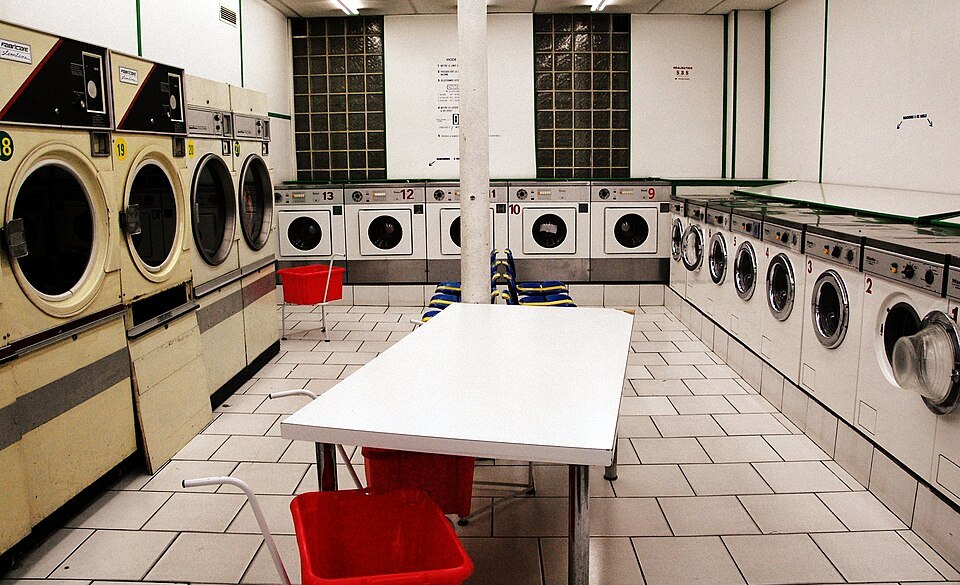
Before confirming payment at a central panel, match the selected number to the actual washer or dryer holding your clothes. Check the selected programme, temperature and amount. Follow the posted sequence: some systems require another press of Start on the machine after payment. Stay long enough to see that the intended cycle has started rather than walking out as soon as the terminal accepts money.
A loyalty card may involve an initial purchase as well as stored credit. Compare the whole cost with your likely use and ask where the balance works before loading money. A displayed discounted cycle price alone does not mean a prepaid card is the cheapest choice for a visitor doing one wash.
Plan the drying and collection time
Leave space in your schedule for waiting, loading, washing, moving items and drying. Sampranie quotes different washing durations by programme and offers drying in time blocks. The Kraków operator warns that one 15-minute drying cycle may not be enough for a full load. Neither example guarantees that your mixed load will finish within one advertised minimum.
Check the dryer setting against each item's label before starting. The Chojnice guide advises checking its machines' different preset temperatures and warns that metal garment parts can become hot. Follow the actual machine instructions for pausing or opening it; a feature described by one operator is not permission to force another dryer's door.
Arrange to collect promptly when the cycle ends. Sampranie says another customer may remove laundry left in a machine for a long time after completion. A locked washing cycle is not a staffed storage service or a guarantee of custody after unlocking. Keep valuables with you, set a reminder and check the drum and surrounding area before taking your bag home.
Pet bedding and cleaning cloths need a separate check
Do not put pet bedding into an ordinary washer merely because it fits. Sampranie permits pet items only in selected specialist machines at specified branches. The Chojnice operator forbids pet items and mops. Those different policies are a reason to ask the actual operator, not a contradiction you can settle by choosing whichever website answer you prefer.
Describe the item and its condition accurately when asking. The branch may distinguish ordinary clothing, pet textiles, cleaning cloths and heavily soiled workwear. Never try to defeat a restriction by hiding the item in a bag or using a quiet time. If no permitted machine is available, find a provider that explicitly accepts the item.
If payment or the machine fails
Use the support number displayed at the location. Record the branch, machine number, programme, time, amount and what happened. Keep the payment evidence and, where safe, photograph the screen or fault message. Do not repeatedly pay to test an unresponsive machine, force a locked door, open a service panel or attempt electrical repairs.
For a refund or damage complaint, explain the problem in writing and say what you are asking the business to do. Keep the care label, item-condition evidence and correspondence. Gov.pl's consumer-help guide directs private consumers dealing with businesses to advisers, local consumer ombudsmen and Trade Inspection. A failed cycle or damaged garment does not establish an automatic compensation amount; the facts and agreement matter.
Useful Polish for a first visit
Czy detergent jest w cenie? means 'Is detergent included in the price?' Czy mogę użyć własnego detergentu? asks whether you may use your own. For drying, Ile minut obejmuje ta cena? asks how many minutes the price includes. Show the machine number when asking about a payment rather than relying on 'the one on the left'.
For an unusual item, Czy można tu prać legowisko dla psa? asks whether dog bedding is allowed. If something fails, Zapłaciłem, ale pralka nie ruszyła means 'I paid, but the washing machine did not start.' The aim is a clear answer before a second payment, an unsuitable cycle or a load that cannot be dried.
Frequently asked questions
What is a self-service laundry called in Polish?
Search for pralnia samoobsługowa. Pranie means washing and suszenie means drying. Check that the business offers self-service machines, not only dry cleaning or drop-off work.
Should I bring detergent?
Check the exact branch and programme. Some operators include automatic detergent and softener; others allow personal detergent. Do not add products to automatic dosing without permission.
Can I wash pet bedding?
Only where the operator explicitly allows it in the appropriate machine. Some branches have specialist pet-item washers, while others forbid pet items altogether.
Does the wash price include drying?
Do not assume so. Check the washer price, separate dryer charge, time block and detergent arrangement before paying. Additional drying may be needed.
What if I paid but the machine did not start?
Confirm the posted start sequence, then contact the displayed support number with the branch, machine number, time and payment evidence. Do not repeatedly pay or force the machine open.
Sources
- Sampranie washing and dosing instructions, checked 27 October 2026
- Sampranie location-specific FAQ, checked 27 October 2026
- Speed Queen Kraków programmes and payment, checked 27 October 2026
- Chojnice self-service laundry guidance, checked 27 October 2026
- GINETEX care symbols under ISO 3758:2023, checked 27 October 2026
- Gov.pl consumer help, updated 13 January 2026, checked 27 October 2026