Nowogrod Museum in Winter: Guided Visits, Free Walks and 120 Steps
The essentials: Nowogrod’s Kurpie museum lists winter weekday hours of 08:00-16:00, with arranged guided visits Tuesday-Friday at 09:00, 11:00 and 13:00. Walking visits exclude interiors. Winter weekends are closed. The site has around 120 stone steps; a riverside entrance requires prior agreement.
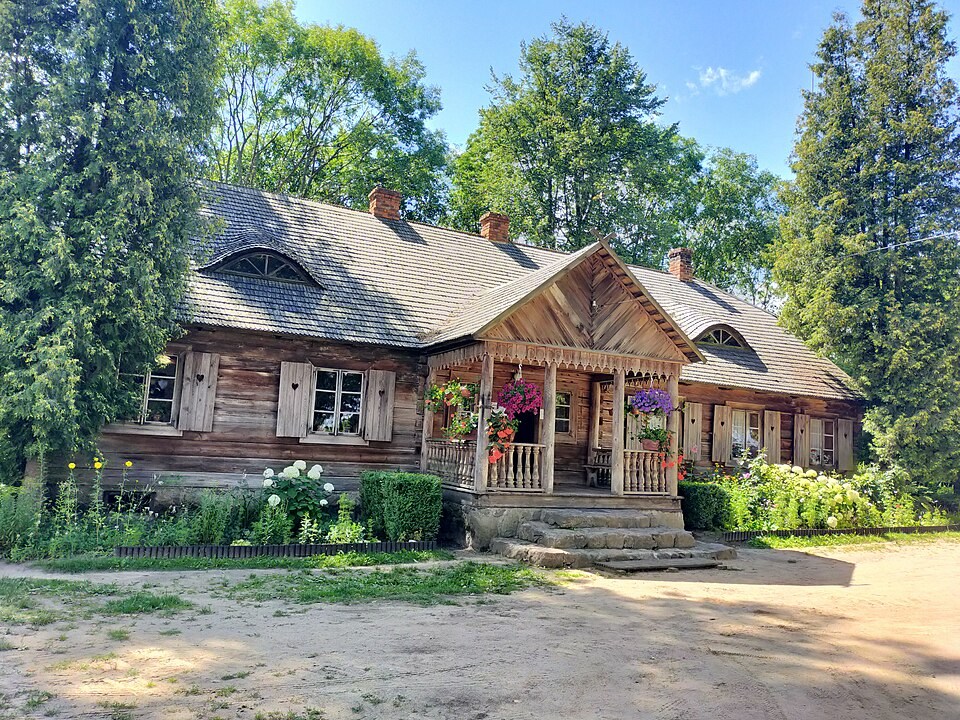
Cover: a wooden manor building at the museum, photographed on 2 August 2023. This archival summer image does not show current winter conditions or guarantee interior access. Photo: Natalia Lenda / Wikimedia Commons, CC BY-SA 4.0. Resized and recompressed under the same licence.
Choose the winter visit before choosing a ticket
The Kurpie open-air museum in Nowogrod is not a winter weekend drop-in attraction. Its current autumn-winter information lists weekday opening and a separate arrangement for guided visits. That matters if you want to enter historic buildings rather than simply walk through the grounds. Start with the type of visit, then arrange the day and ticket around it.
The winter visiting notice gives Monday-Friday hours of 08:00-16:00. Guided visits are available Tuesday-Friday, by prior arrangement on +48 884 541 247. The listed sessions are 09:00-10:30, 11:00-12:30 and 13:00-14:30. They last about an hour and a half. Do not turn the general rule about tours starting on full hours into a promise of a guide at every winter hour.
A walking visit is different. The museum says it is independent, without a guide, and excludes entry to historic interiors. If furnishings, craft equipment or a particular room are your main interest, a grounds-only visit is not a substitute for arranging the guided option. Ask which buildings the agreed tour will include and whether the language works for your party.
Weekday opening does not remove the booking step
The opening-hours page defines the tourist season as running from the Saturday before Palm Sunday to 31 October. It says out-of-season visits are possible after prior telephone arrangements. Read that alongside the winter notice rather than assuming the weekday hours guarantee an unannounced visit of any kind.
Call before travelling, even if you only want the outdoor route. For guided visits, agree one of the published sessions rather than arriving at the ticket desk expecting staff to create a tour. For groups, the rules are especially clear: an email is not itself a reservation. The booking becomes valid only after a museum employee confirms it by telephone or email.
Winter weekends and public holidays are closed under the published timetable. The rules also list specific closure dates, including 24, 25 and 26 December, as well as 1 and 6 January. Do not interpret the weekday pattern as overriding those exceptions. A trip around Christmas needs a check against both the regular schedule and any newer museum notice.
Free walking days and the admission tariff
The current ticket page lists November free-entry dates of 2, 9, 16, 23 and 30 November. The remaining date at the time of this guide is Monday 30 November 2026. The contact page describes Monday access as a free park walk without opening interiors, and the winter notice says the weekly free day has no guided service. It is therefore the wrong choice if you are relying on indoor visits.
That November list is not a December calendar. Check the ticket page again for a later trip rather than carrying a month-specific announcement forward. Free entry also does not mean admission outside opening hours or an exception to the museum's visitor rules.
The tariff lists general admission at PLN 15 standard and PLN 12 reduced. Individual admission with a guide is PLN 25 standard or PLN 20 reduced. Organised groups of at least ten have listed guided rates of PLN 21 standard or PLN 18 reduced per person. These are different ticket categories, not an extra flat guide charge to add automatically to every individual ticket.
The winter notice uses the term walking ticket, while the tariff does not clearly attach that label to its PLN 15 and PLN 12 entries. Confirm the applicable charge when arranging a paid walk rather than treating the terminology as settled. The ticket desk closes one hour before the museum, which means 15:00 under the weekday winter hours. That is not a promise of an additional guided session after the last published 13:00 start.
The stairs are part of the planning, not a minor detail
Nowogrod's setting is one reason to visit, but also one reason not to promise easy access. The museum stands on a high bank above the Narew, opposite the mouth of the Pisa. Its access declaration, updated on 25 March 2026, describes roughly 120 stone steps between the upper entrance area and the lower part of the site.
There is an alternative riverside entrance for people with disabilities, by prior agreement. It can bypass the long stone descent, but it does not make every path and building accessible. The museum describes uneven terrain, buildings on slopes, wooden thresholds, steps of different heights and no lifts or stair platforms. Ask for a route matched to your needs, not simply whether the museum is accessible in general.
The toilet needs special attention. It is in the upper part, beneath the terrace of the manor from Brzozki, and the declaration says it is not adapted for disabled visitors. Three steps, a narrow door and a wooden threshold are listed barriers. Someone using the lower entrance cannot assume an accessible toilet will be waiting near the lower route.
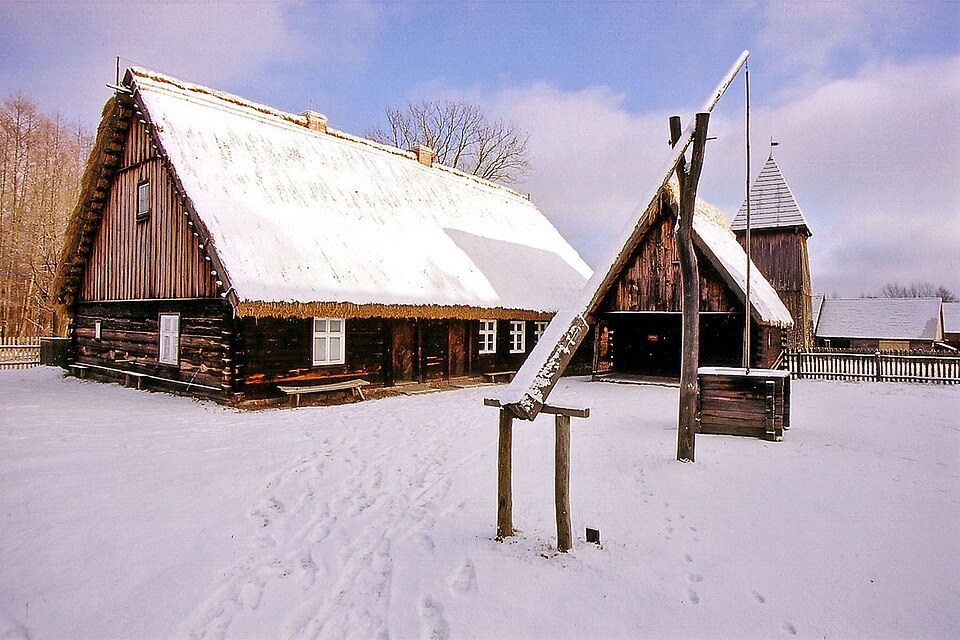
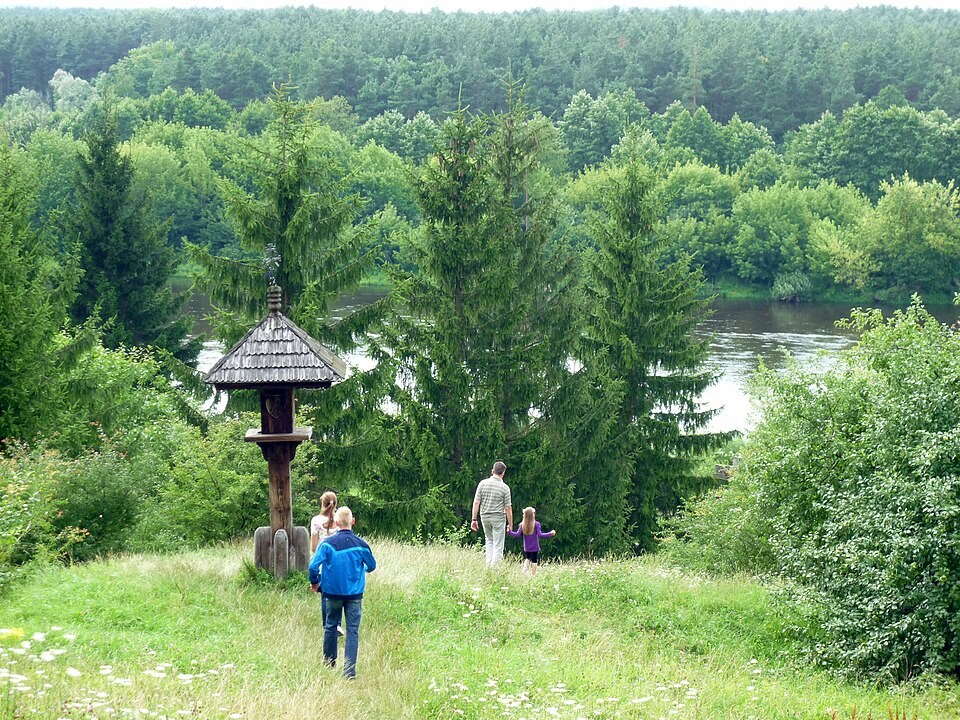
Parking is on ul. Zamkowa, opposite the museum across the road. The main entrance leads towards the manor housing the ticket desk and shop. Discuss the meeting point when arranging an assisted arrival, especially if you need the riverside entrance, a shorter walk or help avoiding the long staircase. A photograph of green summer paths does not show winter footing.
Read the park as a collection, not an intact old village
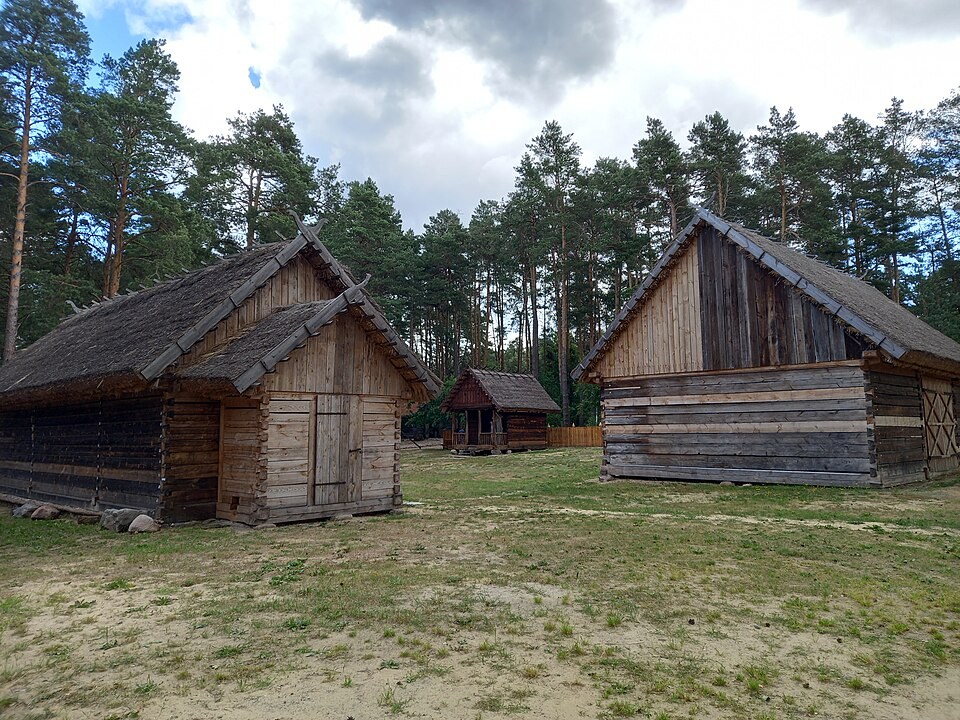
The museum's introduction describes about 3.5 hectares with 23 residential and agricultural buildings, alongside smaller structures such as wells, shrines and beekeeping objects. Its history explains that the park presents traditional wooden architecture rather than reproducing the exact spatial layout of a Kurpie village. The compact arrangement reflects the land available on the riverbank.
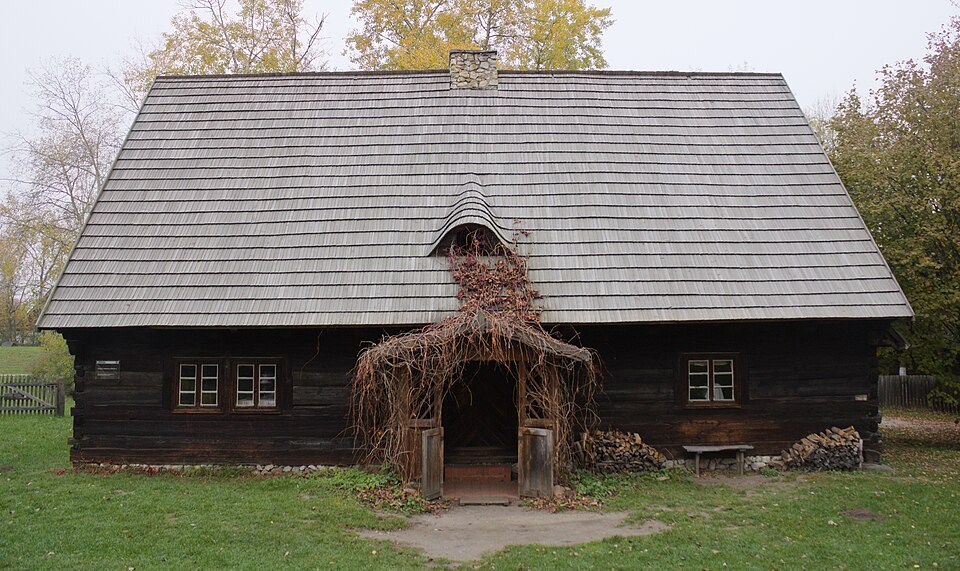
That distinction is useful when looking at the different farmsteads. A group of buildings can explain household work and regional construction without every structure having stood beside its neighbour in its original village. Some are moved historic buildings and others are reconstructions. Look for the museum's labels rather than treating all timber as the same age.
The collection includes a reconstructed farmstead from Kadzidlo. That is not the same place as Zagroda Kurpiowska in the town of Kadzidlo. For this visit, the destination is ul. Zamkowa 25, 18-414 Nowogrod. Use the Nowogrod contact details when arranging your visit, not another museum's booking number.
Three subjects worth looking for on the agreed route
Beekeeping is one of the strongest themes. The museum's history identifies two sections of bee trees among the few objects that survived the wartime destruction of the original museum. They connect the rebuilt park to its pre-war collection. The surrounding log hives help explain the relationship between forest beekeeping and hives kept nearer a household.
Grain storage is another useful subject. The museum route description explains how granaries stood on stones or mushroom-shaped supports to protect stored produce from rodents. Look at what separates a store from the ground and how the entrance is sheltered. These exterior details can make sense even on a walking visit that excludes interiors.
For a guided visit, ask about the cottage from Baranowo. The museum dates the building to 1805 but describes its furnishings as representing the 1960s. The age of a house and the period shown inside it are not necessarily the same. That makes it a useful counterpoint to an assumption that every open-air museum room depicts only the nineteenth century.
Not every named building is a visitor interior
The route description identifies the cottage from Lysy near the entrance as a caretaker's building that is not open for visiting. That is a useful warning against counting every building on a map as an interior included in your ticket. On a winter guided visit, staff should explain which rooms are available on the agreed route.
The park also includes a small windmill from Plewki, a watermill from Dobry Las and an oil mill from Witowy Most. Their presence is not a promise of working machinery or demonstrations that day. Likewise, the reconstructed Dylewo inn is described in connection with seasonal traditional-food workshops. Do not rely on it as a normal winter restaurant without a separate confirmation.
The museum opened as a public institution on 19 June 1927 under Adam Chetnik, and was rebuilt after wartime destruction. Knowing that history helps explain why originals, reconstructions and later displays sit together. It also gives a guided visit a clearer purpose than simply trying to enter the largest possible number of buildings.
Workshops, dogs and the final call before leaving
The education offer includes bread-figure baking, regional biscuits, paper flowers, cutouts and beekeeping activities. These are group arrangements, not guaranteed additions to an ordinary walk. The outdoor washboard-laundry workshop is explicitly offered only through the end of September and depends on weather. It should not be advertised as a winter activity.
For a workshop, ask about participant numbers, language, total price and the programme actually available on your date. The published offer gives a minimum of ten for organised groups and workshop limits of about 25-30. Food activities also need a separate conversation about ingredients if anyone in the group has dietary restrictions.
Dogs must be on leads under the visitor rules; assistance and guide dogs are expressly covered in the access declaration. Professional photography, filming and drones require permission. Before setting out, confirm the visit, meeting point and route. With those details settled, Nowogrod can be a worthwhile winter visit without treating a free walk, a guided interior tour and a workshop as interchangeable tickets.
Frequently asked questions
Can I visit on a winter weekend?
The published timetable closes the museum on out-of-season weekends and holidays. Arrange a weekday visit in advance.
Does a free walking day include historic interiors?
No. The winter notice excludes interiors from walking visits and says no guiding takes place on the free walking day.
Does the riverside entrance make the whole museum step-free?
No. It can avoid the long stone staircase by prior agreement, but the site still has slopes, thresholds and steps. The published toilet is not adapted.
Sources
- Museum: winter visiting arrangements and guided sessions
- Museum: tickets, free dates and visitor rules
- Museum: season and advance arrangements
- Museum: booking contacts and Monday walking access
- Museum: March 2026 access declaration
- Museum: collection overview
- Museum: history and surviving objects
- Museum: building route and interior limitations
- Museum: workshops and seasonal restrictions