Rehabilitation tax relief in Poland 2026: what you can deduct
Short answer: Taxpayers with a disability, or who support someone with one, deduct rehabilitation costs in PIT. Car and some other items are capped at 2,280 zł a year; medicines count above 100 zł a month.
The rehabilitation relief (ulga rehabilitacyjna) lets a taxpayer with a disability, or one who supports a person with a disability, deduct certain costs from taxable income in the Polish annual tax return. This guide follows the tax authority's service page podatki.gov.pl, published on 15 December 2025 and updated on 13 October 2026, as read on 18 October 2026. It does not give tax advice for your case.
Who can use it
You can use the relief if you are a person with a disability, or support one, and you paid for rehabilitation or for things that make daily life easier. You need a document showing the costs and one document showing the disability. The page accepts a certificate placing you in one of the three degrees of disability, a decision granting a disability pension (total or partial inability to work, training or social pension), a certificate for a person under 16, or an older certificate valid until 31 August 1997. Being a retiree or pensioner alone does not qualify.
A supported person is a spouse, or a close relative in the first tax group (descendants, ancestors, stepchild, son- or daughter-in-law, siblings, stepparents, parents-in-law), or a foster child taken in by you or your spouse. Their yearly income cannot exceed 23,741.88 zł in 2026. Alimony for children, the care allowance and several other listed benefits do not count toward that limit.
Costs with no limit
According to the page, you can deduct the whole amount paid for:
* adapting a home or building to the needs that come from the disability, and adapting a motor vehicle, * buying, repairing or renting medical devices from the official reimbursement list, with the equipment needed to use them (not incontinence products), * individual equipment and tools needed in rehabilitation and for daily living that are not on that list, except household appliances, * training publications and materials, * a rehabilitation stay, a stay in a spa treatment facility, a rehabilitation or care facility, * rehabilitation and treatment procedures, including private ones that nobody reimbursed, * home nursing care in a chronic illness, and care services for people in the first disability group, * a sign-language interpreter, * camps for disabled children and young people, and for children of disabled people up to 25, * paid transport by ambulance, and in some cases by other transport, and public transport costs tied to a stay.
Costs with a limit
* Medicines that a specialist doctor says the person should take: you deduct the monthly spending above 100 zł. The page gives an example. With spending of 90, 120, 170 and 245 zł in four months you deduct 0 + 20 + 70 + 145 = 235 zł. It also says you can deduct all medicines the specialist recommended, even those unrelated to the disability. * Incontinence products: up to 2,280 zł a year. * Guides for blind people in the first or second group and for people with a movement disability in the first group: up to 2,280 zł. * Keeping an assistance dog: up to 2,280 zł. * Using a passenger car owned by the person with the disability, or by the taxpayer who supports a disabled person or a disabled child under 16: up to 2,280 zł a year. Fuel, repairs, tyres and insurance count, and you do not need to document this item. There is one limit even if you are disabled and also support someone disabled.
The list of costs is closed, so only the items named in the income tax act qualify.
What you cannot deduct
Costs paid from the company rehabilitation fund, the State Fund for the Rehabilitation of Disabled People (PFRON), the National Health Fund (NFZ) or the company social benefits fund cannot be deducted. Neither can any part that was refunded to you in any form. If a cost was partly subsidised, you deduct only the part you paid yourself.
Documents and foreign costs
You prove costs with an invoice, a receipt, a postal payment slip or a bank transfer confirmation that shows who paid, when, to whom, how much and for what. The tax office can ask you to confirm any cost, even those that need no document. You can also deduct costs paid abroad. Convert a foreign currency cost with the average NBP rate from the last working day before the day of the cost.
How to claim
Report the relief in the PIT-36, PIT-37 or PIT-28 return and attach the PIT/O form. If you earn income from a business, rent or lease, you can already deduct it during the year when calculating advance payments. You deduct it from income taxed by the tax scale or from revenue taxed by lump sum. If your income is too low to use the whole amount, the unused part cannot be carried to later years.
The page does not address foreigners separately. Check your own tax residence and filing duty before you rely on it.
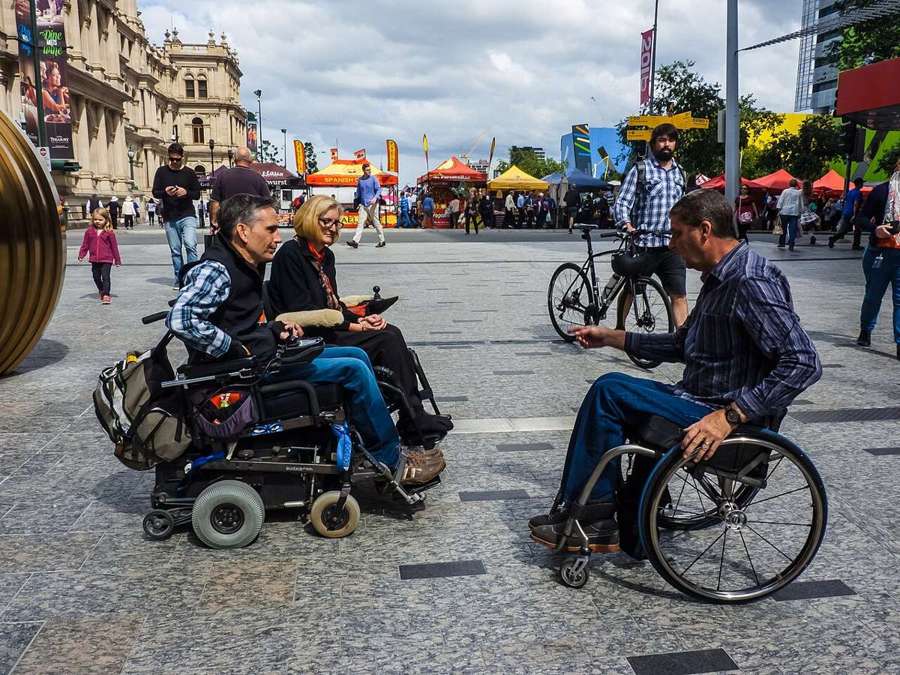
* Photos: people using wheelchairs in a city street, Wikimedia Commons (CC0); stethoscope, Wikimedia Commons (CC0).
Frequently asked questions
What is the yearly limit for the car costs under the relief?
2,280 zł a year, according to podatki.gov.pl as of 13 October 2026. It is one limit per taxpayer, and it does not double if you are disabled and support another disabled person.
Can I deduct private rehabilitation sessions?
Yes, if nobody reimbursed or subsidised the cost, and you can document it.
Can both parents use the relief for a disabled child?
Yes. Each parent can deduct what they actually paid, and each has their own limit for the limited items.
Can I carry an unused deduction to next year?
No. If your income is too low to use it all, the rest is lost.