Salt Labels in Poland: Iodised, Non-Iodised and Seasoned
The essentials: Read iodisation, grain size and mixture ingredients separately. The current Polish rule concerns salt intended for direct human consumption and contains a defined cross-border fortified-food scope exception. The actual packet still matters.
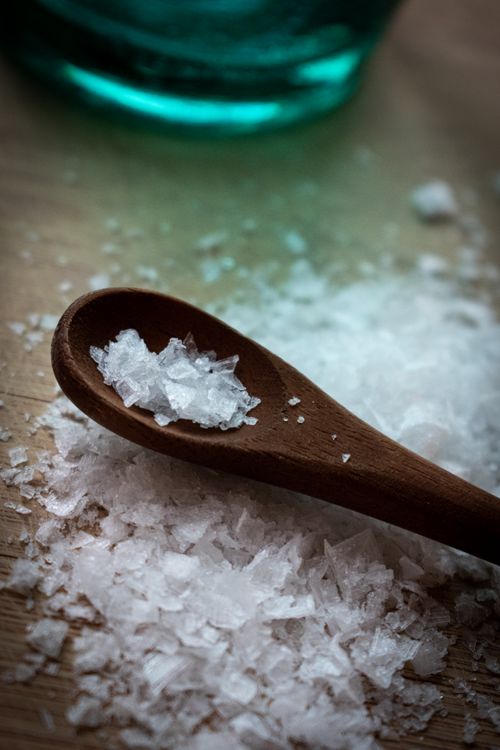
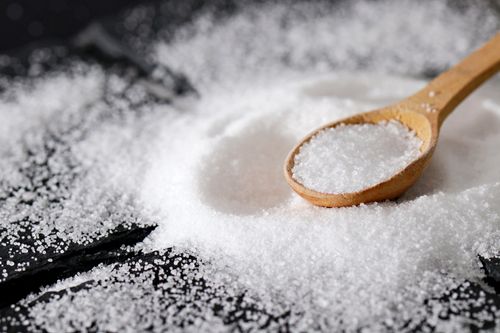
Cover: Maria Petersson, source photograph, Pexels License. Image unchanged. Salt crystals on a spoon. General context; the photograph cannot establish iodisation or product origin.
A Polish salt shelf can combine several kinds of information on one packet: kamienna or morska, jodowana or niejodowana, fine or coarse grains, and sometimes herbs or other ingredients. These words answer different questions. Rock salt is not automatically non-iodised, and a seasoned product is not necessarily just ordinary salt with a decorative name.
This guide explains food labels, not how much salt or iodine you should consume. It gives no thyroid, deficiency, supplement or dietary advice. Current Polish fortification law supplies the legal background; producer pages supply examples of their own products. The photos illustrate salt crystals, not a verified origin, iodine content or Polish product.
Read the whole product identity
Sól is salt. Look for the food's full name and description before focusing on one prominent adjective. A name can tell you about origin or production category, added iodine, grain size or an ingredient mixture. One word rarely settles all of those matters.
For example, kamienna describes rock salt and morska sea salt. Neither word alone tells you whether iodine has been added. The distinction between jodowana and niejodowana needs its own check, just as drobnoziarnista and gruboziarnista describe a different feature again.
Do not assume the packet's colour supplies the missing information. A pink product, a white product and a picture of a salt mine are visual cues, not substitutes for the actual food name and composition. Read the text when a particular feature matters to your purchase.
Understand jodowana and niejodowana
Jodowana means iodised, while niejodowana identifies a non-iodised product. These terms concern added iodine and should not be confused with whether a salt is fine, coarse, rock or sea salt. Several descriptions can properly appear together on the same product.
Kłodawa's producer range illustrates this clearly: it lists iodised food-grade rock salt as well as non-iodised rock-salt products, including a product described for preserves. Those examples establish that the producer offers differently described products. They do not establish a universal reason for every non-iodised salt on the market.
For shopping, preserve the exact adjective rather than buying from memory of the brand alone. If your previous purchase was jodowana, a similar-looking packet marked niejodowana is not the same label choice. This guide does not tell you which of the two is personally appropriate.
Use the current fortification rule, not an old explainer
Poland's current regulation on substances added to enrich food is dated 13 March 2024. Its official record marks it as in force, and its text explicitly repeals the 2010 regulation. An older article quoting the earlier rule should not be presented as the current legal text without checking that change.
The 2024 rule identifies salt intended for direct human consumption and requires potassium iodide or potassium iodate at the stated levels. The direct-consumption wording matters. It should not be shortened into a claim that every form of salt used anywhere in food production must be iodised.
Equally, the rule should not be turned into a shopping claim that every salt packet available in Poland is necessarily iodised. The actual product identity, its intended category and the law's scope still matter. Read the packet rather than treating a national summary as an ingredient declaration.
Keep iodine and its added compound in different units
The regulation expresses the required level as iodine per 100 grams of table salt and gives corresponding amounts of potassium iodide or potassium iodate per kilogram. These are related expressions, but they are not identical substances or identical mass bases.
Its stated level is 2.3, with a tolerance of 0.77, milligrams of iodine per 100 grams of table salt. The corresponding figures are 30, with a tolerance of 10, milligrams of potassium iodide per kilogram, or 39, with a tolerance of 13, milligrams of potassium iodate per kilogram.
A reader should not compare the iodine number directly with the compound number and conclude that one product has mysteriously changed strength. Check both the substance and the unit. These legal composition figures are not serving suggestions, supplement doses or instructions to increase your salt consumption.
Recognise both named iodine compounds without ranking them
Jodek potasu means potassium iodide, and jodan potasu means potassium iodate. Both appear in the current Polish fortification provision. Their names can help you understand the composition declaration without having to interpret a marketing argument about which formulation is superior.
Kłodawa's own product example lists potassium iodide and gives a corresponding specification. That is product evidence, not independent clinical proof. A manufacturer's claims about absorption, thyroid support, purity or advantages over another iodine compound are not adopted by this guide.
If a medical question makes the compound important to you, use qualified individual advice and the actual product information. A label guide cannot decide that question from a brand's promotional language. Its narrower job is to help you recognise the words and avoid mixing up their units.
Preserve the cross-border scope exception accurately
The 2024 regulation contains a scope provision for enriched foods marketed in Poland that are in circulation in other EU member states or in EFTA states that are parties to the European Economic Area agreement. That wording should be kept with its actual fortified-food scope.
It is not a blanket statement that anything imported may ignore Polish or EU food law. Nor should it be casually rewritten as every non-iodised salt is exempt because it might come from abroad. Establishing an individual product's legal position can require more than a front-label photograph.
For ordinary shopping, this means the law explains the framework without replacing the label. If a product's description is unclear, ask a precise question about that item. Do not decide that a packet is unlawful merely because it differs from the first salt product you saw.
Separate grain size from composition
Drobnoziarnista means fine-grained, while gruboziarnista means coarse-grained. The producer's range includes both grain descriptions. They help you select the form you intended, but they do not establish whether iodine or an anti-caking ingredient is present.
Keep those questions separate when replacing a packet. A coarse non-iodised product and a fine iodised product differ in more than appearance. Reading all the descriptors avoids accidentally treating the grain-size word as a shorthand for the whole product.
If you are buying for a refillable grinder or another piece of equipment, follow that item's actual compatibility instructions as well. This guide does not promise that every coarse salt works in every mill, or that a product's name supplies the missing appliance requirements.
Check anti-caking information without making safety claims
Bez antyzbrylacza means without an anti-caking agent. Kłodawa uses that description on its iodised example. The example is useful because it shows that an iodised product can also be described as without anti-caking agents; the two features are not opposites.
Read an actual ingredients or composition statement where provided. Do not treat the presence of a recognised food-additive name as proof that a product is unsafe, or the absence of an anti-caking ingredient as an independent certificate of superior health or purity.
A technical ingredient claim should stay a technical ingredient claim. This guide does not assess the chemistry of additives, validate a producer's environmental-purity claims, or infer contamination from the salt's colour. If those issues matter, they need evidence beyond a general shelf explanation.
Treat seasoned salt as its own mixture
Sól ziołowa identifies herb or seasoned salt. Kamis provides an example in its seasoning range, but the mixture's exact composition must be read from the actual pack. Do not assume the product is simply a packet of single-ingredient salt because sól is the first word you recognise.
Other ingredients can be central to the choice, particularly where an allergy or intolerance is involved. Inspect the current label's ingredient and allergen information rather than assuming every herb-salt mixture uses the same herbs, proportions or manufacturing precautions.
This guide intentionally does not quote a fixed percentage for the Kamis example: available descriptions can differ, and an online paragraph is not a substitute for the bottle or packet supplied to you. The useful lesson is to read the actual mixture, not memorise a recipe as if it were a national standard.
Compare the food identity before a packet's marketing
Terms about local origin, natural character or a particular colour can be meaningful parts of a product's presentation, but they do not answer every composition question. A producer may combine origin information with iodisation, grain-size and additive descriptions. Read each on its own terms.
For a simple shopping record, note the full name, whether it is iodised, its grain size and whether it is a seasoning mixture. That makes the next purchase easier without treating a familiar logo as a guarantee that every product in the range is identical.
Follow the supplied storage instructions too. Kłodawa's cited iodised example specifies a closed container and a dry place protected from sunlight. That is the product's own advice, not a universal opened-packet lifetime invented for every salt or herb mixture.
The practical outcome is a correctly identified food purchase. Read the legal and product names, keep iodine compounds and units straight, and check mixtures separately. You can understand the shelf without turning fortification rules or a supplier's promotional claims into personal dietary advice.
Frequently asked questions
Does rock salt automatically mean non-iodised?
No. Kłodawa lists iodised and non-iodised rock-salt products. Read the actual packet.
Are potassium iodide and potassium iodate the same label amount?
No. The rule gives distinct compound amounts corresponding to its iodine level. Compare the substance and unit, not only the number.