Selling a Flat in Poland: PIT-39, the 5-Year Rule and 19% Tax
Short answer: Sell within five years of the end of the acquisition year and you file PIT-39 (15 Feb to 30 Apr) and pay 19% on income, unless spent on own housing within 3 years.
Selling a flat or house in Poland can trigger income tax, but not always. Whether you owe anything depends mainly on one date: when the property was acquired. This guide follows the Polish tax administration page on selling real estate (podatki.gov.pl, published 15 December 2025 and updated 19 August 2026), as read on 19 October 2026.
The five-year rule
Income from a sale is taxed if you sell within five years, counted from the end of the calendar year in which you bought or built the property. The count starts on 31 December of the purchase year, not on the day of the purchase. The tax office gives this example: a property bought in February 2020 requires a return if sold by 31 December 2025, and from 1 January 2026 a sale no longer does.
For inherited property the five years are counted from the end of the year in which the deceased person acquired it, not from the date you inherited it. The rule does not apply when the sale is part of a business, which is taxed differently.
After five years there is no personal income tax on the sale and no return to file. Within five years the return is mandatory, even if you made a loss.
How the income is calculated
Tax is charged on income, which is revenue minus costs. Revenue is the price in the sale contract, reduced by the costs of the sale itself, such as notary fees and an agent's commission. If the price is significantly below market value, the tax office can use market value instead.
Costs you can deduct are the documented purchase or construction costs, and documented spending that raised the value of the property, such as renovation backed by VAT invoices. For inherited or gifted property the tax office lists the tax paid on the acquisition, the deceased person's costs and the burdens on the estate, in proportion. Keep every contract and invoice, because only documented costs count.
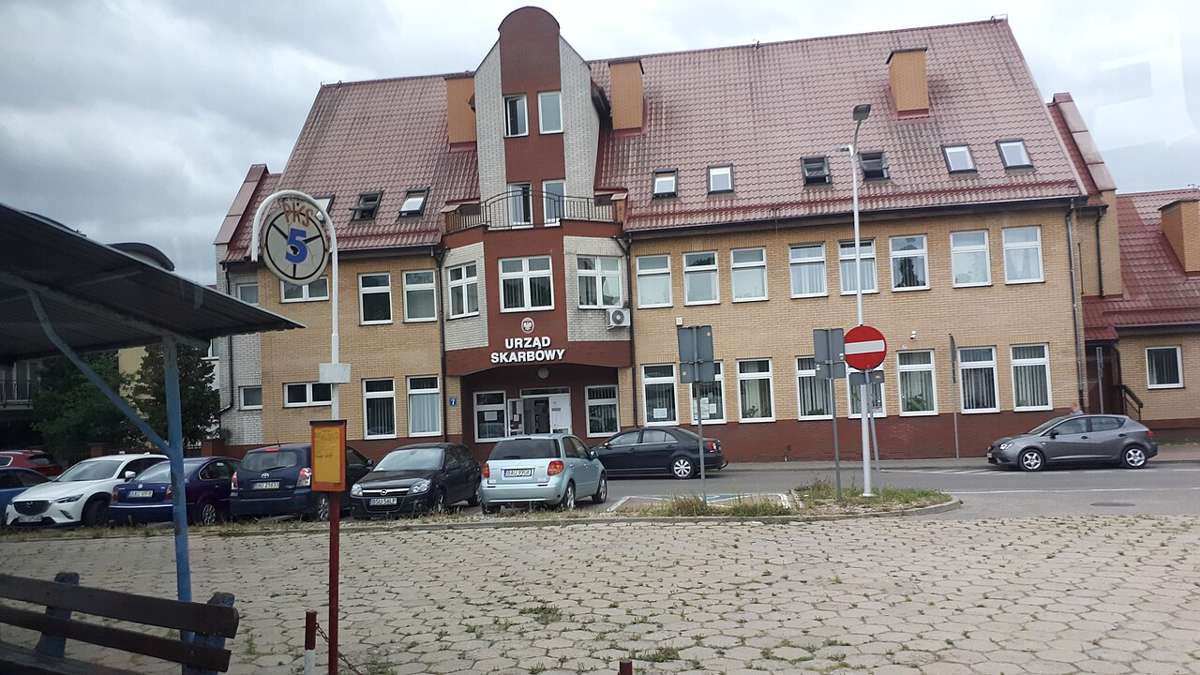
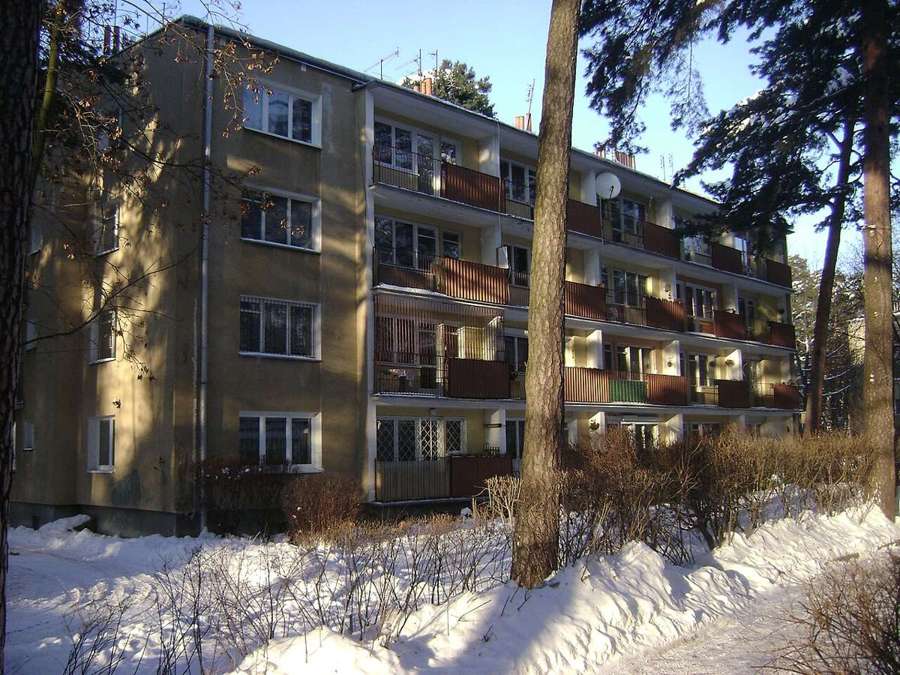
* Photos: apartment block in Konstancin-Jeziorna, public domain, via Wikimedia Commons; tax office in Augustów, CC0, via Wikimedia Commons.
The rate and the form
The tax rate is 19% of the income. If your costs are higher than the revenue, there is a loss and you pay no tax, but you still file the return when the sale falls inside the five-year window.
The form is PIT-39. You file it between 15 February and 30 April of the year after the sale, through the e-US app, e-Deklaracje or on paper. The tax office treats the end of the filing period as the payment deadline, and interest runs from the next day.
The housing-purposes exemption
Income is exempt to the extent you spend the sale revenue on your own housing purposes. You have until three years from the end of the tax year of the sale to spend it. Qualifying spending includes:
buying a house, a flat or a share in one, buying land for a home, building, converting or renovating your own home, and repaying a bank loan taken for your own housing needs. Repaying the loan used to buy the property you sold also counts.
The housing can be in Poland or in another EU or EEA state or in Switzerland, provided the Polish tax office can obtain tax information from that country under international agreements.
If you spend only part of the revenue, the exempt income is income multiplied by housing spending, divided by revenue. The tax office's example: revenue 200,000 zł, costs 150,000 zł, so income is 50,000 zł. With 180,000 zł spent on housing, exempt income is 45,000 zł, and tax is 19% of the remaining 5,000 zł.
If you claimed the exemption but did not spend the money in time, or spent it on something that does not qualify, you must correct the PIT-39 and pay the tax with late-payment interest.
What it means for expats
The page does not set separate rules for foreigners. Residency and double-tax treaties can affect who taxes the income, and those cases are outside this article. If you are unsure, ask a tax adviser before signing the sale contract. Buyers pay their own taxes, see the guides on PCC tax and notary fees when buying a flat, and on inheritance and gift tax for property received from family.
Frequently asked questions
Do I pay tax if I sell a flat after five years?
No. According to the tax office, once five years have passed from the end of the year of acquisition, the sale is not subject to personal income tax and no return is needed.
I sold at a loss. Do I still file PIT-39?
Yes, if the sale is within the five-year window. A loss means no tax, but the return is still required.
When is PIT-39 due?
Between 15 February and 30 April of the year after the sale.
Can I avoid the tax by buying another home?
Spending the revenue on your own housing purposes within three years from the end of the sale year makes the matching part of the income exempt.