Stock Products in Poland: Cubes, Jars and Dilution
The essentials: Bulion can be a concentrated seasoning base rather than a ready bowl of soup. Match the exact cube or jar to the recipe, distinguish concentrate from prepared liquid and use the selected product's own dilution directions.

Cover: Kaboompics, source photograph, Pexels License. Resized and JPEG-compressed. Wrapped stock cubes on a light counter. Illustrative format context, not a cited Winiary or Knorr product or verified formula.
A Polish shelf labelled bulion can contain cubes, a concentrated jar product or another seasoning base intended to be mixed into a dish. The word does not tell you whether the contents are ready to pour into a bowl, how much water to add or whether a spoonful equals a cube. Those decisions belong to the actual product and the recipe you are following.
The useful comparison starts with format, formulation and directions. Winiary's Polish pages show a chicken stock cube alongside chicken and vegetable jar products; Knorr's Polish brand page provides another vegetable cube example. These are concrete buying references, not a test of which tastes most homemade. Keep the complete product name and size when you repeat a purchase or compare a shop's suggested substitute.
Kostka means a cube, not a universal unit of stock
Winiary's Rosół drobiowy page describes a stock cube used to support the flavour of soups. Its ingredient list starts with salt, flavour enhancers, palm oil and potato starch. Further ingredients include flavourings, sugar, poultry fat 1%, spices, parsley leaf, dried onion and carrot, citric acid, dried chicken meat 0.1% and rosemary extract as an antioxidant. This is the actual cited cube's formulation, not a recipe for liquid chicken broth.
The chicken name therefore does not mean the cube consists mainly of chicken meat. It identifies the product's flavour and stated use, while the list explains what is in this particular example. If you want to compare it with a concentrated chicken jar, read both descriptions rather than assuming they are the same mixture pressed into different shapes. Equally, a cube's appearance cannot establish its ingredient percentages.
This article does not assign an invented water quantity to the Winiary cube where the cited product text does not supply a complete preparation ratio. Read the current packet for that operational detail. A shopping guide is more useful when it identifies a missing instruction than when it borrows a familiar number from another brand and presents it as though it came from the selected product.
Vegetable cubes also have a specific formulation
Knorr's Polish Bulion Warzywny 3l brand page lists salt, vegetable fat described as palm, shea and sal, flavour enhancers, starch, sugar, onion 4.4%, carrot 1.5%, garlic 1.3%, parsley leaf 1.3% and other vegetables, herbs and seasonings. The page separately states vegetables 7%. Keep that stated total and the named ingredient percentages as the producer presents them rather than adding every number into a new total.
The same page describes placing a cube in hot water, optionally crumbling it to dissolve faster, then cooking briefly over low heat while stirring. It suggests the resulting stock for soups, sauces and dishes based on rice, groats or pasta. Those are product-use descriptions, not a universal cooking instruction for the whole dish. Rice or meat in a recipe still needs its own preparation method.
A retailer listing for Knorr vegetable stock 60 g, six 10 g cubes, explicitly gives one cube in 0.5 litre of boiling water. That ratio is retailer-transcribed packet information for its listed item, not a figure supplied in the cited brand page's preparation steps. The retailer also carries a different ingredient list from the brand page. Do not merge the retailer's formula and the brand page's percentages into a supposedly verified single current recipe.
A jar of concentrate is not a finished bowl of soup
Winiary's Bulion drobiowy 160 g jar page describes a thick, semi-liquid product. Its full-stock directions are three tablespoons, identified as 45 g, into one litre of boiling water, followed by mixing and bringing it back to the boil. The producer says a jar makes 3.5 litres of stock. These are the maker's directions and yield statement for this named household product, not this guide's calculation.
The same page suggests a smaller amount when the purpose is simply to strengthen a dish's flavour. That is a different use from preparing the full stock described by its ratio. A recipe using a little concentrate directly in a sauce is not automatically instructing you to add the full litre of water as well. Identify whether the recipe wants prepared liquid stock or an amount of concentrate before measuring.
The jar is not interchangeable with a cube by a guessed spoonful. Even when both have a chicken flavour, the formulations and concentration can differ. The useful route is to prepare the selected product according to its own current directions and match the recipe's requested form. This guide does not provide a universal cube-to-paste conversion or promise the same result after an unplanned swap.
Read the chicken jar's nested ingredients carefully
The household chicken jar page lists a chicken-stock base 69.3%, followed by a parenthesised list including water, salt, poultry fat 6.3%, yeast extract, concentrated chicken stock 2.8%, corn starch and concentrated lemon juice. Outside that base, it lists water, sugar, corn starch, flavourings and turmeric. Keep the percentages attached to the ingredient structure shown rather than silently rewriting them as percentages of the complete jar.
This distinction matters when an online title advertises a large stock-base figure. That number is not the same as a percentage of chicken meat, poultry fat or concentrated broth. Nor does the guide calculate a new meat content from nested numbers. The source gives a formulated base and its components; the shopper's job is to recognise what the named figure actually describes.
A photo of a rich golden spoonful does not establish the same information. Colour and thickness may help recognise the selected format, but the ingredients and directions remain the evidence for what you are buying. Treat product images as a useful identity check alongside the written name, not a way to infer an ingredient share that the text does not state.
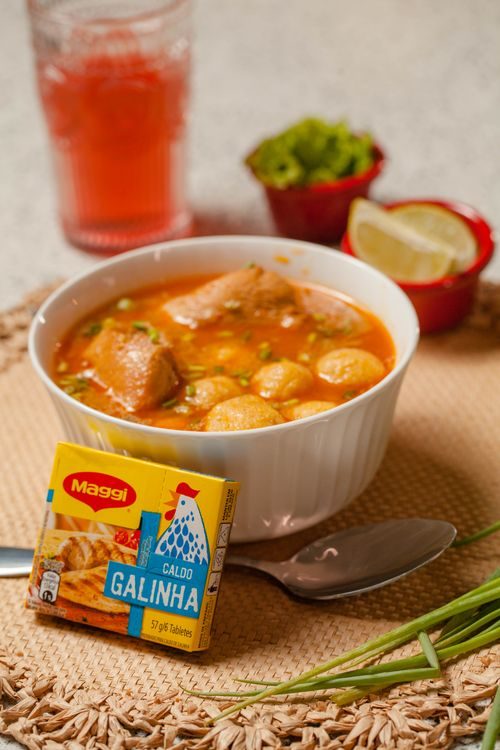
The vegetable jar has its own base and uses
Winiary's vegetable jar page gives the same full-stock preparation quantity as its household chicken jar: three tablespoons, 45 g, for one litre of boiling water, then mix and bring back to the boil. It also says a jar supplies 3.5 litres. These matching directions are supported for those two examples; they do not establish the ratio for every vegetable concentrate in Poland.
Its ingredient statement names a vegetable-stock base 69.6% and, inside that description, vegetables 6.2% comprising carrot, onion, leek, garlic and celeriac, alongside other base ingredients. The page's punctuation is awkward, so do not reconstruct a new simplified formula or turn the inner vegetable number into a claim about the whole jar. Read the current label when the precise hierarchy matters to your choice.
The producer suggests the vegetable product for cream soups, curry, risotto and cooking groats or rice. That can help you identify its intended job as a seasoning base. It does not mean the jar is already a complete curry sauce, a finished vegetable soup or a replacement for every other ingredient in the dish. Keep the base separate from the recipe's final food.
Household and professional products need separate records
Nestlé Professional's chicken-stock page describes a Winiary jar with a 565 g heading and a stated yield of 12.5 litres. Its ingredient statement gives chicken-stock base 67.9%, rather than the household page's 69.3%, and the page also carries different volume wording in its title and imagery. This is a reason to preserve the exact professional product identity, not to treat every Winiary jar as one unchanged formula.
A larger catering jar may be useful for some kitchens, but size alone does not tell you whether it is a scaled-up version of the household item. Check its current pack and instructions before comparing yield or measuring a recipe amount. Do not lift the household ingredient list onto the professional format or assume that a shared brand guarantees identical ingredients.
Likewise, a product page's headline, image and detailed description can come from different updates. Where those details do not agree, retain the uncertainty. This guide uses the professional page only to demonstrate that the product line has a separately stated formula and yield, not to settle a disputed pack volume or recommend buying a particular catering pack.
Keep nutrition and storage in their proper context
The cited Winiary pages describe nutrition after preparation, with tables based on 100 ml and particular portions. Those figures are not automatically values for 100 g of concentrate. If you compare products, first confirm the basis of each table. This article does not turn unlike table formats into a health ranking, a salt target or advice about an individual's dietary needs.
The household chicken jar page says to keep the opened product refrigerated and use within two weeks. Treat that as this named product's instruction, not a storage period for every cube, paste or liquid concentrate. Read the selected packet for its own handling requirements. A dry cube and a half-used jar are different formats, and the word bulion does not erase that difference.
A useful shopping note prevents the wrong substitution
Record brand, flavour, format, exact product and whether the recipe needs concentrate or prepared liquid. If you are comparing a cube with a jar, retain each product's own full-stock instructions rather than assuming equal units. If a store offers a substitute, check the formulation and directions before accepting it, especially when a familiar title hides another size or product line.
The goal is not to memorise a single rule for the whole shelf. It is to recognise a seasoning base, know what form your recipe expects and prepare the selected product on its own terms. That simple distinction avoids adding both concentrate and an unintended extra volume of water, or buying a finished soup when you meant to buy a stock base.
Frequently asked questions
Does every stock cube use the same water quantity?
Do not assume so. Use the selected packet. The cited 0.5-litre Knorr example is retailer-transcribed information for a named six-cube product.
Is a professional Winiary jar identical to the household jar?
The cited pages state different base percentages and pack information. Keep the exact household and professional products separate.