Szlachetna Paczka 2026: How Expats Can Join Poland's Noble Gift
The essentials: Choose a family from the online database when it opens on 14 November 2026, fulfil the key needs on its list, and deliver the parcel to the programme's warehouse on 12-13 December. Groups, workplaces and donors abroad can all take part; no Polish required.
Every December, thousands of Poles spend a weekend packing boxes of food, cleaning products and clothes for families they will never meet. Szlachetna Paczka - "the Noble Parcel", rendered on the organisation's own English page as Noble Gift - is one of Poland's largest social programmes, and it is deliberately built so that anyone can take part, including foreigners living here. The 2026 edition is now on the calendar: the family database opens on 14 November and the finale, the Weekend of Miracles, falls on 12-13 December. Here is how it works, what it costs, and how to join as an expat.
What Szlachetna Paczka is
Running since 2001, the programme matches donors with specific families in difficult situations - elderly people living alone, large families, people after accidents or living with illness or disability. The matching is done by volunteers, who visit families across the country, learn their stories and record their concrete needs. Donors then prepare an individual parcel for one chosen family, and volunteers deliver it. The model is anonymity in both directions: donors learn the family's story, never their address; the family learns that someone cared, not who.
The scale is national. In the 2025 edition - the programme's 25th - help reached 19,955 families, with parcels worth a combined 84,120,914 zł, prepared with the involvement of 13,102 volunteers, per the organisation's published results. It also notes that roughly 83% of supported families receive a Noble Parcel for the first time, so this is not a closed circle of the same recipients year after year.
The 2026 calendar
The official schedule, announced on 7 October 2026:
- 14 November 2026 - the Family Database opens. From that day, the stories of families in this year's edition appear on szlachetnapaczka.pl and donors can choose the family they want to help. New families are added daily, with the last volunteer visits taking place in early December - so if nothing near you is listed on day one, keep checking.
- 12-13 December 2026 - Weekend Cudów (the "Weekend of Miracles"). This is the finale: donors deliver their prepared parcels to the programme's warehouses, and volunteers take them to the families.
Choosing early matters: the organisation asks that families be picked early enough for donors to have time to shop and pack before the finale weekend.
How it works, step by step
1. Pick a family. From 14 November, browse the online Family Database. Each entry is an anonymised story plus a list of needs, marked with the three key needs that matter most. You can filter by location, family size and situation. 2. Confirm and meet your volunteer. After choosing, you receive a confirmation with the contact details of the volunteer who looks after that family. They are your point of contact for everything - questions about the needs, unusual items, delivery logistics. 3. Shop and pack. Build the parcel around the family's needs list. You are not required to buy everything on it, but by choosing a family you commit to fulfilling the needs marked as key. 4. Deliver to the warehouse. During the Weekend of Miracles, 12-13 December 2026, you bring the parcel to the programme warehouse assigned to your family - the confirmation tells you where. From there, volunteers deliver it to the family. Because of data-protection rules, the volunteer cannot give you the family's address or phone number; anything non-standard is arranged through them.
Doing it as an expat
The programme is entirely expat-compatible, with a few practical notes:
- Language. The Family Database and family stories are in Polish; the organisation runs an English information page explaining the model. Browser translation handles the database well enough, and the needs lists are concrete (products, sizes, quantities), so they survive machine translation intact. The hotline, +48 12 333 78 00, works seven days a week, 10:00-18:00.
- Do it as a group. The organisation itself says a parcel is easiest to prepare in a group - at a company, a school or with friends - and notes that a typical parcel is prepared by around 30 people. For an expat workplace this is a natural team initiative: one coordinator picks the family and talks to the volunteer, everyone takes items off a shared shopping list, and someone drives the boxes to the warehouse.
- Not in Poland in December? You can still prepare a parcel: the donor guide explicitly allows sending it by courier to the warehouse, as long as you arrange the details with the family's volunteer first.
What goes in the box - and what does not
Typical contents are food staples with long shelf life, cleaning and hygiene products, and clothing, shaped by the family's actual list. A few rules worth knowing:
- Key needs are binding. You do not have to buy the whole list, but the needs marked as key in the family's description are the commitment you make when you choose them.
- Used items are allowed only in very good condition. The organisation is blunt about this: a parcel is not a way to clear out old furniture or a decade-old box of clothes. The parcel is a message that someone cares, and worn-out things do not carry that message. There is no general collection of donated goods - the programme has no storage for them - so if you have a specific item to offer, the suggested route is the donors' Facebook group.
- Big items need a conversation. If the family needs a washing machine, a fridge or coal for heating, arrange the how and when with the volunteer before buying. The same applies to non-standard needs like glasses, a hearing aid or a dentist visit.
- What it costs. There is no fixed fee - you spend what the parcel requires. For calibration, the organisation quotes an average parcel value of 4,343 zł, which is exactly why group preparation is the norm: split across a workplace team, that is a manageable per-person contribution.
If a parcel is too much: money and the 1.5%
Choosing a family is not the only door in. The organisation accepts financial donations, and as a registered public-benefit organisation (OPP) it can receive the 1.5% of your Polish personal income tax that taxpayers may redirect: its KRS number is 0000050905 - look for Stowarzyszenie WIOSNA on the OPP list when filing your PIT. If you work in Poland and file a Polish tax return, this costs you nothing extra; it redirects tax already due.
Practical tips
- Set a reminder for 14 November. The best-matched families - for example near your city, or with needs your group can realistically meet - are chosen quickly.
- Read the whole story before choosing. The needs list is the contract; the story tells you who you are buying for, which makes the shopping far less abstract.
- Keep the volunteer close. They have done this before and can save you from expensive mistakes, especially on appliances and fuel.
- Pack like it matters - it does. The donor guide asks for parcels packed with care, not bin-liner bundles; many donors wrap gifts for children separately.
- Photograph nothing, expect nothing back. Anonymity is the point. Families often send thanks through volunteers, but the programme is built so that help carries no obligation on either side.
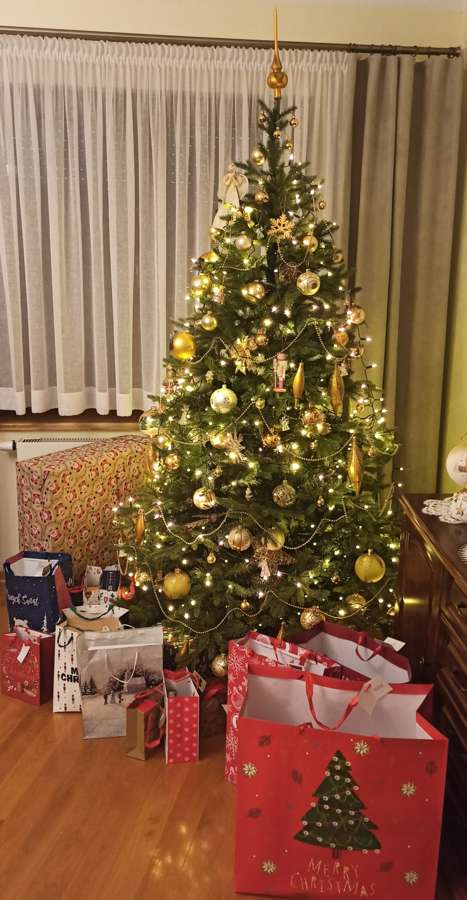
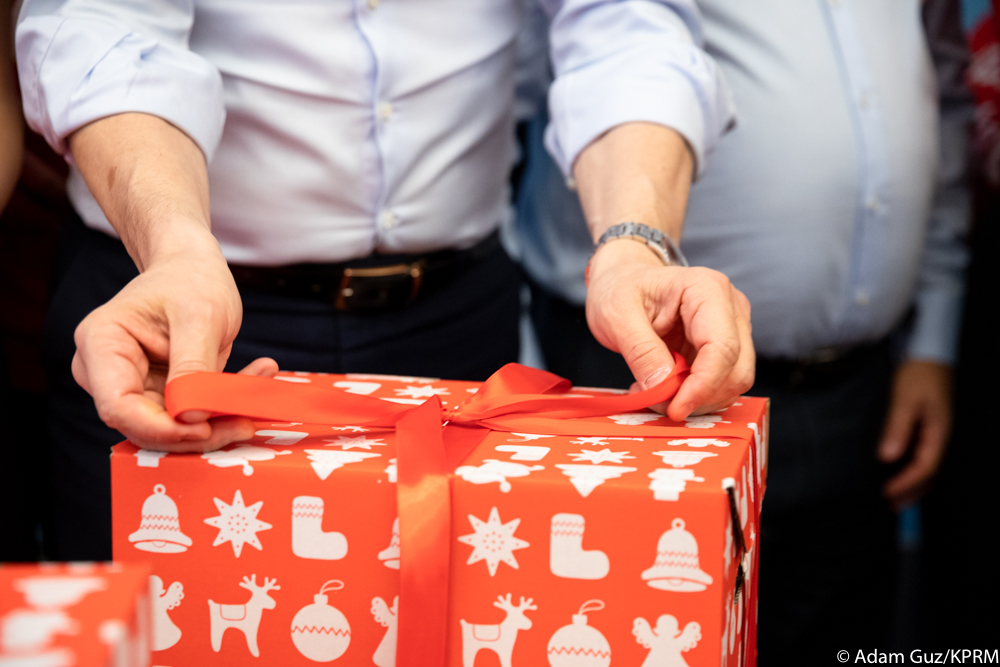
*Photos: CC BY 4.0 by Aw58 via Wikimedia Commons: Christmas presents under a tree, December 2025 (cover); public domain by Adam Guz / KPRM via Wikimedia Commons: tying the ribbon on a Noble Parcel box, December 2019.jpg) (above). Dates, figures and rules verified against the programme's official pages on 25 October 2026.*
Frequently asked questions
When can I choose a family for Szlachetna Paczka 2026?
From 14 November 2026, when the Family Database opens on szlachetnapaczka.pl. New families are added daily until early December, so check back if your area has none listed yet. Parcels must reach the programme's warehouse on the Weekend of Miracles, 12-13 December 2026.
Do I need to speak Polish to take part?
It helps but is not required. The family stories and needs lists are in Polish and translate well with browser tools; the organisation has an English information page, and the volunteer assigned to your family is your direct contact for anything unclear. The hotline is +48 12 333 78 00, seven days a week, 10:00-18:00.
How much does it cost to prepare a Noble Parcel?
There is no set amount - it depends on your family's needs. The organisation quotes an average parcel value of 4,343 zł, which is why most parcels are prepared by groups of colleagues, classmates or friends who split the shopping list.
Can I include second-hand clothes or furniture?
Only if they are in very good condition. The programme explicitly asks donors not to treat the parcel as a clear-out of used belongings, and it does not run a general collection of donated goods.
Can I take part if I will not be in Poland in December?
Yes. The donor guide allows preparing a parcel from abroad and sending it by courier to the programme's warehouse, after arranging the details with the volunteer who looks after your chosen family. Alternatively, you can support the programme financially or through the 1.5% tax mechanism (KRS 0000050905).
Will I find out who received my parcel?
No - anonymity works both ways. You know the family's story and needs, not their identity or address, and the family does not learn who their donor was. Thank-you messages, when they come, travel through the volunteer.
Sources
- Szlachetna Paczka - 2026 calendar announcement, 7 Oct 2026
- Szlachetna Paczka - donor guide (poradnik Darczyncy), checked 25 Oct 2026
- Szlachetna Paczka - homepage with 2025 results, checked 25 Oct 2026
- Noble Gift - official English information page, checked 25 Oct 2026
- Szlachetna Paczka - Paczka w liczbach (average parcel value), checked 25 Oct 2026