Tarnów for a Weekend: A Renaissance Square and Two Unusual Museums
The essentials: Tarnów rewards a weekend: one of Poland's most beautiful Renaissance squares, a cathedral of princely tombs, the Bimah of the destroyed Great Synagogue, and the country's only Roma culture exhibition. Museums 12 zł, free Tuesdays; about an hour by train from Kraków.
Polish guidebooks have called Tarnów the Pearl of the Renaissance for so long that the phrase stopped meaning anything. Go anyway. An hour east of Kraków, this small city holds one of the most beautiful market squares in the country, a Gothic cathedral stuffed with princely tombs, the moving remnant of a destroyed synagogue, and a museum collection you will not find anywhere else in Poland. Two days here cost a fraction of a Kraków weekend, and you will have the square nearly to yourself. 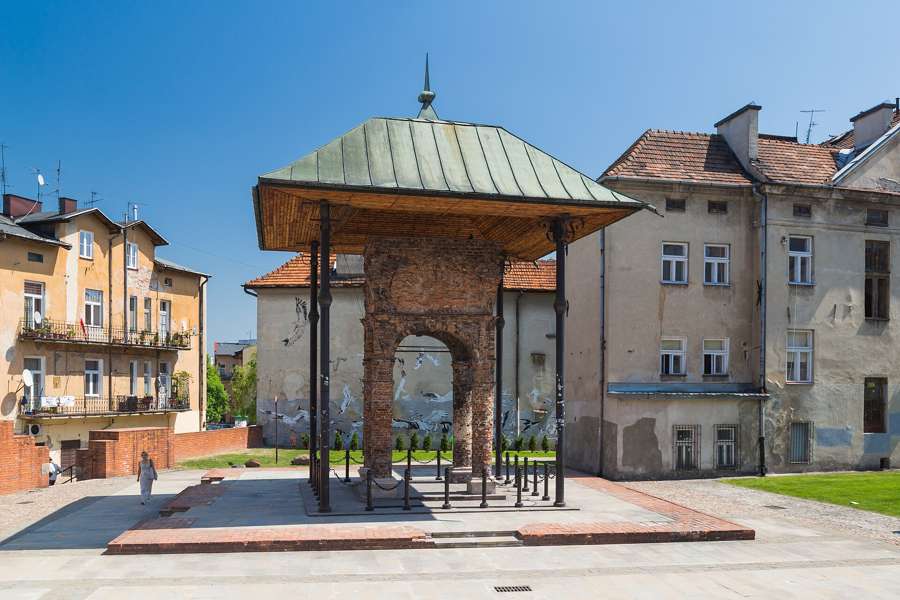
Getting there
Tarnów sits in Małopolska, about 80 km east of Kraków on the main rail line toward Rzeszów. Trains from Kraków Główny run frequently and take around an hour; from Rzeszów the journey is about an hour and a half, and from Warsaw around three and a half. That makes Tarnów the easiest possible side trip from Kraków, and a worthy weekend in its own right. The station is a short walk from the old town, and everything in this guide is compact and walkable.
Tarnów was founded in 1330 as a private town of the Leliwita family, and its golden age came two centuries later under Hetman Jan Tarnowski, the military commander who turned his home town into a Renaissance showpiece. The railway age brought a second boom, and in the 1920s the city grew a planned garden suburb, Mościce, around a new chemical works. The layers survive unusually intact: medieval street grid, Renaissance square, and a lived-in small-city present that never turned into a tourist theatre.
Data source: rail operator and Tarnów city information, checked 22 October 2026.
The square and the cathedral
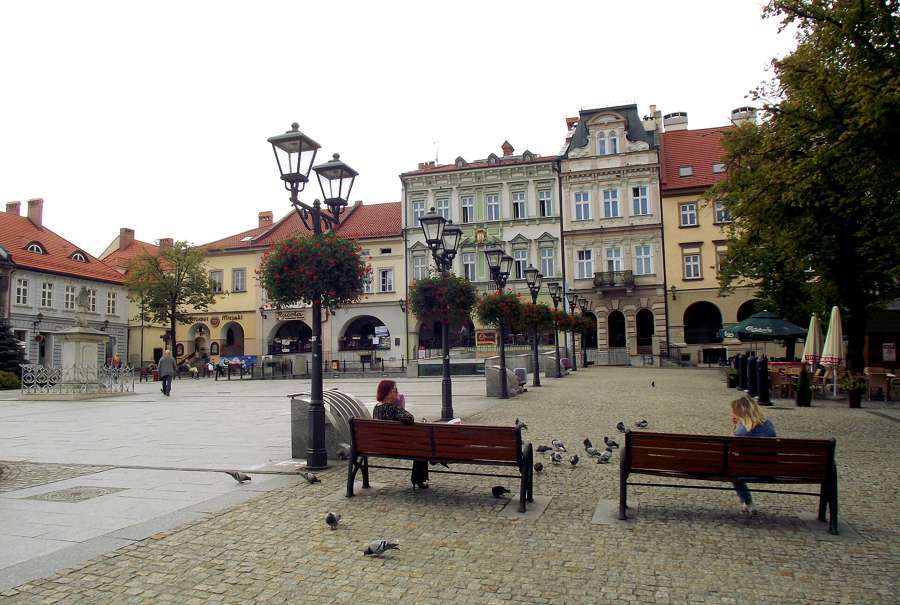
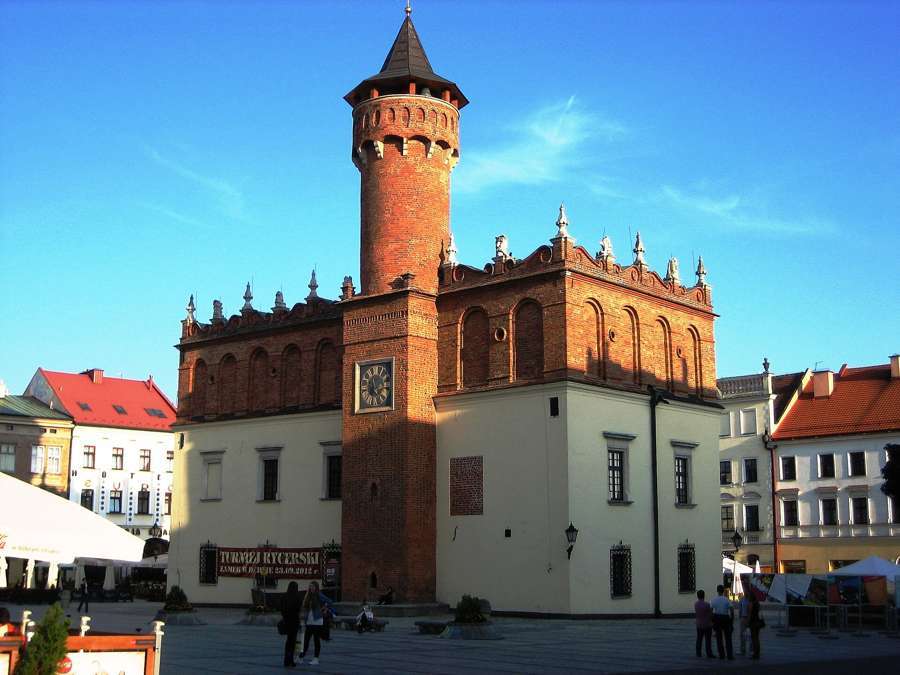
Tarnów's Rynek is the reason for the superlatives. Laid out in the 14th century and dressed in Renaissance form two hundred years later, it is a perfect, slightly tilting square of pastel tenements with arcaded walkways, crowned by a town hall whose brick attic and tower have become the city's emblem. Climb the tower for the panorama: the combined ticket for the Town Hall Museum and the tower costs 20 zł, and the view over the red roofs to the Beskid foothills is worth every step. On a clear day the horizon fills with the first ridges of the Carpathians, a reminder that the mountains begin barely an hour south of the square.
Two minutes away rises the Cathedral Basilica of the Nativity of the Virgin Mary, a vast 14th-century brick Gothic church whose real treasures are inside: a sequence of Renaissance and Mannerist tombs of the Tarnowski and Ostrogski magnates, including the towering memorial to Hetman Jan Tarnowski, among the finest sculpted tombs in Poland. Give it time; this is one of those interiors that rewards standing still.
The lanes between the square and the cathedral deserve a slow hour on their own. Fragments of the medieval city walls survive along the southern edge of the old town, small courtyards open off the arcades, and the whole quarter sits on a gentle ridge above the Wątok stream. Tarnów's old town is compact enough that you will cross it half a dozen times in a weekend, and each crossing turns up another carved portal or painted ceiling.
Data source: Museum of the Tarnów Region and cathedral information, checked 22 October 2026.
The Bimah: memory in the open air
Before the Second World War, almost half of Tarnów was Jewish. The community's Great Synagogue was burned in November 1939, and in June 1940 the first transport of prisoners to Auschwitz departed from Tarnów. What remains in the former Jewish quarter, a few minutes from the square, is one of the most affecting monuments in Poland: the brick bimah, the raised platform from which the Torah was read, standing alone under a modern canopy where the synagogue once stood. It is free, always open, and unforgettable. Come at dusk, when the canopy lights up and the brick column glows against the darkening courtyard; few memorials in Poland carry so much loss in so small a space. The surrounding streets hold more fragments of the community's life, and the city's old Jewish cemetery, with its monument of broken gravestones, lies a short walk away.
The Ethnographic Museum's Roma exhibition completes this strand of the city's story: the Tarnów region has been a centre of Polish Roma life for centuries, and the museum began collecting their history in the 1970s, when few institutions in Europe thought the subject mattered. Between the Bimah and the Roma wagons, Tarnów tells two minority histories that most Polish cities have simply lost.
Data source: Tarnów city and museum information, checked 22 October 2026.
The museum trail
The Museum of the Tarnów Region (Muzeum Ziemi Tarnowskiej) runs several branches, and two deserve your time. The Museum of the History of Tarnów and the Region, on the square itself, tells the city's story from medieval trading post to railway boomtown; tickets are 12 zł normal and 9 zł reduced. The Ethnographic Museum on Krakowska street holds the collection that makes Tarnów truly unique: the only permanent exhibition in Poland devoted to the history and culture of the Roma people, gathered over decades alongside the museum's folk-art holdings. Tickets here are likewise 12 zł normal and 9 zł reduced, with family tickets at 28 zł. On Tuesdays, entry to the permanent exhibitions at both branches is free, and a 40 zł pass covers one visit to each of the museum's six branches within 30 days. The branches close on Mondays.
Data source: Museum of the Tarnów Region official price list, checked 22 October 2026.
With children
Tarnów works well as a low-key family weekend. The town hall tower is the obvious hit, part climb, part treasure hunt, with the panorama as the prize. The Ethnographic Museum surprises families: the Roma wagons and painted folk art are visual enough for young children, and the museum runs regular workshops. For water and slides, the Termy Tarnów thermal pools on the southern edge of the city handle a rainy or hot afternoon. The old town is small and mostly traffic-calmed, so the whole weekend runs at walking pace, and prices for meals and museums stay gentle throughout.
For food, the square and the streets around it carry the city's dining: milk bars and pierogi at one end, modern Małopolska kitchens and a respectable coffee scene at the other. Portions are generous and prices sit well below Kraków's; dinner for a family rarely breaks the budget here. In season, the square's terraces fill from late morning, and the people-watching, over coffee or a glass of something cold, is among the best in Małopolska.
Data source: museum and city information, checked 22 October 2026.
A simple weekend plan
Saturday: train from Kraków, the Rynek and the town hall tower, the cathedral, then a slow walk through the former Jewish quarter to the Bimah. Sunday: the History Museum and the Ethnographic Museum, coffee on the square, home by evening. Tarnów does not shout. It simply hands you a Renaissance square, a princely cathedral and a story that spans six centuries, and lets you keep them.
Practical notes: the tower climb involves narrow stairs, so carry small children rather than bring the buggy. Museums close on Mondays, so a Monday-to-Tuesday visit pairs a closed day with a free one. And if you have a car and extra hours, the painted cottages of Zalipie, the museum village of floral house-painting, lie about 35 km north and make a famous half-day add-on.
Frequently asked questions
How much do Tarnów's museums cost?
The History Museum and the Ethnographic Museum each charge 12 zł normal and 9 zł reduced, with family tickets at 28 zł. Permanent exhibitions are free on Tuesdays, and the Town Hall Museum with tower access costs 20 zł.
What is the Bimah in Tarnów?
The Bimah is the preserved brick platform of Tarnów's Great Synagogue, burned in 1939, standing under a canopy in the former Jewish quarter. It is one of the most important surviving monuments of the city's Jewish community and is freely accessible.
How do I get from Kraków to Tarnów?
Frequent trains from Kraków Główny take around an hour, making Tarnów an easy day trip or weekend from Kraków. From Warsaw the journey is about three and a half hours.
What is special about Tarnów's Ethnographic Museum?
It holds the only permanent exhibition in Poland devoted to the history and culture of the Roma people, alongside a rich collection of regional folk art. Tickets cost 12 zł normal, with free entry on Tuesdays. * Photos: Tarnów Town Hall by Jeffpola, CC BY-SA 3.0; the Bimah of the Old Synagogue by Marcin Konsek, CC BY-SA 4.0, both via Wikimedia Commons.