How Much Does It Cost to Rent a Three-Bedroom Apartment in Warsaw?
The essentials: Three-bedroom flats rent as 4-room listings in Poland: average asking rent 6,884 zł/month in Warsaw (1 July 2026 snapshot, 25,999 offers). Two-bedroom (3-room) flats average 5,208 zł. Districts span Rembertow (2,808 zł) to Wilanow (5,630 zł). Warsaw's overall average was 4,900 zł in August 2026, down 2.3% y/y (Otodom).
The headline numbers
A true three-bedroom apartment in Warsaw - in Polish listing language, a 4-pokojowe (four-room) flat - carries an average asking rent of 6,884 zł per month, based on 25,999 monitored offers snapshot on 1 July 2026 by the ZnajdzNajem rental index. If what you actually need is two bedrooms plus a living room (a 3-pokojowe), the average asking rent drops to 5,208 zł.
For context across the whole market: Warsaw's average asking rent across all sizes was 4,067 zł (median 3,500 zł) in that index, while Otodom's separate August 2026 report put the Warsaw average at 4,900 zł, down 0.4% month-on-month and 2.3% year-on-year. Different portals, different samples - the useful takeaway is that family-sized flats cluster between roughly 5,000 and 7,000 zł depending on rooms, district and standard.
*Data sources: ZnajdzNajem rental index, Warsaw report June 2026 (znajdznajem.pl, snapshot 1 July 2026) and Otodom "Raport z rynku najmu - sierpien 2026" (otodom.pl) - checked 21 October 2026.*
First: learn to count rooms the Polish way
This trips up almost every newcomer. Polish listings count all rooms, not bedrooms. The living room is a room. So:
- Kawalerka - a studio (one room plus kitchen and bathroom). Warsaw average: 2,625 zł (ZnajdzNajem June 2026).
- 2-pokojowe - one bedroom plus living room. Average: 3,684 zł.
- 3-pokojowe - typically two bedrooms plus living room. Average: 5,208 zł.
- 4-pokojowe - typically three bedrooms plus living room. Average: 6,884 zł.
When a Polish friend says they live in a "three-room flat", they mean two bedrooms. When your relocation agent sends you a "4-room" listing, that is the three-bedroom you asked for. Filter your portal searches accordingly or you will browse the wrong shelf entirely.
What a three-bedroom actually costs
At the June 2026 snapshot, the average four-room (three-bedroom) offer in Warsaw asked 6,884 zł per month. That is an average across the entire city, so it blends renovated Śródmieście tenements with 1990s blocks on the city's edge. In practice:
- Below ~5,500 zł - older blocks in outer districts, longer commutes, basic standard.
- 5,500-7,500 zł - the broad middle: decent blocks or newer estates in Mokotow, Wola, Praga-Poludnie, usually 70-90 m².
- Above ~7,500 zł - new developments, premium districts like Wilanow or central Śródmieście, or genuinely large flats of 100 m² or more.
Warsaw's average asking price across all sizes translates to about 85 zł per square metre per month in the June index - a handy sanity check when a listing looks oddly cheap or expensive for its size.
How Warsaw compares with the rest of Poland
Warsaw is the country's most expensive rental market, and it is not close. Otodom's August 2026 report put the capital's average asking rent at 4,900 zł, against 3,276 zł in the Tri-City, 3,170 zł in Krakow, 3,084 zł in Wroclaw and 2,642 zł in Poznan. The unweighted average across all voivodeship capitals was 2,711 zł; weighted by supply - which pulls Warsaw's large market in properly - it was 3,573 zł.
The gap widens with flat size, because family-sized supply concentrates where salaries are highest. If your budget is firm, the comparison matters most when your job allows a choice of city.
*Data source: Otodom, "Raport z rynku najmu - sierpien 2026", average asking rents by city (otodom.pl) - checked 21 October 2026.*
District by district
The June 2026 index shows how much location moves the number. Average asking rents (all sizes) by district:
- Wilanow - 5,630 zł, the most expensive district in the sample
- Śródmieście - 5,315 zł
- Mokotow - 4,831 zł
- Wola - 4,676 zł
- Praga-Poludnie - 3,624 zł
- Rembertow - 2,808 zł, the cheapest district in the sample
Otodom's July 2026 commentary makes the same point from the other side: Warsaw has no single "typical" rent, because offers spread across 2,500, 3,000, 3,500 and 4,000 zł almost evenly, and identical square metreage can differ by 1,000-1,500 zł depending on the district. For a three-bedroom flat, expect that spread to be wider still - premium districts concentrate the large new-build supply.
*Data sources: ZnajdzNajem Warsaw report June 2026; Otodom rental report July 2026 commentary (otodom.pl) - checked 21 October 2026.*
The costs beyond the rent
The advertised rent is rarely the whole monthly bill. Budget for:
1. Czynsz administracyjny - the building administration fee covering stairwells, lifts, waste, and often advance payments for water and heating. Some listings include it in the headline rent, many do not. Always ask. 2. Utilities - electricity, gas and internet on top, unless the listing says otherwise. 3. Kaucja (deposit) - customarily one month's rent, refundable at the end of the tenancy; two months happens for furnished premium flats. 4. Agency fee - if you rent through an agent, a one-off commission is common; direct-from-owner listings (look for "bez posrednikow") skip it.
Ask every listing the same three questions: is the admin fee included, what were recent utility bills, and how much is the deposit. It saves a viewing-trip's worth of surprises. One more check matters for larger flats: older blocks sometimes carry district-heating and hot-water advances inside the admin fee, while newer estates meter everything separately - two flats at the same rent can differ by several hundred złoty a month once winter heating settles in.
The seasonal rhythm
Rental supply and demand breathe with the academic and job calendar. Otodom's July 2026 report tracked the student season starting: active listings nationwide fell 2% month-on-month to 23,000 as the academic year approached, while 17,500 new offers entered circulation - the highest monthly inflow of the year at that point. Availability tightened most in student cities, with Poznan down 29% year-on-year. By August, supply rebounded 6% month-on-month to 24,300 active listings, the strongest monthly supply growth of 2026 to that date.
For a family hunting a three-bedroom flat, the practical reading is simple: late summer brings competition for anything near good schools and universities, while late autumn and winter tend to be quieter. A lease starting in November or January often meets more relaxed landlords than one starting in September.
*Data source: Otodom rental reports, July and August 2026 editions (otodom.pl) - checked 21 October 2026.*
How fast the market moves
Warsaw's rental market is liquid rather than desperate. Otodom's August 2026 report notes that in May the city ended the month with 6,809 active offers - only 149 more than it started with - while 5,099 new listings entered circulation. Roughly 75% of the active listing base refreshes every month, which Otodom reads as balance, not frenzy: good flats go quickly, but supply keeps arriving.
The same report shows where demand points: the most searched combination nationwide is a two-room flat around 40 m² (20% of searches), followed by two-room flats around 30 m² (18%) and three-room flats around 50 m² (9%). Three-bedroom hunters compete in a thinner, slower segment - which cuts both ways. Fewer bidders per flat, but also fewer flats per week.
*Data source: Otodom, "Raport z rynku najmu - sierpien 2026", supply and search-structure data - checked 21 October 2026.*
Renting as a foreigner: what to expect
Warsaw landlords routinely rent to foreigners - the expat market is large and established - but expect a few practical asks. Many owners prefer tenants who can show employment income in Poland or a work contract, though international contracts and proof of savings usually work too. Have your passport, your PESEL number if you have one, and employment documentation ready before you start viewing; good family flats attract several interested parties, and the prepared applicant wins ties.
On contract type, you will encounter two forms: an ordinary tenancy agreement (umowa najmu) and the "occasional tenancy" (najem okazjonalny), a notarized variant some landlords prefer because it simplifies eviction procedures. Both are standard in the market; the occasional tenancy involves a trip to a notary and a declaration about where you would move if the tenancy ended, which catches some newcomers off guard. Neither form changes your rent - but read whichever you sign, ideally with someone who reads Polish, and keep an inventory protocol with photos from day one.
Practical tips for three-bedroom hunters
1. Search "4-pokojowe", not "three-bedroom" - and set the portal filter to rooms, not bedrooms. 2. Compare against 85 zł/m² (June 2026 city average) before booking viewings. 3. Check the district split: the same budget rents noticeably more space in Praga-Poludnie or outer districts than in Wilanow or Śródmieście. 4. Move fast on good listings - with three quarters of Warsaw's offer base turning over monthly, a well-priced family flat will not wait for a second viewing weekend. 5. Negotiate from data: asking rents are offers, not contracts, and with Warsaw average rents down 2.3% year-on-year (Otodom, August 2026), polite offers below asking are a normal part of the market. 6. Read the contract for the deposit return terms and the rules on rent indexation before signing.
Frequently asked questions
How much is a three-bedroom apartment in Warsaw?
The average asking rent for a four-room (three-bedroom) flat was 6,884 zł per month at the 1 July 2026 snapshot of the ZnajdzNajem index. A three-room flat (two bedrooms plus living room) averaged 5,208 zł.
Why do Polish listings say four rooms when I want three bedrooms?
Polish listings count every room including the living room. A three-bedroom flat is listed as 4-pokojowe. Filter portals by rooms, not bedrooms.
Which Warsaw districts are cheapest for families?
In the June 2026 index the lowest district average was Rembertow at 2,808 zł per month; Praga-Poludnie averaged 3,624 zł. Wilanow (5,630 zł) and Śródmieście (5,315 zł) were the priciest.
Are Warsaw rents rising or falling?
Falling gently. Otodom's August 2026 report shows Warsaw's average asking rent down 2.3% year-on-year and 0.4% month-on-month, at 4,900 zł.
Is the deposit extra on top of the rent?
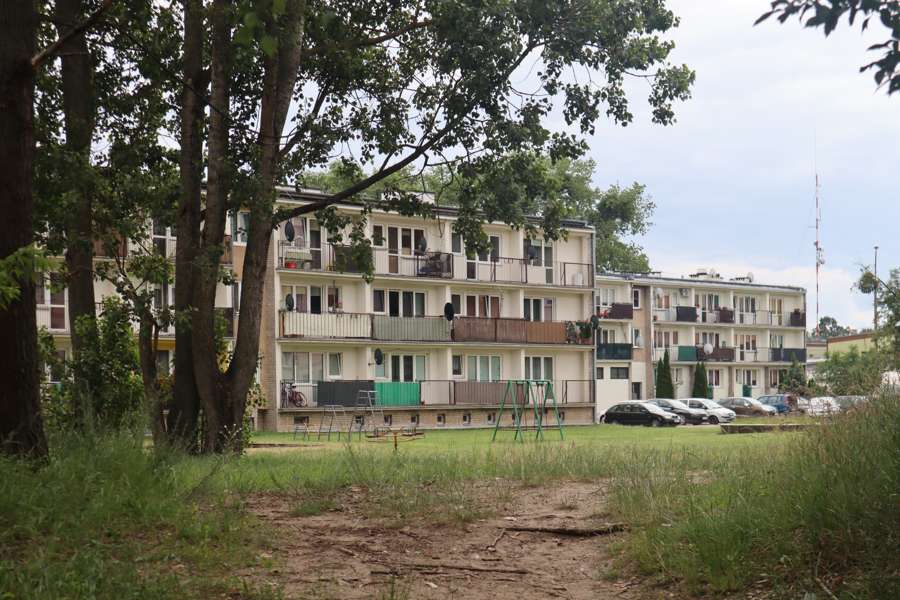
Yes. The kaucja is typically one month's rent paid upfront and refunded when you move out, assuming no damage. Administration fees and utilities may also sit outside the advertised rent - always ask what is included. * Photos: "Warszawa Ciupagi, osiedle" and "Warszawa Dziatwy, osiedle blokow" by Cybularny (CC0), via Wikimedia Commons.