Tyniec Abbey Day Trip From Krakow: Hours, Tickets and History
The essentials: Tyniec Abbey, founded traditionally in 1044, is Poland's oldest active monastery, 12 km from Krakow. Guided tours (30 zl) run six times daily Mon-Sat and four on Sundays Apr-Oct; the church is free, open 6:30-21:30. Reach it by bus 112 or the Vistula cycle path.
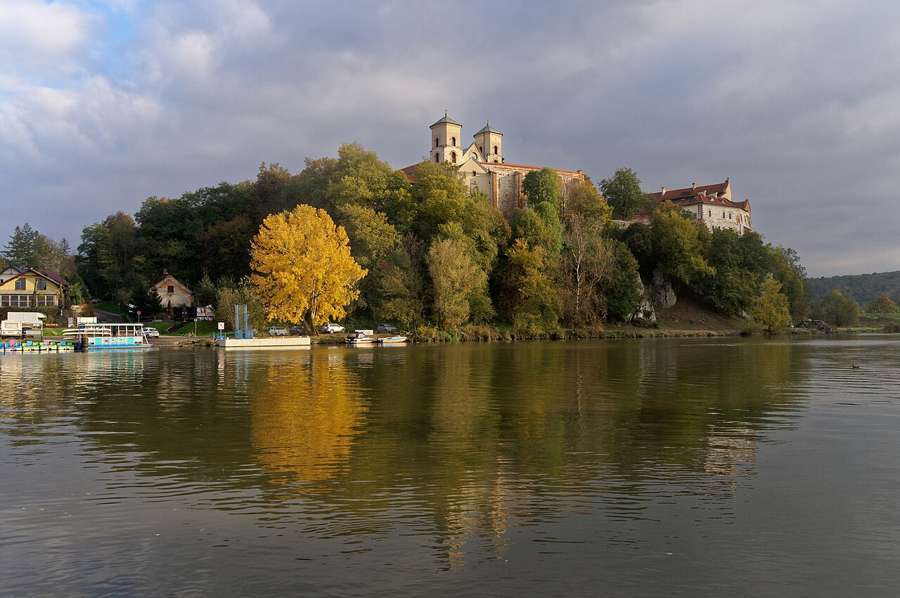
Poland's oldest working monastery, on a rock above the Vistula
About twelve kilometres west of Kraków's Main Square, the village of Tyniec sits on a limestone promontory above the Vistula, and on top of that rock stands the Benedictine Abbey: the oldest existing and still active monastery in Poland. Tradition dates its foundation to 1044, which makes the community's history almost as long as the history of Poland itself. Apart from a 123-year break between 1816 and 1939, when the abbey was dissolved, the Benedictines have lived and prayed here continuously.
For an expat in Kraków, Tyniec is the easiest deep-history day trip in the region: no advance planning for tickets like Wieliczka or Auschwitz, no full-day commitment, and a genuine working monastery rather than a museum reconstruction. The monks still follow the Benedictine motto ora et labora, work and pray, and the rhythm of their services shapes what visitors can see and when.
* Data source: Opactwo Benedyktynów w Tyńcu official visiting pages and krakow.travel abbey entry, both fetched 23 October 2026.
A thousand years of history on one hill
The hill was inhabited long before the monks arrived. Kraków's official tourism portal notes that the area was very likely settled by Celts a thousand years before the Order of St Benedict appeared, and archaeological digs on the site have uncovered tools and pottery from one of the first farming communities in Poland. The first Benedictine monks came in the mid-11th century, and the abbey grew rich on royal patronage: the abbot of Tyniec was nicknamed "the abbot of a hundred villages", a hint of the medieval economic power concentrated here.
The abbey doubled as a fortress from the start, which it needed to be. Thirteenth-century fortifications did not save it from being burned during the Tatar invasions. Its heyday came in the 15th and 16th centuries, and the characteristic twin-towered facade dates from a later rebuilding. In 1816, during the partitions of Poland, the Austrian authorities dissolved the order and the monks were forced out; the complex changed hands repeatedly and slid into ruin. The turning point came in 1939, when the Archbishop of Kraków, Prince Adam Stefan Sapieha, brought the Benedictines back from Belgium. The abbey played the fortress one last time in 1945, when it was held against the advancing Red Army much as Monte Cassino had been held in Italy.
After the war the monastery was rebuilt, and the long-ruined library building, known simply as the Great Ruin, was restored by 2008. It now houses the Benedictine Institute of Culture and the abbey museum.
* Data source: krakow.travel Benedictine Abbey in Tyniec entry, fetched 23 October 2026.
Visiting the abbey: the guided tour
The historic interiors, including the cloisters, the old chapter house, the reconstructed monastic scriptorium and the Romanesque Reserve with the remains of the first, 11th-century church, are visited on a guided tour. You also see a Romanesque church wall that is roughly a thousand years old and the viridarium, the cloister garden laid out on the plan of an "ideal monastery". The tour includes the Baroque church when the service schedule allows, and the ticket covers entry to the abbey museum.
Tour times depend on the season. From April to October, tours run Monday to Saturday at 10:00, 11:00, 12:00, 14:00, 15:00 and 16:00, and on Sundays at 14:00, 15:00, 16:00 and 17:00. From November to March, tours run Monday to Friday at the same six weekday times, Saturdays at 10:00, 11:00, 12:00, 14:00 and 15:00, and Sundays at 14:00 and 15:00. Tickets cost 30 zl normal, 20 zl reduced, 70 zl for a family ticket, or 50 zl for a family with the Large Family Card. Groups of more than 20 people pay an 80 zl priority-reservation fee and must book through the museum reception.
A few practical rules matter. Groups are capped at 25 people because of the size of the Romanesque Reserve, so in peak season individual visitors can find a given hour sold out to an organised group; the abbey recommends calling the museum reception (+48 503 032 420, Monday to Friday 10:00 to 16:00, or [email protected]) to confirm your slot before travelling. Arriving more than 15 minutes late means losing the guided tour. Tours in English are possible but availability is limited, so checking with reception in advance is essential if you do not manage Polish. The Romanesque Reserve is underground and its current temporary entrance is not adapted for visitors with limited mobility, though the museum and guest house have lifts.
* Data source: chronicdobro.org official abbey visiting page, prices and schedules as published there on 23 October 2026.
The abbey museum
The museum sits in the cellars of the old library building and covers both the monastery's history and the much older story of the hill itself. The star exhibits are Romanesque architectural details from the turn of the 11th and 12th centuries, column capitals carved with plant and geometric ornament that rank among the finest examples of Polish Romanesque art, along with fragments of 13th-century floor tiles from the church and a copy of a chalice and paten from one of the earliest abbatial burials, found during excavations in the 1960s.
A second strand of the exhibition presents archaeological finds from digs carried out in the late 1940s and 1950s during the abbey's post-war reconstruction: flint tools and pottery fragments from a small Neolithic farming settlement, one of the first communities of farmers on Polish soil. Admission to the museum is free with a guided-tour ticket; visited separately it costs 15 zl normal and 10 zl reduced. From April to October the museum opens Monday to Friday 9:30 to 17:00, Saturdays 10:00 to 17:00 and Sundays 11:00 to 18:00; from November to March it opens Monday to Friday 9:30 to 17:00 and weekends 10:00 to 16:00, with last entry 15 minutes before closing. A touch model of the abbey is available for blind and partially sighted visitors.
* Data source: chronicdobro.org museum page, prices and hours as published there on 23 October 2026.
The Church of St Peter and St Paul
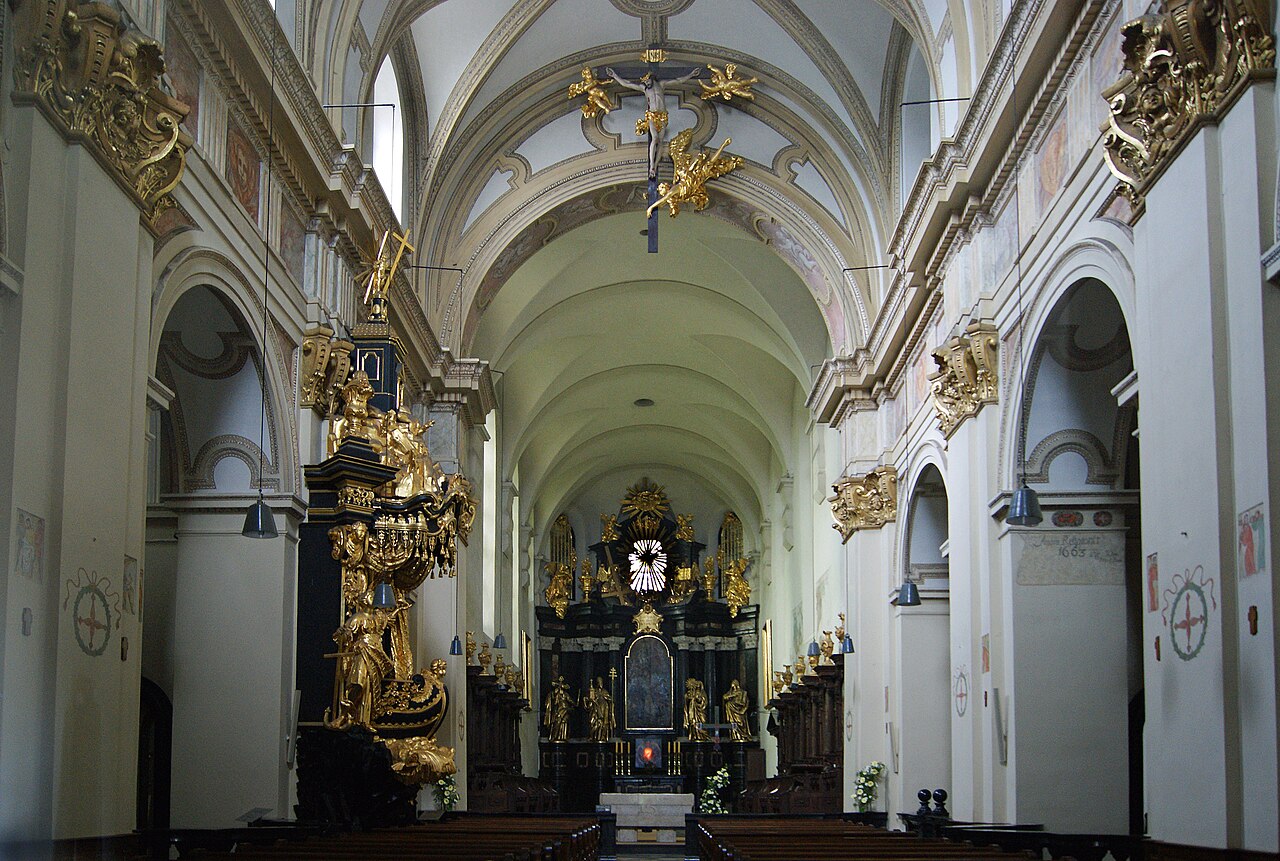
The abbey church is a working parish church, open daily from 6:30 to 21:30, and entry is free outside the tour route. It is a three-aisled basilica with Baroque furnishings over older bones: look for the Gothic chancel, the rococo high altar of black marble, the pulpit shaped like a boat, and 16th-century murals of the Adoration of the Magi. On the way in, the elaborate iron door latch shaped like a fish, one of the oldest symbols of Christ, is an easy detail to miss and worth finding.
Because this is first of all a place of worship, the monks ask visitors to treat it that way: sightseeing pauses during services, and the tourist route through the church depends on the day's prayer schedule. Mass times are posted by the parish of St Peter and St Paul, which shares the building.
* Data source: krakow.travel abbey entry, opening hours as published there on 23 October 2026.
Getting there from Kraków
The abbey's own directions are simple: from Kraków Główny station, take a bus or tram to Rondo Grunwaldzkie, then bus 112 to the centre of Tyniec, from where the abbey on its rock is a short uphill walk. The whole trip takes well under an hour from the city centre. The address for drivers is ul. Benedyktyńska 37, 30-398 Kraków.
The most scenic option, and the one locals will push you towards, is the bicycle: a dedicated cycle path follows the Vistula boulevards west out of the city almost all the way to Tyniec, flat and riverside nearly the whole route. Kraków's official tourism portal describes the ride as the pleasant way to arrive, and on a dry autumn or spring day it turns the trip into a half-day outing rather than a transfer. In season, boat trips up the Vistula to Tyniec have also run from Kraków's riverside; schedules change year to year, so treat the river option as a bonus to check shortly before you go rather than a fixed plan.
* Data source: opactwotynieckie.pl official directions page and krakow.travel, both fetched 23 October 2026.
Planning the visit
A realistic Tyniec visit is half a day: an hour's travel each way by bike or bus, 60 to 90 minutes for the guided tour and museum, plus time on the viewpoint terraces above the Vistula bend, which are free and open. Sundays are the busiest day and have the fewest tour slots relative to demand, so a weekday morning is the calm choice. With children, the fortress-like walls, the underground Romanesque rooms and the boat pulpit usually land well; the museum's touch model and lifts make much of the site workable with a pushchair, except the Romanesque Reserve.
Combine Tyniec with the Benedictine Abbey's neighbour across the river, the Camaldolese monastery on Srebrna Góra in Bielany, visible from the same viewpoints, or with a longer Vistula ride. And if you are in Kraków over the winter, note the November-to-March schedule above: last Sunday tours run at 14:00 and 15:00 only.
* Photos: CC BY-SA 4.0 Jakub Hałun via Wikimedia Commons (the abbey above the Vistula in autumn, cover); CC BY-SA 4.0 Zygmunt Put Zetpe0202 via Wikimedia Commons (the abbey church interior, body).
Frequently asked questions
How much does it cost to visit Tyniec Abbey?
The guided tour of the historic interiors costs 30 zl (20 zl reduced, 70 zl family), and it includes the abbey museum. The church itself is free to enter. Museum-only tickets are 15 zl (10 zl reduced).
Do I need to book in advance?
Individuals can usually just turn up for a scheduled tour, but groups over 20 must book, and any tour slot can be taken by an organised group, so the abbey advises calling the museum reception (+48 503 032 420) before travelling, especially in high season.
Can I visit Tyniec Abbey in English?
Tours in English are possible but availability is limited. Contact the museum reception in advance to arrange or confirm an English-language tour.
How do I get to Tyniec from Kraków without a car?
Take a bus or tram to Rondo Grunwaldzkie, then bus 112 to Tyniec centre, or cycle the Vistula riverside path, which is flat and signposted almost the entire way from the city centre.