Vistula Boulevards and River Beaches: Warsaw's Waterfront Explained
The essentials: Warsaw's Vistula Boulevards stretch 2.2 km along the left bank: free, open 24/7, with pavilions, floating barges and legal outdoor drinking. River beaches (Poniatowka, Rusalka, Saska, Zoliborz) offer free deckchairs in season; free ferries cross the river May-September.
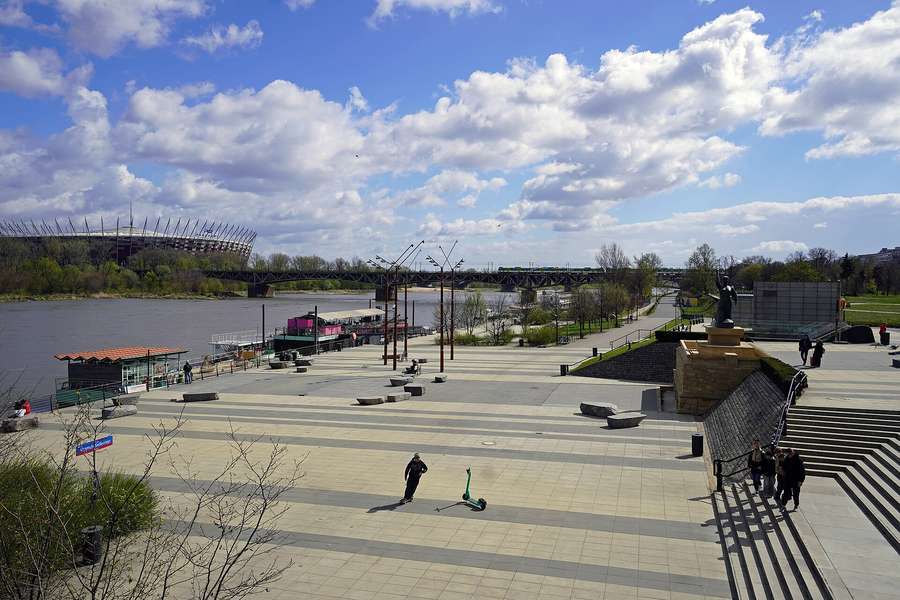
Every city has a place where it goes to breathe. In Warsaw, for most of the 20th century, that place emphatically was not the Vistula. The river that gave the city its reason to exist sat behind a flood expressway and a band of windswept concrete, admired from a distance and used by almost no one. Then, between 2013 and 2019, Warsaw rebuilt its entire left-bank waterfront - and today the Vistula Boulevards (Bulwary Wiślane) are the city's favorite outdoor room: 2.2 kilometers of promenades, floating cafés, free ferries, wild beaches and, famously, one of the only places in Poland where you can legally drink a beer outside.
For an expat, the waterfront is the fastest way to understand modern Warsaw: a city that spent a decade turning a neglected riverbank into public space that actually works. Here is how to use it like a local.
From forgotten concrete to city showcase
The boulevards' rebirth was one of Warsaw's most complicated recent projects. The city committed in 2008 to rebuilding 2,200 meters of the left-bank embankment, with the design by landscape studio RS Architektura Krajobrazu. Construction began in 2013 and had to contend with hydrology, the heritage setting of the Old Town, and the simultaneous excavation of metro line M2 underneath. The first section, at the level of the Old Town, opened in August 2015; further stretches followed in 2017, and the final section around the Mermaid monument opened in 2019.
The engineering is worth knowing about because it explains what you see. The Vistula's water level here swings by about 440 cm over a typical year, so the whole promenade is flood-adapted: the café pavilions are light modular structures designed to be demounted or even to float, the underpasses connecting the boulevards to the city have mobile flood barriers, and the mooring quay was built to take river ships. More than 200 trees and thousands of shrubs and perennials were planted to soften the concrete.
The river itself is protected: Warsaw's stretch of the Vistula sits within the Middle Vistula Valley bird area, one of Poland's ten most important breeding grounds for two tern species threatened at EU level - which is why the opposite, right bank has been deliberately left wild.
Data source: Zarząd Zieleni m.st. Warszawy (zzw.waw.pl, "Bulwary Wiślane"), checked 22 October 2026.
What is actually there
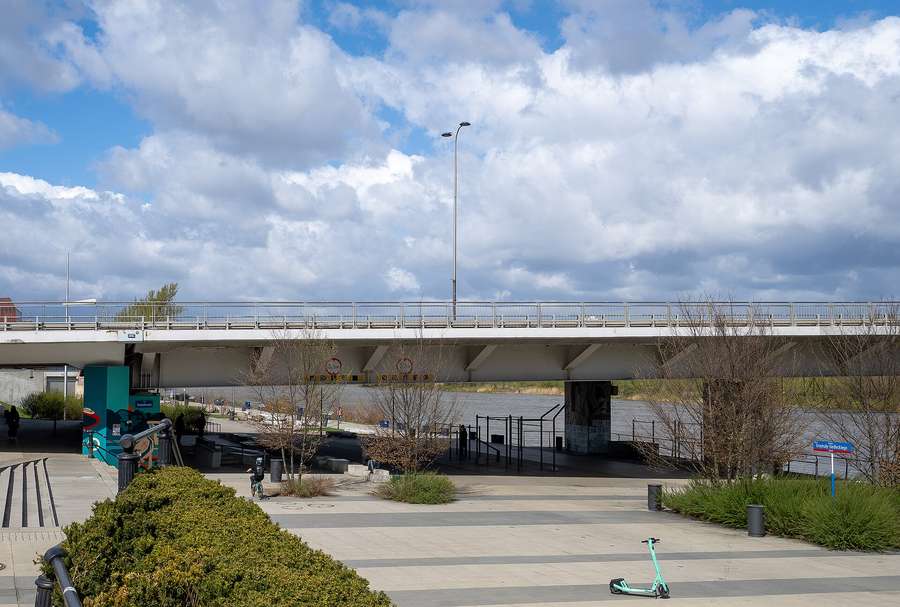
The boulevards run along the left bank roughly from the Old Town down past the Świętokrzyski bridge, neighboring the Royal Castle, Mariensztat and the Copernicus Science Centre. The northern part keeps the classic promenade layout with a mooring quay; the central stretch has display platforms for outdoor art and events and a water play area with a fountain. Landmarks to look for:
The pavilions and barges. Single-story pavilions house cafés, restaurants and exhibition space, leased out by the city. Alongside them, four floating barge-pavilions are moored at the quay, doubling as cruise stops with cultural and food offerings - and each has a free public toilet, a detail you will appreciate.
The Warsaw water gauge (wodowskaz). A sculptural cluster of columns showing the river's level in different periods, with one highlighted column marking the current level.
The Podzamcze viewpoint. A platform raised 4.5 m above the promenade (with a lift) looking out over the Old Town skyline and the wild right bank.
The Mermaid monument section. Opened last, in 2019, with a mist fountain and a water cascade, plus a sports zone with a skatepark and outdoor gym and a hammock area by the Świętokrzyski bridge. This is also home to part of the riverside "gallery of lights": murals, large-format projections on the bridge supports, the Dzielnica Wisła neon, and a rainbow tunnel with a soundtrack of riverside birdsong.
Data source: Zarząd Zieleni m.st. Warszawy (zzw.waw.pl, "Bulwary Wiślane"), checked 22 October 2026.
The new bridge to Praga
The biggest recent addition to the waterfront is the pedestrian and bicycle bridge that opened on 28 March 2024 - a month ahead of schedule after two years of construction. At 452 meters it is one of the longest footbridges of its kind in the world, 127 meters longer than London's Millennium Bridge. It crosses from the level of Wybrzeże Kościuszkowskie, near ul. Karowa on the left bank, to ul. Okrzei in Praga on the right, and you can walk it in about six minutes or cycle it in two.
The zigzag deck widens from 6.9 to 16.3 meters, with wooden benches at the two bends where people stop for the view - and the view is the point: the UNESCO-listed old town panorama straight ahead, beaches and the National Stadium to the south. The design began as a master's thesis by Małgorzata Dembowska at Warsaw University of Technology's architecture faculty, developed by the Schuessler Plan studio. In the evenings the bridge is illuminated, and it has quickly become the default sunset walk in the city.
Data source: Zarząd Dróg Miejskich Warszawa (zdm.waw.pl, "Most pieszo-rowerowy już otwarty", 29 March 2024), checked 22 October 2026.
Free ferries across the river
From spring to early autumn, Warsaw runs three completely free pedestrian ferries across the Vistula as part of its tourist lines program. In the 2026 season, schedules valid from 1 May 2026 cover three crossings: the W1 Słonka (Cypel Czerniakowski - Saska Kępa beach), the W2 Pliszka (Most Poniatowskiego - Stadion Narodowy beach), and the W3 Wilga (Podzamcze Fontanny - the ZOO beach). The crossing takes a few minutes and is the nicest possible way to get from the boulevards to the wild beaches opposite.
The ferries run on Saturdays, Sundays and holidays from 1 May to late September, and daily during the school summer holidays from 1 July to 31 August. They take bikes, they are genuinely free - no ticket, no app - and on a hot day the breeze mid-river is the best air conditioning in Warsaw.
Data source: Warszawski Transport Publiczny (wtp.waw.pl, "Promy przez Wisłę", schedules valid from 1 May 2026), checked 22 October 2026.
The beaches and the Plażowi
Warsaw's river beaches are a genuine anomaly: wide, sandy and mostly wild, strung along both banks. The main ones are Poniatówka (by the Poniatowski bridge, facing the National Stadium), Rusałka and Żoliborz further north, and Saska on the Praga side, plus a small city beach on the Patton boulevard under the Dance Pavilion. These are recreation beaches - for sand, sun, volleyball and fires in designated spots - not supervised bathing areas, so treat the river itself as scenery, not a swimming pool.
What makes them work is the Warszawscy Plażowi program, run by the city's Dzielnica Wisła team for over 13 years. Through the 2026 season, beach hosts staff points at all five beaches from 11:00 to 19:00 - on weekends in June and September, and every day in July and August. They lend out free deckchairs (around 37,000 people use them in a typical season), beach toys, volleyball and beach-tennis gear and blankets; they keep water bowls for dogs, hand out portable ashtrays and clean-up kits, run a free beach library, and are trained in first aid. The 2026 season also brought beach festivals to Rusałka (11 July), Saska (15 August) and Poniatówka (19 September).
Data source: City of Warsaw (um.warszawa.pl, "Warszawscy Plażowi wracają nad Wisłę. Rusza sezon plażowy 2026", 9 June 2026), checked 22 October 2026.
The drinking exception, explained
Yes, you can drink a beer on the boulevards - it is not a loophole, it is the law. Since 20 April 2018, a Warsaw city-council resolution has explicitly permitted alcohol consumption on the Vistula boulevards along the Flotylli Wiślanej, Grzymały-Siedleckiego, Pattona, Karskiego and Religi stretches, in the zone between the riverbank and the cycle path or walkway. Poland's Supreme Administrative Court upheld the resolution against a legal challenge on 25 January 2023.
Two caveats matter. First, the exception covers the designated boulevard zone, not the whole city - drinking in other public places in Warsaw remains an offence with an on-the-spot fine, and the beaches across the river are a different jurisdiction nuance worth respecting. Second, the unwritten local rule is behavior: the boulevards stay open precisely because the crowd keeps it civil. Buy from the pavilion bars or bring your own, keep it low-key, and take your bottles to the bins.
Data source: City of Warsaw (um.warszawa.pl, "Alkohol na bulwarach legalny", 2018; NSA ruling of 25 January 2023), checked 22 October 2026.
Practical tips
Getting there: the nearest metro is M2 Centrum Nauki Kopernik, about ten minutes on foot from the central boulevard; buses and trams stop along Wybrzeże Kościuszkowskie, and underpasses with ramps (plus a lift) cross under the Wisłostrada expressway. The boulevards are open around the clock and free. Summer weekends are busy but never unbearable; weekday evenings in June and September are the sweet spot. In winter the pavilions mostly hibernate, but the promenade stays open and the river fog is atmospheric in its own right.
Cyclists should note the promenade gets crowded - the dedicated cycle path runs along the upper level. If high water is forecast, lower sections can be closed off by the flood barriers; closures are posted locally. And if you only have two hours: start at the Copernicus Science Centre, walk north along the water to the Mermaid, cross back over the new bridge to Praga for the view, and ferry or tram home.
Frequently asked questions
Are the Vistula Boulevards free?
Yes. The boulevards, the beaches, the pedestrian bridge and the seasonal ferries are all free. You pay only for food, drink and any paid cruises moored at the quay.
Can you drink alcohol on the Vistula Boulevards?
Yes - within the designated boulevard zone between the riverbank and the cycle path, legal since 20 April 2018 under a Warsaw city-council resolution upheld by the Supreme Administrative Court in January 2023. Elsewhere in Warsaw's public spaces, drinking remains an offence.
When do Warsaw's free Vistula ferries run?
In the 2026 season: weekends and holidays from 1 May to late September, and daily from 1 July to 31 August, on three free crossings (Słonka, Pliszka, Wilga) linking the boulevards with the right-bank beaches.
What are Warsaw's main river beaches?
Poniatówka by the Poniatowski bridge, Rusałka and Żoliborz to the north, Saska on the Praga side, and a small beach on the Patton boulevard. In season, city beach hosts lend free deckchairs and sports gear daily in July and August and on June and September weekends. * Photos: Igor123121 (CC BY 4.0), via Wikimedia Commons.