Wolf's Lair and Mamerki: Hitler's Masurian Bunkers From Warsaw
The essentials: The Wolf's Lair (Gierłoż) and Mamerki are two vast WWII German headquarters hidden in the Masurian forests, about 260 km from Warsaw. Both open year-round; entry is 25-35 zł per site. See both in one long day trip or a weekend based in Kętrzyn.
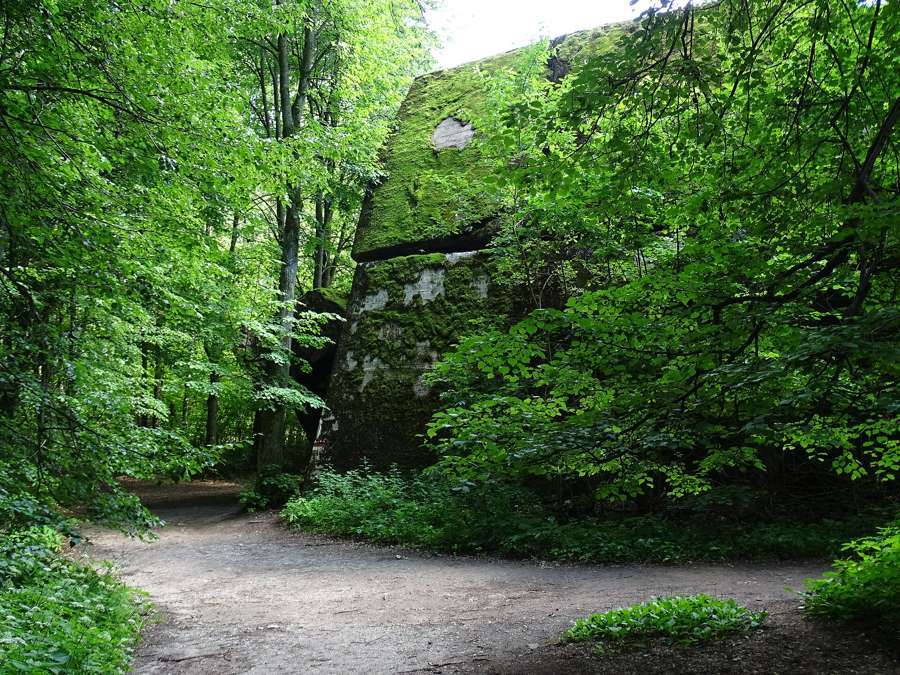
Deep in the forests of Masuria, 260 kilometres northeast of Warsaw, stand the remains of the two most important German military headquarters of the Second World War. The Wolf's Lair (Wilczy Szaniec) in Gierłoż was Adolf Hitler's personal field headquarters, and 18 kilometres away the village of Mamerki hid Mauerwald, the command centre of the German army's high command. Today both are open-air museum sites among the trees, and together they make one of the most striking weekend trips you can take from Warsaw. Here is the history that matters, the 2026 ticket and opening details, and how to plan the journey.
Two headquarters hidden in one forest
The two complexes are easy to confuse, so keep them apart from the start. The Wolf's Lair was built for Hitler himself and the armed-forces high command (OKW). Mamerki, code-named Mauerwald, housed the high command of the land army (OKH) - the generals who actually ran the eastern campaign day to day. They sit just 18 kilometres apart, close enough to visit comfortably in one day, and each tells a different half of the story: the Lair is about Hitler, the July 1944 assassination attempt and monumental demolition; Mamerki is about the professional army, and it survived the war almost intact.
Data source: official site histories at wilczy-szaniec.pl and mamerki.com, checked 22 October 2026.
The Wolf's Lair: where Hitler ran the eastern front
In early autumn 1940, senior officers of the German armed-forces high command arrived in the Gierłoż forest with Dr Fritz Todt, Hitler's chief engineer, to scout a location for the Führer's headquarters. Construction began in November 1940 under the cover story of a chemical works called "Askania". On 250 hectares of woodland, the builders put up around 200 structures: heavy air-raid shelters, lighter concrete and brick buildings, and wooden barracks. The complex had three guarded entrances, three concentric security zones, its own railway station, and two airfields - the main one six kilometres away near Wilamowo, a reserve strip near the village of Parcz. With water and sewage systems, a barber, a sauna and a cinema, it functioned as a self-sufficient forest town.
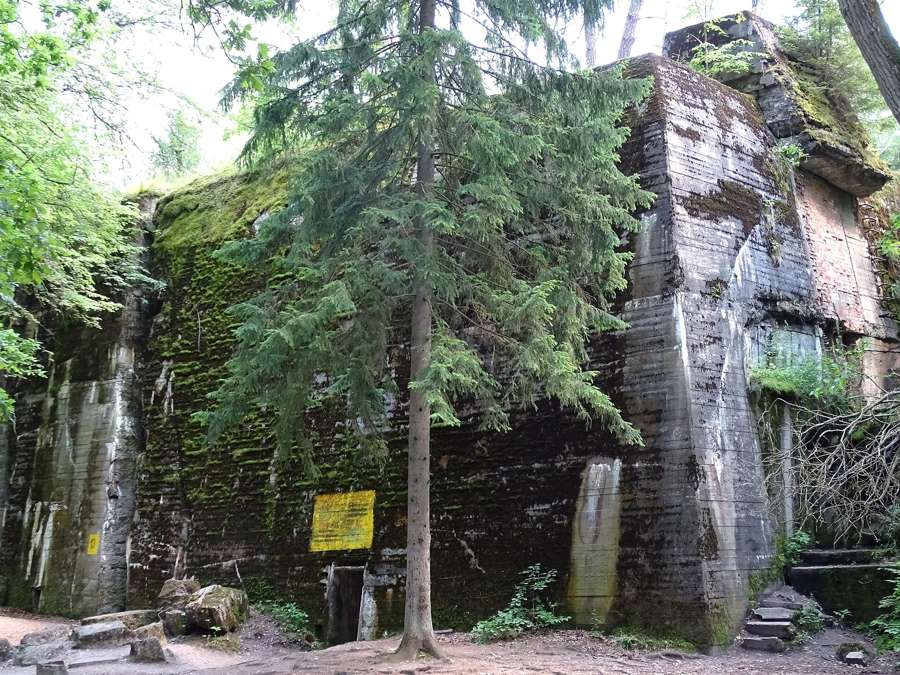
Hitler directed the invasion of the Soviet Union from here after it began on 22 June 1941, and the site remained his principal headquarters for most of the war. It was also here, on 20 July 1944, that Colonel Claus von Stauffenberg planted the bomb that narrowly failed to kill him. As the Red Army closed in, Hitler left the Wolf's Lair for the last time on 20 November 1944; two days later Field Marshal Keitel ordered its destruction, and in the night of 24-25 January 1945 the shelters and barracks were blown up. Soviet troops entered the abandoned ruins on 27 January 1945 without firing a shot. What you walk through today is that demolition frozen in place: enormous slabs of reinforced concrete tipped and cracked among tall pines.
Data source: official Wolf's Lair history page of the Srokowo Forest District (State Forests), checked 22 October 2026.
Visiting the Wolf's Lair in 2026
The site is open all year, seven days a week, including holidays, with seasonal hours: from 1 October to the end of February it opens 08:00-16:00; March runs 08:00-18:00; April 08:00-19:00; May to August 08:00-20:00; and September 08:00-18:00. Tickets are sold only at the gate - there is no online sale and no advance reservation in season. From 1 April to 31 October a normal ticket costs 30 zł and a reduced ticket 25 zł; from 1 November to 31 March those fall to 25 zł and 20 zł. Children under six enter free, and the reduced rate covers pupils up to 18, students to 26, Large Family Card holders and visitors with disabilities plus one carer. Guides contracted from outside pay a 25 zł guide ticket.
Budget a little extra for parking: 15 zł for a car, 10 zł for a motorcycle, 20-35 zł for larger vehicles, while bicycles and fully electric cars park free. One autumn-winter caveat matters: between 1 November and 31 March the indoor exhibitions stay closed, so an off-season visit is purely the outdoor trail through the ruins - which, honestly, is the main event anyway. The site is run as a history and nature education centre by the Srokowo Forest District, part of Poland's State Forests, and the grounds include a café, souvenir shop, toilets and a mother-and-child room.
Data source: official visiting page at wilczy-szaniec.pl, price list updated 1 December 2025, checked 22 October 2026.
Mamerki: the army headquarters that survived intact
Mamerki - German Mauerwald - lies on the Masurian Canal, eight kilometres from Węgorzewo, 25 from Kętrzyn and 18 from the Wolf's Lair. Between 1940 and 1944 the Todt Organisation secretly built roughly 250 objects here for 40 of the Wehrmacht's most senior generals and field marshals and some 1,500 officers and soldiers, including 30 reinforced-concrete shelters. This was the working brain of the eastern war: army commander Field Marshal Walter Brauchitsch and general-staff chief Franz Halder moved in as the invasion began, Friedrich Paulus had personally drafted much of the Barbarossa plan, and Heinz Guderian later served here as chief of the general staff. Stauffenberg himself was stationed at Mamerki from June 1941 to February 1943, and the museum's account describes the forest as the place where he quietly recruited fellow plotters.
The key difference from the Wolf's Lair: the Wehrmacht abandoned Mamerki without a fight in January 1945 and never demolished it, so the bunkers stand complete rather than shattered - the site's operators call it one of the best-preserved undestroyed German bunker complexes in Poland. The newest draw is a full-scale, 1:1 replica of the Amber Room, opened on 26 April 2025, recreating the chamber looted from Tsarskoye Selo whose original has never been found. Mamerki is privately run and dogs are welcome on the grounds.
Data source: official Mamerki history page at mamerki.com, checked 22 October 2026.
Visiting Mamerki in 2026
Admission currently costs 35 zł for adults and 30 zł for children and young people; group rates of 22 zł and 17 zł apply only to travel agencies and school groups. Parking is free. As of 22 October 2026 the site lists autumn hours of 11:00-15:00 daily and 11:00-16:00 on Saturdays and Sundays - considerably shorter than the 09:00-18:30 summer schedule the English page still shows, so treat hours as seasonal and phone ahead (+48 698 793 104) before a long drive, especially in winter. Live guides in Polish, German, French or English can be booked in advance by phone or email, with a private guide costing from 150 zł for up to ten people.
Data source: official Mamerki price list at mamerki.com/cennik, checked 22 October 2026.
Getting there from Warsaw
Driving is by far the simplest option. Gierłoż is about 260 kilometres from Warsaw, roughly three and a half to four hours via the S8 and S61 express roads toward Ostrów Mazowiecka, Łomża and Kętrzyn; the Wolf's Lair is signposted from Kętrzyn, ten kilometres away. Without a car, direct PKP Intercity trains link Warszawa Centralna with Kętrzyn, and from Kętrzyn station a taxi covers the last stretch to Gierłoż - check current departures on the official rozklad-pkp.pl planner, since services on this line change with each timetable. Reaching Mamerki, another 18 kilometres on, is awkward without a car, so train-based visitors should arrange a local taxi or join an organised tour. If you want an unhurried trip, base yourself overnight in Kętrzyn, Węgorzewo or Giżycko and add the lakes the next day.
Data source: rozklad-pkp.pl passenger portal and route planners, checked 22 October 2026.
Planning an autumn or winter visit
In the short days between October and February, timing is everything: the Wolf's Lair closes at 16:00 and Mamerki at 15:00, so leaving Warsaw by 07:00 is not excessive if you want both sites in daylight. Do the Wolf's Lair first - it needs a good two to three hours on the marked trails - then drive the 25 minutes to Mamerki after lunch. Wear proper shoes, because both sites are forest paths that turn muddy after rain and icy in winter. Large Family Card holders pay the reduced rate at the Wolf's Lair; Mamerki, as a private attraction, lists no KDR discount. Photography is welcome at both, and the scale of the concrete against the birch and pine is genuinely photogenic in low autumn light. Finally, remember what these places are: preserved ruins of a command centre, presented as education rather than spectacle - both sites take that framing seriously, and it shows.
Data source: official visiting pages of both sites, checked 22 October 2026.
Frequently asked questions
How much does it cost to visit the Wolf's Lair?
In the main season (1 April to 31 October) a normal ticket costs 30 zł and a reduced one 25 zł; from November to March the prices drop to 25 zł and 20 zł. Children under six enter free. Parking adds 15 zł per car, and tickets are sold only at the gate.
Can you see the Wolf's Lair and Mamerki in one day?
Yes - the two sites are only 18 kilometres apart. Allow two to three hours at the Wolf's Lair and about 90 minutes at Mamerki. In autumn and winter start early, because both close by mid-afternoon.
Is the Wolf's Lair open in winter?
Yes, the site opens every day of the year including holidays; from October to February the hours are 08:00-16:00. Note that indoor exhibitions close for the off-season (1 November to 31 March), so a winter visit covers the outdoor ruins only.
What is the Amber Room at Mamerki?
It is a full-scale 1:1 replica of the famous Amber Room, opened to visitors on 26 April 2025. The original chamber was looted by German forces from Tsarskoye Selo during the war and has never been found.
How do I reach the Wolf's Lair without a car?
Take a direct PKP Intercity train from Warszawa Centralna to Kętrzyn, then a taxi for the final ten kilometres to Gierłoż. Check rozklad-pkp.pl for current train times, and plan ahead if you also want to see Mamerki, which is 18 kilometres further. * Photos: Goering's bunker and the remains of Hitler's shelter at the Wolf's Lair, Gierłoż, both by Adam Jones, CC BY-SA 2.0, via Wikimedia Commons.