Zaduszki: All Souls' Day in Poland on 2 November, Explained
The essentials: Zaduszki (All Souls' Day) falls on 2 November and is not a public holiday in Poland: Monday 2 November 2026 is a normal working day with shops open. Poles keep visiting cemeteries, light znicz candles and order wypominki prayers; expect cemetery traffic into the evening.
The candles do not go out when 1 November ends. On Monday 2 November 2026 Poland marks Zaduszki - All Souls' Day, the second half of the country's days of the dead. It is quieter than All Saints' Day, but for many Poles it is the more personal one: the day of praying specifically for the souls of the departed. If you are new to Poland, here is what Zaduszki means, what stays open and what to expect on the streets.
Is 2 November a day off in Poland?
No. Poland's statutory list of public holidays, set out in the Act on days off work (ustawa o dniach wolnych od pracy), includes only two November dates: 1 November (All Saints' Day) and 11 November (Independence Day). All Souls' Day has never been on that list.
In 2026 that means Monday 2 November is a completely normal working day:
- Offices, schools, universities and public institutions (urzędy) work their usual Monday hours.
- Shops are open. The Sunday trading ban does not apply because 2 November is a Monday, and it is not a holiday.
- Banks, post offices and parcel lockers operate normally.
The one visible exception is the mood: many people leave work a little early to reach a cemetery before dark, which falls around 16:00-16:30 in early November.
What is Zaduszki?
Zaduszki (formally Dzień Zaduszny, "the day of prayers for the souls") is the Roman Catholic Commemoration of All the Faithful Departed, observed on 2 November. Where All Saints' Day honours the saints, All Souls' Day is for everyone else: ordinary dead, remembered by name. The feast was standardised in the 10th century by St Odilo of Cluny and entered the general Roman calendar in 1311.
In the Polish folk calendar, the two days always belonged together. Historians note that for ordinary people the eve of All Saints and Zaduszki itself were the heart of the commemoration - the days when the boundary between the living and the dead was believed to grow thin, and the souls of ancestors were expected to visit their old homes. The old Slavic name for the feast, Dziady (Forefathers), survived in the title of Adam Mickiewicz's famous Romantic drama.
What actually happens on 2 November
The rhythm of Zaduszki is a quieter continuation of 1 November:
- Cemetery visits continue. Families who could not travel on the weekend, or who prefer to avoid the crowds, go on Monday. Cemeteries are noticeably calmer but still busy by everyday standards, especially from mid-afternoon.
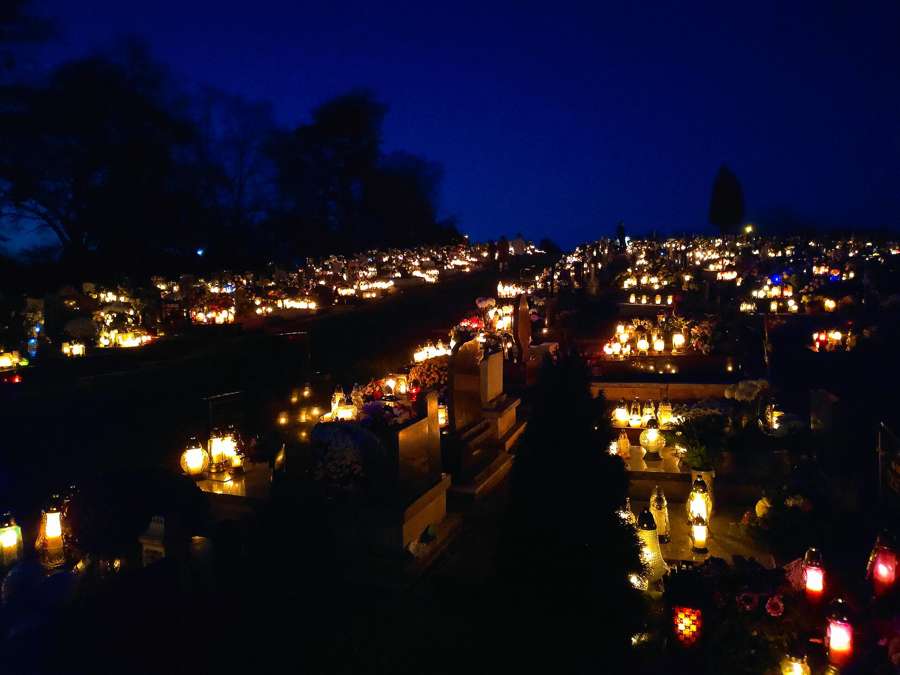
- Candles keep burning. The sea of znicz lanterns lit on 1 November is replenished, and the evening "glow" over big cemeteries is just as striking on 2 November.
- Churches hold services for the dead, often including the reading of wypominki (see below).
- Most special cemetery transport lines have ended. In the cities we covered, the extra cemetery buses and trams generally ran until Sunday 1 November (Warsaw, Kraków, Gdańsk, Wrocław, Poznań, Katowice and the GZM, Łódź, Toruń, Lublin, Bielsko-Biała and others). Regular lines still serve cemetery districts, and a few cities extend selected services into 2 November, so check your operator's notices if you plan a Monday visit.
- Traffic stays heavy near cemeteries. Police run the nationwide "Znicz 2026" operation through the whole All Saints period, with extra patrols and traffic control around cemeteries, as regional police announcements from the past days confirm. In 2025 the operation ran from Friday 31 October to Sunday 2 November with around 5,000 officers on the roads; expect similar coverage this year and congestion around big cemeteries into Monday evening.
The traditions behind the day
Wypominki: names read aloud
The most distinctive living custom is wypominki - lists of the dead, read aloud during prayers. Families write the first names of their departed on slips of paper or in small envelopes (wypominki envelopes, sold at churches in the weeks before), add a donation for the parish or for charity, and the names are read out at masses and cemetery services through the Zaduszki period. The custom is ancient: Polish History notes that prayers of this type were practiced in Poland as early as the 10th century, with the oldest written record from the 15th century, and that in the mid-19th century priests charged a fixed fee of three grosze "per soul" for the reading.
Znicze: the fires of the dead
The candle lanterns on every grave feel timeless, but ethnographers trace them to something older than the custom itself. According to the Ethnographic Museum in Rzeszów, quoted by the state history portal dzieje.pl, fires were once lit in homes so that returning souls could warm themselves - and this is where today's grave candles come from. Curiously, lighting candles on graves is a fairly young habit in Poland: a Kraków newspaper described it in the 19th century as a custom "brought over from the West not long ago". Before that, remembrance happened at home or at church, not in the cemetery.
Dziady and food for the souls
The oldest layer of the feast, Dziady, involved sharing food with the dead. Cemetery feasts left small portions of honey, groats, bread and poppy seeds on graves so the souls would have something to eat, and beggars - themselves called dziady - were invited into homes for a meal rather than given money. In parts of Poland women baked special "bread for souls", handed out to the poor, to children and to priests; some families baked and gave away two or three hundred small buns, believing generosity to the dead brought prosperity to the living.
Pańska skórka: the Warsaw sweet
If you pass a Warsaw cemetery gate around Zaduszki, look for stalls selling pańska skórka ("lords' crust") - pink-and-white peppermint nougat sold from glass cases. As TVP Polonia's Zaduszki traditions report notes, the sweet is a distinctly Warsaw part of the season, the local answer to Sicily's marzipan fruits. It is the closest thing Poland has to a trick-or-treat candy, and it appears only around these days.
How to take part as an expat
Zaduszki is not a private ritual - cemeteries are public, and nobody will look twice at a foreigner with a candle. A few pointers:
- Buy a znicz before you go. Candles and flowers are sold at cemetery gates, in supermarkets and at petrol stations; gateside stalls keep the longest hours on these days.
- Light a candle for an unvisited grave. Leaving a light on a grave nobody has tended is an accepted, appreciated gesture - you do not need to know the person.
- Keep it subdued. No music, no phone calls, no picnicking. Photography of the general candlelight is common, but do not photograph mourning people or individual graves up close.
- Dress warmly and practically. Paths are uneven, unlit and crowded; early November evenings hover around 0-5 degrees.
- Go after dark at least once. The view over a large cemetery - Powązki in Warsaw, Rakowicki in Kraków, Łostowicki in Gdańsk - glowing with thousands of flames is one of the most striking sights Poland offers, and Monday evening is far calmer than Sunday.
The remembrance does not end on Monday evening. Graves stay decorated for days, families return through the week to replace burnt-out candles, and many parishes continue reading wypominki through the whole octave of All Souls. Only after that does Poland's long, grey ordinary November truly begin - which is exactly why expats who have seen the candlelit cemeteries once tend to go back every year.
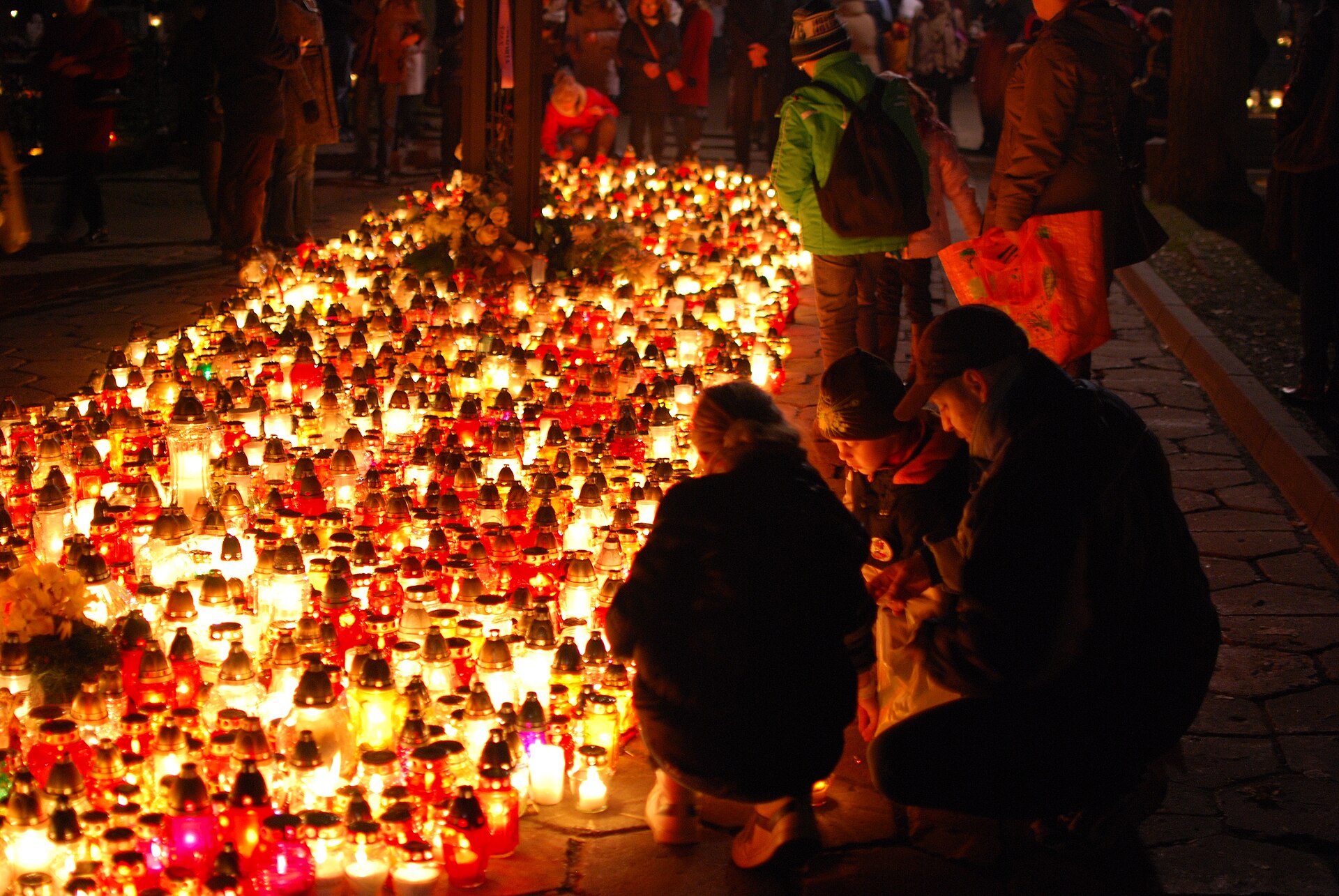
Cover photo: a hillside cemetery glowing with hundreds of znicz candle lanterns on All Saints' evening in Poland, by Marek Slusarczyk - Tupungato (CC BY 3.0, via Wikimedia Commons). Photo below: a family among hundreds of grave candles on All Saints' Day 2014 in Lodz, by Zorro2212 (CC BY-SA 4.0, via Wikimedia Commons).
Frequently asked questions
Is 2 November 2026 a public holiday in Poland?
No. Only 1 November (All Saints' Day) and 11 November (Independence Day) are statutory holidays in November. Monday 2 November 2026 is a normal working day: offices, schools, shops and banks all operate as usual.
Are shops open on Zaduszki?
Yes. The Sunday trading ban does not apply (2 November 2026 is a Monday), and Zaduszki is not a statutory holiday, so stores, supermarkets, pharmacies and shopping centres keep normal Monday hours.
What is the difference between All Saints' Day and All Souls' Day?
All Saints' Day (1 November) honours all saints and is the public holiday with the biggest cemetery crowds. All Souls' Day (2 November) commemorates all the faithful departed - ordinary people remembered by name - through cemetery visits, candles and wypominki prayers. In practice Poles treat the whole period as one time of remembrance.
What are wypominki?
Wypominki are written lists of the first names of dead relatives, given to a parish with a donation and read aloud during prayers around Zaduszki. The custom has been practiced in Poland for roughly a thousand years.
Can foreigners take part in Zaduszki?
Yes. Cemeteries are public, candles are sold at every gate, and lighting a znicz - even for a grave no one else has visited - is welcome. Dress warmly, keep quiet and respectful, and do not photograph people in mourning.
Do special cemetery bus and tram lines run on 2 November 2026?
Mostly no: in the major cities the special cemetery lines ran until Sunday 1 November 2026, though a few cities extend selected services into Monday. Regular lines still serve cemetery areas - check your city operator's notices before a Monday evening visit.
Sources
- Polish History: The genesis of All Saints' and All Souls' customs
- dzieje.pl: Dziady - the forgotten customs of All Saints' and Zaduszki
- TVP Polonia: Zaduszki in culture and tradition, 2 Nov 2025
- Ustawa o dniach wolnych od pracy, t.j. Dz.U. 2020 poz. 1920
- moja-jeleniagora.pl: Znicz 2026 police operation, 23 Oct 2026
- Autokult: Znicz 2025 operation, 31 Oct 2025