Zalipie: Poland's Painted Village, a Day Trip from Kraków
The essentials: Zalipie, 110 km from Krakow, is Poland's painted village: a living tradition of floral cottage murals since the 19th century. The Felicja Curylowa homestead museum costs 12 zl (free Wednesdays), closed Mondays. Drive via Tarnow in 1.5 hours, or train to Tarnow then local bus.
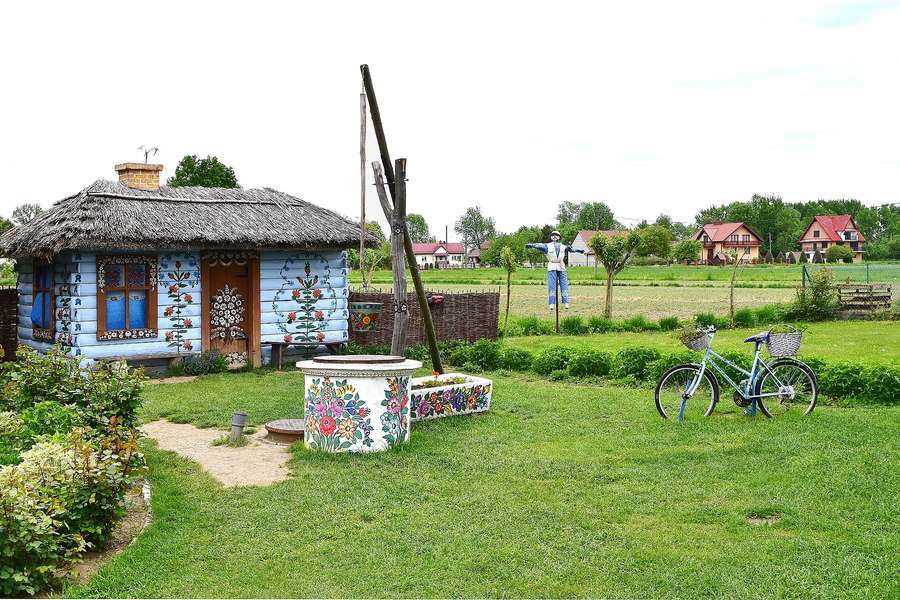
About 110 kilometers east of Kraków, where the Vistula plain spreads into the farming country of Powiśle Dąbrowskie, there is a village where the cottages bloom all year. In Zalipie, farmhouses wear hand-painted garlands of roses, peonies and pansies on their walls - and so do the barns, the wells, the doghouses, the beehives, the fences and, inside, the stoves, ceilings and furniture. It is not a folk village built for tourists; it is a living village that has been painting itself for more than a century, and it makes one of the most unusual and charming day trips in southern Poland.
For expats in Kraków, Zalipie is the antidote to the city's well-trodden circuit. There are no crowds, no ticket queues longer than a farmhouse door, and admission costs less than a coffee in the Rynek. Here is what you are looking at, and how to do the trip well.
Why a whole village paints its houses
The tradition's roots are practical, not decorative. Until the late 19th century, rural cottages in this region were "smoky houses" (dymne chaty) with no chimneys: smoke from the hearth drifted through the room and out, blackening walls and ceilings with soot. As chimneys arrived and walls were whitewashed, women began painting over the remaining stains and uneven patches of lime with white spots known as "packi". The spots grew into flowers, the flowers into garlands, and by the turn of the 20th century a distinctive local style had emerged - bold bouquets and wreaths in strong colors, passed down, the museum notes, usually from mother to daughter.
What makes Zalipie special is the scale of adoption. This was never one artist's quirk: across Zalipie and neighboring villages, generations of women painted not just walls but everything paintable - interiors, canvases, furniture, stoves, wells, chicken coops and dog kennels, even individual objects like trunk lids and picture frames, alongside the paper cut-outs (wycinanki) and tissue-flower bouquets that dressed cottage interiors. The styles vary from painter to painter: some favor tight, symmetrical bouquets, others loose climbing vines, and the classic Zalipie look - big multi-colored bunches of flowers on a white or blue ground - is instantly recognizable. Over a hundred years later, the custom is a core part of local identity, sustained deliberately through a famous annual competition.
Data source: Muzeum Ziemi Tarnowskiej (muzeum.tarnow.pl, "Zagroda Felicji Curyłowej w Zalipiu"), checked 22 October 2026.
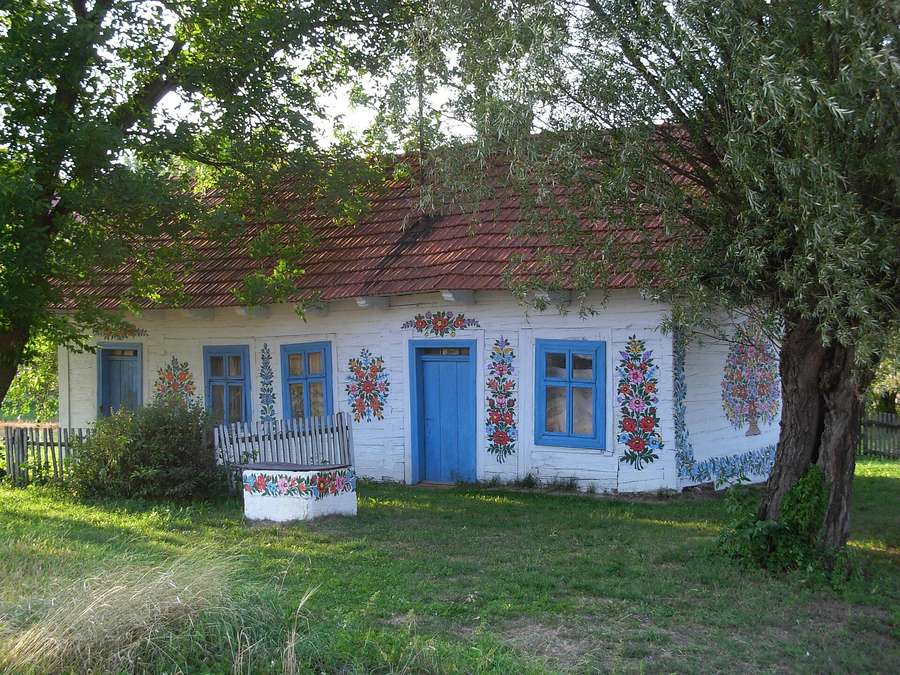
The museum: three cottages and a painted world
The heart of a visit is the Zagroda Felicji Curyłowej, the homestead of Felicja Curyłowa (1903-1974), the tradition's most celebrated painter, now a branch of the Muzeum Ziemi Tarnowskiej at Zalipie 135, right on the main road. Her cottage was already a destination for folk-art lovers in her lifetime and is preserved exactly as she left it: a black hallway ceiling patterned with white clay motifs in the oldest local technique, walls hung with painted "carpets", cut-outs and tissue flowers, a traditional Powiśle costume she made herself, and a kitchen whose stove is painted blue and covered in multi-colored floral murals.
The homestead has two more buildings. Next door, the fully furnished cottage of Stefania Łączyńska, another noted painter and poet, is the museum's second decorated interior - and the museum is explicit that these two are the only painted interiors you can enter: the other decorated houses in the village are lived-in private homes, not an open-air museum. The third building is a "poor cottage" (chata biedniacka), a single-room log house with the animals historically kept under the same roof, whitewashed and decorated only on the outside - a quiet reminder that the painting style crossed every class of village life.
Data source: Muzeum Ziemi Tarnowskiej (muzeum.tarnow.pl), checked 22 October 2026.
Tickets, hours and the free day
Admission is genuinely cheap. The price list in force since 1 March 2024 charges 12 zł normal, 9 zł reduced, 28 zł for a family ticket and 6 zł social, with a guide at 60 zł plus entry. One current bonus: since 3 August 2026, Wednesdays are free for permanent exhibitions across all Muzeum Ziemi Tarnowskiej branches, Zalipie included - though entry to the exhibition is limited to 25 people at a time at set hours, so arrive early on a free day.
The homestead is closed on Mondays. In summer (1 May - 30 September) it opens Tuesday, Wednesday, Friday and Saturday 10:00-18:00, Thursday and Sunday 9:00-17:00; in winter (1 October - 30 April) the midweek days run 8:00-16:00 with the same Thursday-Sunday pattern. Last visitors must leave the exhibition 15 minutes before closing.
Data source: Muzeum Ziemi Tarnowskiej (muzeum.tarnow.pl, visitor page and price list effective 1 March 2024), checked 22 October 2026.
Malowana Chata: the competition that keeps it alive
Every year around Corpus Christi, Zalipie hosts the "Malowana Chata" (Painted Cottage) competition - first held in 1948 and today the longest-running folk art competition in Poland. Organized since 1976 by the Tarnów museum together with Zalipie's Dom Malarek cultural center, it draws around a hundred participants from the Powiśle Dąbrowskie region, who refresh or create decorations on houses, barns, wells, doghouses and everyday objects, as well as interior murals, paintings on canvas and paper, cut-outs and tissue-flower bouquets. Free paint is supplied to participants by Dom Malarek and a Tarnów company.
A jury of ethnographers visits the entered homesteads over the two weekend days after Corpus Christi, and results are announced on the Sunday at the Zalipiański festyn village fair. The 63rd edition wrapped up in June 2026, with works due for judging on Friday 11 June. If you can time your trip for the week after Corpus Christi, you will see the village at its freshest - newly repainted, in full color, and in festival mood.
Data source: Dom Malarek w Zalipiu (dommalarek.pl, "Malowana Chata") and Muzeum Ziemi Tarnowskiej news (63rd edition, 2026), checked 22 October 2026.
Getting there from Kraków
By car, Zalipie is about 110 km and roughly an hour and a half from Kraków: take the A4 east towards Tarnów, exit for Tarnów, then head north through the Dąbrowa Tarnowska road to Zalipie, which lies about 35 km north of Tarnów. The museum homestead sits directly on the main road and is easy to spot.
By public transport, there is no railway to Zalipie itself - the nearest station is Tarnów, which has frequent trains from Kraków in about an hour. From Tarnów, a local bus runs from ul. Krakowska-Planty through Dąbrowa Tarnowska to Zalipie and on to Gręboszów; the service is weekday-heavy, so check the current timetable on the regional tourism portal before setting out, and consider a taxi from Tarnów for flexibility. The honest verdict: doable without a car, much better with one.
Data source: Muzeum Ziemi Tarnowskiej accessibility page and zalipie.tarnow.travel bus timetable, checked 22 October 2026.
Making a day of it
Zalipie itself fills an unhurried half day: the museum homestead, a slow drive or walk past the painted private homesteads (look, photograph from the road, but remember these are people's homes), and a stop at Dom Malarek, the village cultural center that keeps the painting workshops and competition alive - its instructors teach the Zalipie motifs, and in season you can sometimes watch painters at work or join a workshop yourself, which makes a far better souvenir than anything in a gift shop. Pair it with Tarnów on the way back - its Renaissance market square and town hall are twenty minutes off your route home and criminally undervisited. In summer, the whole area is flat, green and ideal for cycling; in winter the painted cottages look even stranger and brighter against snow.
Practical notes: the museum buildings are small historic interiors, so large bags are a nuisance; photography rules are posted at entry; and card payment is generally available but carry some złoty for village shops. There is no café culture in Zalipie - eat in Tarnów or pack a picnic. If you are visiting with children, the painted farmyard objects - the dog kennel, the well sweep, the beehives - tend to land better than the interiors, and the short walking distances suit small legs.
Frequently asked questions
How much does it cost to visit Zalipie?
The Felicja Curyłowa homestead museum charges 12 zł normal, 9 zł reduced, 28 zł family and 6 zł social (prices effective 1 March 2024). Wednesdays have been free for permanent exhibitions since 3 August 2026, with 25-person entry limits.
Can you enter the painted houses in Zalipie?
Only two painted interiors are open to visitors, both inside the museum homestead: Felicja Curyłowa's cottage and Stefania Łączyńska's cottage. The other painted houses in the village are private, lived-in homes.
When is the best time to visit Zalipie?
The week after Corpus Christi (early-to-mid June), when the annual Malowana Chata competition ends and the village is freshly repainted. The competition, first held in 1948, is Poland's longest-running folk art contest.
How do I get to Zalipie from Kraków without a car?
Take a train from Kraków to Tarnów (about an hour), then the local bus from ul. Krakowska-Planty towards Gręboszów, which stops in Zalipie about 35 km north of Tarnów. Buses are infrequent, so check the timetable first - or take a taxi from Tarnów. * Photos: Scotch Mist (CC BY-SA 4.0), Piotrus (CC BY-SA 3.0), via Wikimedia Commons.