Bydgoszcz Weekend Guide: Granaries on the River, Mill Island and Soap
The essentials: Two days in Bydgoszcz covers the half-timbered granaries on the Brda, Mill Island and its tightrope-walker sculpture, the Soap Museum (39 zł, daily 10-18), the canal quarter and the Myślęcinek forest park. Fast IC trains link the city with Warsaw.
Bydgoszcz is a city built on water that most travellers to Poland never think of, which means you get its best assets almost to yourself: 18th-century half-timbered granaries standing in the river, a museum island ringed by mill streams, a forest park the size of a small town, and one of the oddest little museums in the country. This is a two-day plan from Warsaw with current prices and the train changes worth knowing about.
Getting there from Warsaw
PKP Intercity links Warsaw and Bydgoszcz directly, and the corridor is being upgraded into one of the operator's flagship routes. Today's fast IC Brda runs with few stops; from December 2026 a second "sprinter" service, IC Moniuszko, joins it, stopping only in Toruń and Włocławek, with two more sprinters (IC Ogiński and IC Łuczniczka) following from September 2027. The operator plans 12 pairs of trains a day between Bydgoszcz, Toruń, Włocławek and Warsaw, four of them sprinters at roughly four-hour intervals with the shortest journey times on the route.
One caution for winter trips: during the new timetable from 13 December 2026, modernization at Warszawa Wschodnia sends selected trains between Warsaw and the Kujawsko-Pomorskie region via Warszawa Gdańska instead of Centralna, Wschodnia and Zachodnia, so check the departure station on your ticket. Bydgoszcz Główna station is a 15-minute walk or a short tram ride from the old town and the river.
Data source: PKP Intercity press office, 2026/2027 timetable release for Kujawsko-Pomorskie (intercity.pl), checked 22 October 2026.
Day one: the granaries and Mill Island
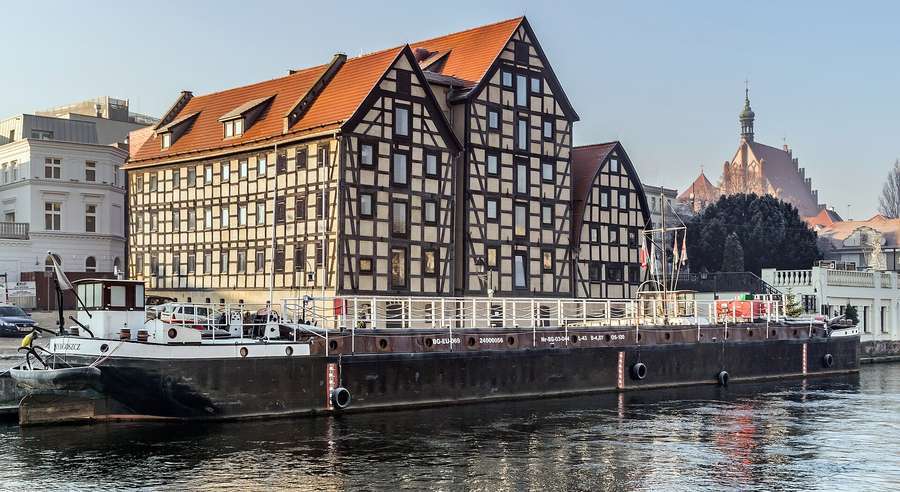
Bydgoszcz's postcard view is the row of half-timbered granaries standing on stilts over the Brda river at Grodzka Street, built in the days when the city was a grain port on the waterway between the Oder and Vistula systems. The 18th-century timber frames now house District Museum exhibitions, and the view from the opposite bank, with barges moored below and the cathedral's spire behind, is the shot every visitor takes.
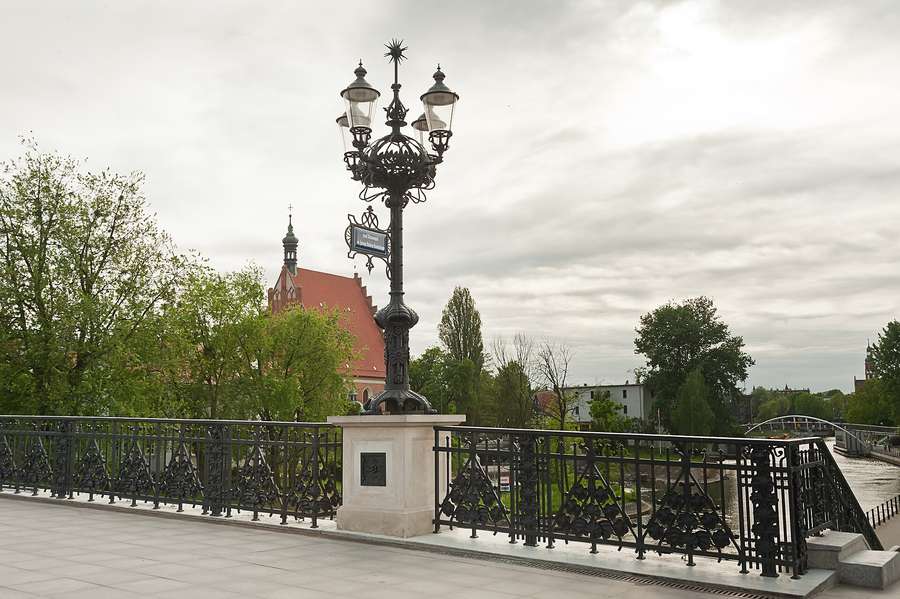
From the granaries, bridges lead onto Wyspa Młyńska, Mill Island, a green island wrapped in mill channels where the city's flour mills once ran on the current. Today it is Bydgoszcz's park quarter: lawns, footbridges, an old red-brick mill complex holding the District Museum's main collections, riverside cafes, and the famous sculpture of a tightrope walker balanced on a wire above the channel, installed in 2004 and beloved enough to appear on everything from postcards to the city's souvenirs. The island is free, open at all hours, and takes an unhurried hour to circle. Come twice if you can: once in daylight for the mill architecture and the museum collections, and once after dark, when the bridges and the old mill walls are lit and the tightrope walker gleams over the black water. In summer the lawns fill with picnics and open-air events; in autumn the island's old trees drop leaves into the channels and the whole loop feels like a park someone hid in the middle of a city.
Day one, afternoon: the Soap Museum and the old town
For families, Bydgoszcz's secret weapon is the Museum of Soap and History of Dirt on Długa Street in the old town. It is less a museum than a 50-minute workshop show: visitors learn how soap was made through the centuries and then make their own bar to take home, with plenty of theatre along the way. The museum is open daily 10:00 to 18:00; tickets are 39 zł normal and 35 zł reduced or group, groups are capped at 35 people per session, and the operator advises booking ahead as sessions fill.
Data source: Museum of Soap and History of Dirt official site (muzeummydla.pl), checked 22 October 2026.
The rest of the old town repays a slow loop: the market square with the old town hall, the Gothic cathedral with its richly painted interior, and the streets of the former wool market quarter. The cathedral's interior, repainted in deep reds and golds in the 20th century, surprises everyone who steps in expecting a bare Gothic nave, and the treasury chapel holds centuries of liturgical gold. Between sights, the old town's cafe scene is strong for a city this size, with roasteries and cake shops filling the front rooms of the old merchants' houses. In the evening, cross the river to the Opera Nova, the modern white opera house on the bank of the Brda, whose foyer windows frame the granaries across the water; even without a ticket, the riverside path past it is the best dusk walk in town.
Day two morning: the Venice of Bydgoszcz and the canals
The Brda and its channels give the centre its second face. The Wenecja Bydgoska quarter, where the Młynówka channel threads between old warehouse walls, is best seen from the water in season, when water trams run loops from the Rybi Rynek landing; off-season, walk the towpaths instead, past the locks and the old port basins. Bird-watchers should look down as much as around: the channels hold herons, kingfishers and the occasional beaver even in the city centre. The waterways also explain the city's name on the map: Bydgoszcz grew where the Brda meets the Vistula's great bend, and the 18th-century Bydgoszcz Canal, dug to join the two great river systems, still threads east from the centre through a string of old locks, a green corridor popular with weekend cyclists.
Day two afternoon: Myślęcinek
North of the centre, Myślęcinek is one of the largest city parks in Poland: over 800 hectares of forest, lakes and meadows inside the city limits, with a botanical garden, a small zoo corner, treetop walking paths, cycling and running trails, and horse-riding stables at its edge. In autumn the beech and oak woods are at their best; in winter the cross-country tracks appear with the first snow. Buses and trams from the centre reach the main entrances in about twenty minutes, and a half day here turns a city weekend into a proper outdoors break.
Food and practical notes
Eat along the old town lanes rather than the station strip: Bydgoszcz does good modern Polish bistros around the market square and Gdańska Street, the long 19th-century avenue running north from the river, which is worth a walk in itself for the architecture and the independent shops. Card payment is universal, English is common in the centre, and hotel prices sit well below Gdańsk or Kraków. A weekend here pairs naturally with Toruń, forty minutes away by train, if you want two old towns in one trip.
A realistic weekend plan
Saturday: morning train, drop bags near the centre, the granaries and Mill Island, lunch in the old town, the Soap Museum show booked for mid-afternoon, then the Opera Nova river path at dusk. Sunday: the Venice quarter and channels in the morning, tram to Myślęcinek for the early afternoon, and the evening train back to Warsaw. With more time, add Toruń as a second day or swap Myślęcinek for a lazy brunch and the District Museum's art collections on Mill Island. In the rain, the plan compresses gracefully: the Soap Museum, the District Museum and the cafes of the old town absorb a full wet day without the weekend feeling lost. Winter visitors should simply dress for the river wind; the granaries and the island in snow are arguably the city's prettiest season of all.
Frequently asked questions
How do I get from Warsaw to Bydgoszcz by train?
PKP Intercity runs direct fast IC services; from December 2026 a second sprinter joins the route and the corridor grows to 12 pairs of trains a day through 2027, with the four fastest pairs stopping only in Toruń and Włocławek. From 13 December 2026 some trains run via Warszawa Gdańska instead of Centralna, so check your ticket.
What is the Museum of Soap and History of Dirt?
A workshop-style museum on Długa Street in Bydgoszcz's old town where visitors learn how soap was made through history and make their own bar. Open daily 10:00 to 18:00; tickets are 39 zł normal and 35 zł reduced, with advance booking recommended.
What is Mill Island in Bydgoszcz?
Wyspa Młyńska is a green island in the Brda's mill channels in the city centre: footbridges, lawns, a red-brick mill complex holding the District Museum, riverside cafes and the famous tightrope-walker sculpture. Entry is free at all hours.
Is Bydgoszcz worth a weekend trip?
Yes. The riverside granaries, Mill Island, the soap workshops and the vast Myślęcinek forest park fill two days comfortably, prices are lower than in Poland's bigger tourist cities, and Toruń is an easy add-on forty minutes away.
What is Myślęcinek?
One of Poland's largest city parks: over 800 hectares of forest, lakes and meadows inside Bydgoszcz, with a botanical garden, treetop paths, cycling and running trails and riding stables, about twenty minutes from the centre by bus or tram. Entry is free. * Photos: Cover - the half-timbered granaries on the Brda by Krzysztof Golik, CC BY-SA 4.0, via Wikimedia Commons. Body - footbridge lamp on Mill Island by Hans-Jürgen Neubert, CC BY 4.0, via Wikimedia Commons.