Renting a Car in Poland: Deposits, Collection and Return
The essentials: Check the supplying branch requirements before paying, including driver documents, accepted cards, security hold and protection. Inspect and record the vehicle at collection and return, follow fuel and route conditions, and keep the final account and handover records.
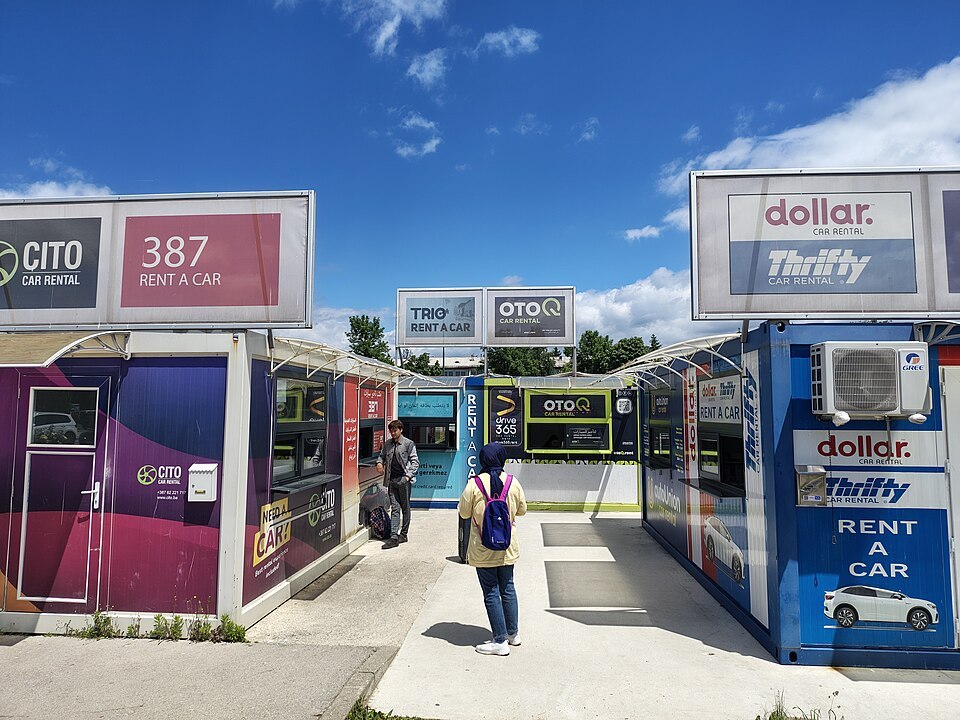
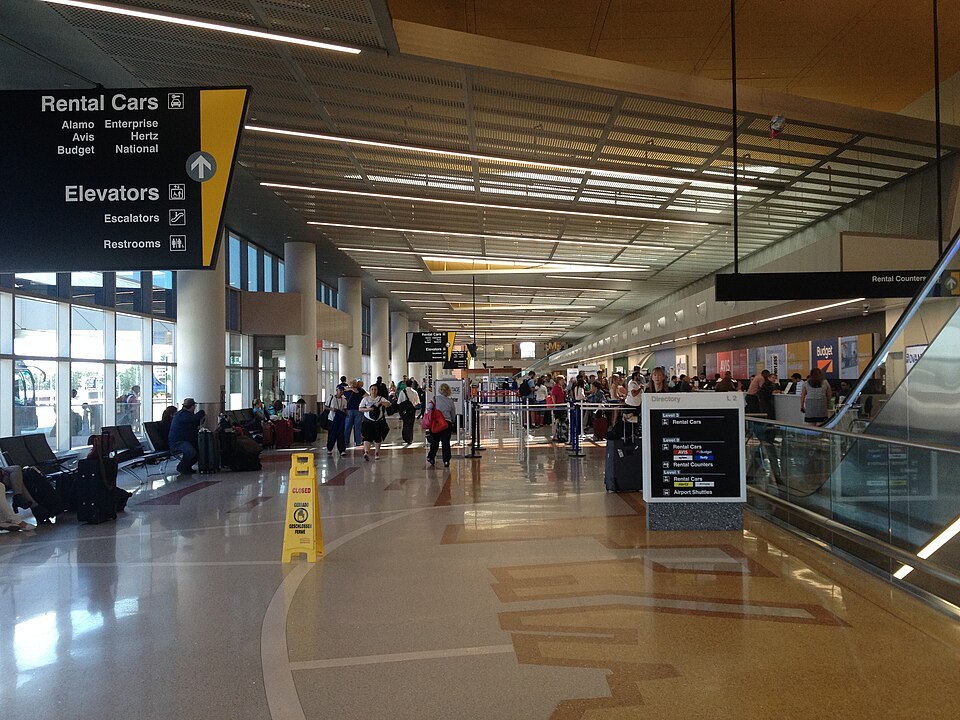
Illustrative rental kiosks at Sarajevo Airport, May 2025, not a Polish pickup location or provider recommendation. Modular science / Wikimedia Commons, CC BY 4.0. Resized.
Renting a car in Poland is a series of separate checks: whether the driver qualifies, whether the payment card works for the security hold, what the protection covers and how the vehicle must be returned. A low daily price does not settle any of those questions. Neither does a booking confirmation if the documents presented at collection do not meet the supplier's conditions.
This guide is for arranging and checking a rental, not deciding whether a particular foreign licence is legally valid for your circumstances. Operator terms and Polish consumer-advice pages were checked on 27 October 2026. Use the terms attached to your actual booking and ask the supplying branch to resolve anything unclear before you pay or travel.
Identify the supplier as well as the booking website
If you book through an intermediary, record which company supplies the vehicle and which company sold any separate protection product. Save the offer, confirmation, cancellation terms and supplier conditions. The European Consumer Centre in Poland, ECK, identifies disputes involving deposits, intermediary insurance, late arrivals and extra equipment as recurring rental problems.
Check the actual collection address and process. An airport-branded listing may still require a particular desk, car park, shuttle or meeting point. Confirm the branch hours and late-arrival instructions. Do not rely on a general airport arrival time when your rental counter or pickup arrangement has its own deadline.
If a flight is delayed, contact the rental supplier through its verified booking details. ECK recommends informing the company about delays because arrival outside the agreed period without notice may be treated as a no-show. Ask how long the vehicle is held and what happens outside office hours; do not assume entering a flight number guarantees unlimited waiting.
Check every driver's documents before booking
Give the provider the licence issuing country, licence category, driver age and how long the licence has been held. Ask what physical documents, translations or international permit it requires for the specific vehicle group. Rental eligibility and legal permission to drive are related but separate questions, and a generic travel forum answer is not enough for either.
SIXT's Poland rental-information page illustrates why the vehicle group matters: it gives different age and licence-holding requirements for different categories, plus conditions for non-EU licences and non-Roman scripts. This guide does not reproduce a universal age threshold or country list. Verify the current requirements against the branch and category you intend to collect.
Bring the required valid original documents and identification rather than assuming a phone photograph will be accepted. SIXT's checked page excludes photocopies and unverified digital licences. Arrange any additional driver through the agreement, including their eligibility and charge. Being a competent licensed friend is not the same as being an authorized driver of that rental vehicle.
Distinguish the rental price from the deposit hold
Before paying, ask which card type, cardholder name and physical-card requirements apply at collection. Confirm the security amount, currency and available credit or balance needed in addition to the rental payment. ECK warns that prepayment and the card required at handover can be different issues; successfully paying online does not prove that the collection deposit can be secured.
SIXT's Poland page says the card must be in the driver's name and physically presented. It describes debit-card acceptance for certain categories and two-credit-card requirements for some higher groups. Those are supplier-specific examples, not a statement that all Polish rental companies require credit cards or that all debit cards work for every car.
Ask whether the amount is a pre-authorization hold or an actual payment, when the supplier releases it and what evidence is provided. The bank's processing time may be a separate issue. Do not plan essential spending around an assumed same-day release. Keep the contract and transaction details so you can distinguish the rent, security hold and any later additional charge.
Understand excess and protection before adding another product
The excess or udział własny is not simply another word for the deposit. Read what liability remains, for which events and subject to which exclusions. A deposit is a payment-security arrangement; protection changes liability only within its terms. Neither a large hold nor a product called 'full protection' explains the whole agreement.
ECK distinguishes intermediary products that reimburse a damage excess from protection offered by the rental supplier that may reduce the customer's liability. A reimbursement policy may still require you to pay the rental company first and submit a claim afterwards. Ask who handles the claim, what evidence is needed and whether the supplier still requires its normal security hold.
Check exclusions for tyres, glass, keys, interior, underside, incorrect fuel, unauthorized drivers and prohibited use as applicable to the actual product. SIXT's checked page lists separate coverage options and exclusions, showing why one headline label is not enough. If staff propose another product, ask whether it is optional, what it changes and what you would owe without it before signing.
Confirm mileage, fuel, route and extras
Check the mileage allowance, how excess distance is charged and whether the quote covers the planned duration. Ask about an extension before keeping the car longer. A one-way return or another branch may have its own fee and permission requirements. Do not assume a modification accepted by a booking platform has also reached the supplying station.
For travel outside Poland, obtain the supplier's permission and confirm the allowed countries, fees and protection conditions for that vehicle. SIXT's Poland information contains territorial and brand/category restrictions and requires foreign trips to be requested at the station. Crossing an open border does not by itself establish contractual permission to take a rented car there.
Agree the fuel or battery-return requirement. ECK explains that returning below the agreed fuel level can involve both fuel and a refuelling service charge. For an electric vehicle, check the required return charge, charging equipment and procedure just as carefully. Keep the final refuelling receipt or charging evidence, and do not assume unused prepaid fuel is refunded.
For a child seat, winter equipment or other extra, confirm availability, suitability, charge and whether it is guaranteed. ECK specifically recommends checking whether reserved equipment is guaranteed. A request noted in a booking is not necessarily a promise that the exact item will be waiting. Resolve essential equipment before relying on the car for the trip.
Inspect the car before driving away
Review the agreement, vehicle identification, price, chosen extras and damage record before acceptance. Inspect the actual vehicle with a staff member where possible. ECK recommends inspection at both collection and return regardless of protection purchased. If a joint inspection is unavailable, record the condition carefully and follow the supplier's reporting process before departure.
Photograph existing scratches, dents, wheels, glass and other visible condition, plus the fuel or battery display and mileage. Keep original images with their time information rather than only edited social-media copies. ECK advises particular care with areas such as the lower bumpers and sills and with multiple marks that might otherwise be recorded as one.
Have discrepancies added to the handover record and keep a copy. Check required equipment, keys and documents, then ask for an explanation of unfamiliar controls or charging arrangements. If something appears unsafe or materially different from the agreement, stop and raise it before leaving rather than assuming you can settle it after the trip.
Use the supplier's instructions for incidents
Keep the verified assistance number and incident procedure available without depending solely on mobile reception. Ask what to do for a breakdown, warning light, collision, theft or lost key. Follow emergency requirements when needed, then notify the supplier through the agreed route. Do not commission repairs or towing on an assumption that any bill will be reimbursed.
Record what happened and retain the documents the provider or insurer requires. Do not treat protection as permission to ignore reporting duties. Equally, ask for a written explanation of an unexpected charge rather than accepting an unclear description at the counter. The exact liability and claim process depend on the agreement and facts.
Return with evidence, not only the keys
Allow time for the agreed return location, fuel or charging requirement and a joint inspection. Record mileage, fuel or charge level and vehicle condition again. Remove belongings and personal information you connected to the car, and return all issued keys, documents and accessories. Ask for a return record showing any new issues or confirming the recorded condition.
For an out-of-hours return, get the instructions in advance, including where to park, how to leave keys and when responsibility ends. A key-drop photograph is useful evidence but is not, by itself, proof that the supplier has inspected and accepted the vehicle. Keep your records until the final account and any security release have been reconciled.
If you dispute damage or another charge, ask for the basis and supporting evidence, then complain in writing with the contract, payment records, photographs and requested outcome. ECK publishes car-rental complaint templates. Gov.pl distinguishes domestic consumer-advice routes from cross-border assistance: choose the route appropriate to where the consumer and trader are based, rather than assuming every Poland rental is an ECK cross-border case.
Frequently asked questions
Does paying online mean my card will work for the deposit?
No. Check the supplier requirements for card type, driver name, physical presentation and available security amount before booking.
Is excess-reimbursement cover the same as reducing liability at the desk?
Not necessarily. A separate reimbursement policy may require you to pay a charge first and claim it back. Read who provides the protection and what the rental supplier still requires.
Can I drive a rental car from Poland into another country?
Only within the supplier permissions and applicable rules. Confirm countries, vehicle restrictions, fees and protection before the journey; an open border is not rental permission.
Should I photograph the vehicle if I bought extra protection?
Yes. ECK recommends collection and return inspections regardless of protection. Keep damage, mileage and fuel or charge evidence and the handover records.
Does dropping keys after hours prove the rental is closed?
No. Follow the agreed return process and check when responsibility ends. Keep evidence and obtain the final account and return confirmation.
Sources
- SIXT Poland rental information, current page, checked 27 October 2026
- SIXT Poland published rental terms, checked 27 October 2026
- ECK car-rental agreement and consumer risks, checked 27 October 2026
- ECK photographic evidence, 28 June 2021, checked 27 October 2026
- ECK car-rental complaint templates, checked 27 October 2026
- Gov.pl consumer help, updated 13 January 2026, checked 27 October 2026