Chocolate Labels in Poland: Product Names and Cocoa Solids
The essentials: Find the actual product designation, then read what its cocoa percentage refers to. Czekolada mleczna is milk chocolate, biała white and nadziewana filled. Cocoa solids, fillings and sweetened cocoa mixtures are different composition questions.
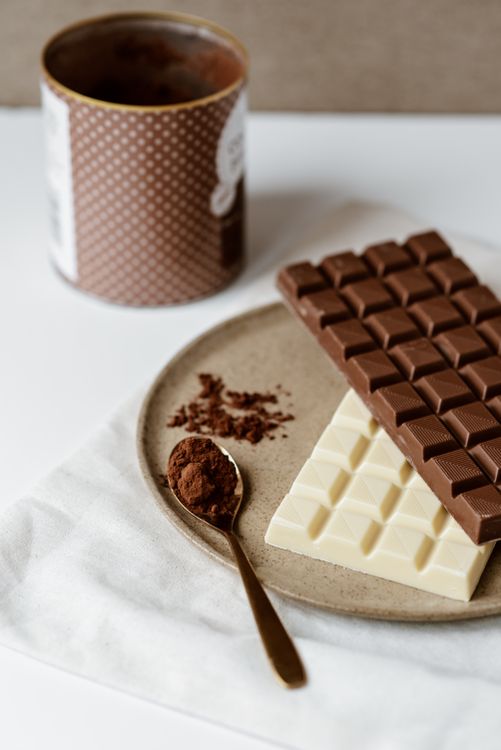
Cover: Anete Lusina, source photograph, Pexels License. Image unchanged. Chocolate bars and cocoa powder arranged together. Illustrative context, not proof of product category or cocoa percentage.
A chocolate-coloured wrapper is not the same thing as a chocolate product name. In Poland, the useful starting point is the actual designation on the label: czekolada, czekolada mleczna, czekolada biała or another specific description. The name, cocoa declaration and ingredients work together. None should be replaced by the first attractive picture on the front.
This guide concerns product designations and composition information, not a nutrition ranking, an allergy assessment or a baking recipe. The photographs illustrate chocolate and cocoa-related shopping. They do not verify the ingredients, category or cocoa percentage of the pictured products.
Find the legal product name before the slogan
Czekolada means chocolate. Czekolada mleczna is milk chocolate, czekolada biała white chocolate and czekolada nadziewana filled chocolate. A large brand name or invented product name can be more prominent than this information. Read beyond it to find what the product is actually called.
IJHARS explains that chocolate products have legal designations and that additional descriptions can accompany them. Gorzka and deserowa are words you may encounter alongside the name. Do not treat a descriptive adjective as a replacement for the underlying category and its actual composition.
A product that resembles a chocolate bar may have a different designation. That is a reason to read carefully, not to declare every differently named sweet fraudulent. Establish what the label claims before deciding whether it matches what you wanted to buy.
Understand what the cocoa percentage describes
Masa kakaowa minimum followed by a percentage concerns total dry cocoa solids. It is not a statement that the same percentage is sugar, milk or a single ingredient called cocoa powder. Cocoa-derived components can include cocoa butter as well as non-fat cocoa solids.
The EU chocolate directive requires this minimum declaration for specified categories, not every chocolate-related item without exception. White chocolate, pralines and filled products do not all follow the same declaration requirement. Do not accuse a product of missing mandatory information before establishing its category.
When comparing two bars, read both the name and what the percentage refers to. A percentage displayed elsewhere on the wrapper might describe a highlighted filling or another ingredient. The number is useful only when its subject is clear.
Know the basic category thresholds without becoming a laboratory
For the basic chocolate category, the EU definition sets at least 35 percent total dry cocoa solids, including at least 18 percent cocoa butter and 14 percent dry non-fat cocoa solids. Those figures describe a legal composition framework, not a home test you can carry out by tasting a square.
Milk chocolate has its own definition. The basic category includes minimum cocoa and milk components; the headline thresholds include at least 25 percent total dry cocoa solids and 14 percent dry milk solids. Other required components and special forms also matter. A short consumer guide should not pretend that one number checks the entire recipe.
Use these distinctions to understand why category names are meaningful. Do not try to certify a product from a package photograph, or assume that every special form has exactly the same thresholds as an ordinary bar. Where a detailed compliance question arises, the full definition and actual product evidence are needed.
White chocolate is a distinct defined category
White chocolate is not simply an ordinary dark bar with its colour removed. The EU definition uses cocoa butter, milk or milk products and sugars. It requires at least 20 percent cocoa butter and 14 percent dry milk solids, with a milk-fat minimum within that definition.
This explains why the absence of a familiar dark colour is not proof that a product cannot legally be chocolate. Read czekolada biała as its own category. At the same time, a pale coating or cream is not automatically white chocolate merely because it looks similar.
For a purchase, keep the question specific: does the label name white chocolate, or something else? Do not infer the answer from colour, a dessert photograph or an English marketing phrase that omits the actual designation.
Filled chocolate and pralines need a different comparison
Nadziewana refers to a filled product. The EU definition of filled chocolate requires a chocolate outer portion constituting at least 25 percent of the total product weight. The definition also excludes some interiors, such as bakery products, biscuits or edible ice, from that particular designation.
Pralines and single-mouthful chocolates have their own definition and composition conditions. A gift box can contain different pieces rather than one uniform bar. Read the description and ingredients for the actual selection instead of applying the front image to every piece inside.
This matters when comparing percentages. A cocoa statement about a chocolate component is not automatically the percentage of the whole filled sweet. Read the basis stated on the label. If the wording is unclear, ask rather than performing a calculation from assumptions about the filling.
Distinguish cocoa powder from sweetened drink products
Kakao can appear on a baking shelf and on products intended for a sweetened drink. The EU directive distinguishes cocoa powder from mixtures of cocoa powder and sugars. Plain cocoa powder and a prepared drink powder are therefore not interchangeable descriptions.
The legal framework also distinguishes fat-reduced cocoa powder. That is a composition category, not a promise that a recipe can be changed without affecting the result. Follow the recipe and the actual product information when deciding what to use.
For shopping, the useful step is simple: read whether the product is cocoa powder or a sweetened mixture, then read the composition. This article supplies no substitution ratio or cooking method. A photograph of a brown drink is not enough to settle which product is in the package.
Read other vegetable fats without making a blanket accusation
EU rules permit certain vegetable fats other than cocoa butter in specified chocolate categories under conditions. They do not give unrestricted permission to replace the defining cocoa components. The rules also require a clear statement when these fats are used in the relevant products.
In Polish, look for wording such as oprócz tłuszczu kakaowego zawiera tłuszcze roślinne: contains vegetable fats in addition to cocoa butter. Read it with the product name and ingredients. Its presence does not, on its own, mean the product is illegal or cannot be called chocolate.
Conversely, do not assume every product using cocoa ingredients qualifies as chocolate. The category and composition requirements still matter. This guide does not calculate manufacturing compliance from the order of ingredients or certify a substitute-fat amount from appearance.
Keep ingredient claims separate from category names
A name such as milk chocolate supplies useful category information but does not replace reading the actual ingredients. Additions, fillings and highlighted ingredients can differ. If a particular ingredient matters to your purchase, inspect the information for that item rather than borrowing it from another flavour in the range.
Do not use gorzka, a high cocoa percentage or a dark colour as proof that a product meets a particular dietary requirement. This article makes no dairy-free, vegan, allergen-free or personal-health guarantee. Those questions need their own current product evidence.
Likewise, a promotional word such as premium does not tell you the whole composition. Compare concrete information first: category, cocoa declaration where applicable, filling description and ingredients. Taste preference can remain a personal choice without being presented as a legal conclusion.
Compare the actual quantity and version
Check the net weight of the item you plan to buy. IJHARS has warned consumers to read gram quantities rather than assuming that a familiar-looking wrapper still contains the same amount. This guide does not claim that a particular brand has changed its pack size.
Keep the exact version in view. A brand can sell plain, milk, white and filled products with similar packaging. A label image for a different flavour or size is not reliable evidence for the item in your basket.
For an online order, save the name and readable label information. If only the front is shown, ask for the missing product details when they matter. Do not fill gaps with a remembered wrapper from another country or a photograph of an older version.
Resolve unclear information with a factual question
Ask what the product's designation is and what a displayed percentage refers to. If two statements appear inconsistent, preserve both and check that they concern the same item. A precise question is easier for a seller to answer than a broad accusation that the product is not real chocolate.
Keep a clear package photograph and proof of purchase if a concern needs review. Do not diagnose composition from a surface mark, colour or taste, and do not use this guide to decide whether an unfamiliar or damaged product should be eaten.
A repeatable shelf routine is to find the designation, identify the cocoa statement's basis, distinguish fillings and cocoa-drink mixtures, and then read the other product information separately. The result is a clearer purchase, not a universal ranking. A chocolate label tells you what is declared; it does not ask you to invent what the rest of the wrapper leaves unanswered.
Frequently asked questions
Is white chocolate a defined category?
Yes. Its EU definition uses cocoa butter, milk components and sugars with specific composition requirements.
Does every chocolate-related product need the same cocoa percentage declaration?
No. The EU directive specifies the categories covered. White chocolate, filled products and pralines are not all treated alike.
Is sweetened drink powder the same as plain cocoa powder?
No. Read the actual name and composition rather than substituting from the package picture.