Olive Oil Labels in Poland: Categories, Origin and Claims
The essentials: Find the full category: extra virgin, virgin, refined-and-virgin blend or olive-pomace oil. Read origin rules by category, separately from the business address. Cold-production phrases and harvest years do not replace the designation or storage instructions.
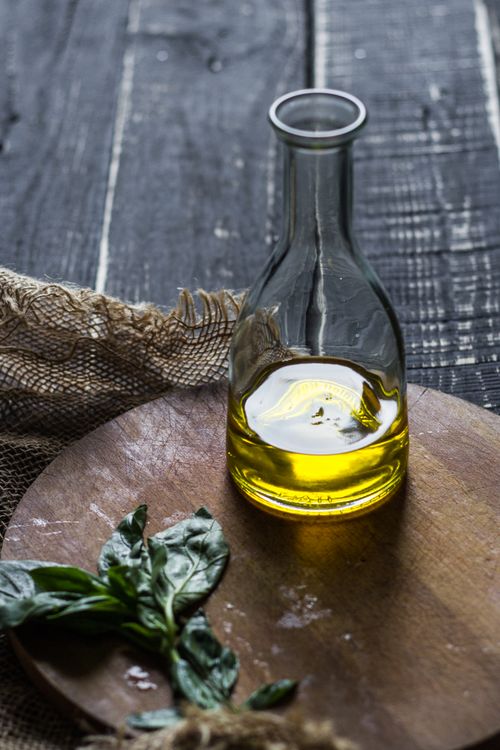
Cover: Vladimir Gladkov, source photograph, Pexels License. Image unchanged. A bottle of oil on a cutting board. Illustrative olive-oil context, not proof of category, origin or storage instructions.
An olive branch on a label does not tell you which olive-oil category is in the bottle. In Poland, the long Polish name often supplies the useful answer. Extra virgin, virgin, a refined-and-virgin blend and olive-pomace oil are different categories. Read the designation before trying to interpret the brand, country imagery or an attractive description on the front.
This guide explains category and origin information for shopping. It does not recommend an oil for a medical goal, assign cooking temperatures or offer a home test for authenticity. The photographs illustrate bottles and olive-oil context. They do not prove a category, origin, production method or compliance for the pictured oil.
Find the full category name
IJHARS's May 2026 consumer guidance identifies four categories available at retail. The first is oliwa z oliwek najwyższej jakości z pierwszego tłoczenia, the Polish designation for extra virgin olive oil. The second is oliwa z oliwek z pierwszego tłoczenia, or virgin olive oil.
The third has a longer name: oliwa z oliwek składająca się z rafinowanej oliwy z oliwek oraz oliwy z oliwek z pierwszego tłoczenia. It describes olive oil composed of refined olive oil and virgin olive oil. The fourth is oliwa z wytłoczyn z oliwek, olive-pomace oil.
Do not shorten all four to the same shopping description. If you are trying to buy a particular category, find that category in the actual name. A brand's shared bottle design or a prominent word on the front should not replace the full designation.
Read the description accompanying the category
The extra virgin designation comes with wording explaining the highest category of olive oil obtained directly from olives and solely by mechanical means. Virgin olive oil has corresponding wording about being obtained directly from olives and solely by mechanical means. These descriptions help distinguish the categories, but do not turn a shopper into a testing panel.
The refined-and-virgin category describes oil containing refined olive oil and oil obtained directly from olives. That is different from a bottle whose legal designation is extra virgin. Do not use a small optional phrase elsewhere on the label to erase the distinction made by the name.
For pomace oil, read the category description rather than assuming the word oliwa means the same production route in every bottle. This guide does not explain industrial processing as a home procedure or claim that one category is suitable for every task.
Keep category and personal preference separate
The legal category has defined characteristics, assessed through the relevant rules and methods. It is not a complete prediction of whether you will enjoy the taste. Nor does it answer how much oil you should consume or whether a particular diet suits you.
A shopper can prefer one product's flavour without claiming laboratory proof of its category. Conversely, a familiar taste or colour does not verify a label. Do not turn a tasting impression at home into an accusation of adulteration or a certificate of authenticity.
Use the category to understand the product offered. Then consider the other information relevant to your purchase. Keeping these questions separate is more useful than asking one word, such as extra, to settle origin, recipe compatibility, health and value at once.
Read origin where the category requires it
IJHARS explains that origin information is required for extra virgin and virgin olive oil. A country name or a reference to the European Union can have a defined role here. Read the origin statement on the actual label, not only a flag, an Italian-sounding name or a landscape photograph.
For blends, the wording can refer to olive oils originating in the EU, outside the EU, or both. A statement that the oil is a blend from the EU does not identify one particular member state. Do not make it more specific when translating or describing the bottle to someone else.
The origin rules are category-specific. IJHARS distinguishes the other retail categories from extra virgin and virgin for this purpose. Do not demand that every category carry the same origin declaration or treat the absence of one familiar phrase as a universal fraud test.
Do not confuse a business address with the oil's origin
The responsible business's name and address are important product information, but they have a different role from the origin statement. An address identifies the business responsible for the food information. It does not by itself prove where the olives were harvested or the oil was produced.
An invented example helps separate the pieces. A bottle can carry a Polish business address and an EU-blend origin statement. Those statements do not automatically conflict. One identifies a business; the other describes the declared origin under the applicable category rules.
Do not fill in a missing country from the retailer's location either. Buying a bottle in Poland does not turn its agricultural or production origin into Poland. Keep the wording as specific, or as broad, as the label actually makes it.
Treat cold-production phrases as additional information
Phrases about cold extraction or a first cold pressing concern production methods. IJHARS says these optional descriptions are reserved for the relevant virgin categories and have conditions. They are not a substitute for reading the legal category name.
If a phrase is important to your purchase, read it together with the category and the rest of the label. Do not assume a vague English word such as pure or traditional supplies the same information as a defined category and method description.
This article does not give a production-temperature threshold or a method for assessing the claim at home. The useful consumer step is to identify what is actually declared, not to invent a production history from the bottle's shape or price.
Keep harvest information separate from the date label
A harvest-year statement is additional information, not the same thing as the product's minimum-durability date. IJHARS says the harvest year can be stated for extra virgin and virgin oils when all the contents come from that harvest. Read the actual wording instead of assuming any printed year has that meaning.
A number beside a brand story, an establishment date or a batch code may have another purpose. If the label does not make the meaning clear, ask. Do not translate every year on a bottle into a harvest claim.
This guide does not establish a universal shelf life or a fixed period after opening. Read the product's own durability and storage information. A category guide should not quietly become advice to ignore a date or invent an extra grace period.
Follow the stated storage conditions
IJHARS's current olive-oil guidance says storage information should tell consumers to keep the oil in a cool, dark place. Read the actual bottle's instructions and arrange storage accordingly. Do not use an attractive photograph of oil on a sunny windowsill as a storage recommendation.
The bottle's appearance does not remove the need to read the conditions. Nor does transferring oil to another vessel preserve the information automatically. Keep the original label or a clear record of the identity and instructions if the packaging is no longer with the oil.
This article offers no heating, frying or smoke-point table. Those are different questions from category and origin reading. A statement about mechanical production is not a cooking-temperature instruction for a recipe.
Use quantity and identity for a fair comparison
Read the net volume printed on the bottle. A tall bottle and a short bottle can contain different quantities, and a familiar design may be sold in several sizes. Do not compare only the shelf price while assuming the volume is unchanged.
Keep the exact product name and version in view online. A retailer may show a brand's general image while offering a particular size or category. Ask for clarification if the written designation and image seem to concern different items.
A batch identification is useful if a specific bottle needs review. Preserve it along with the business name and proof of purchase when relevant. A photograph of the front alone can omit information needed to distinguish the bottle from another product in the same range.
Read inspection findings with their limits
IJHARS's May 2026 report describes inspections that found category, analytical and labelling problems in the products checked. Such findings explain why accurate names and origin information matter. They do not prove that every oil on the Polish market is mislabelled.
This guide does not convert inspection-sample percentages into a market-wide failure rate or accuse an unnamed product. If a concern arises about your bottle, collect product-specific information rather than borrowing a conclusion from a different inspection sample.
Laboratory and sensory checks have their own methods. A shopper should not replace them with a fridge test, a colour comparison or a claim about how genuine oil must behave. No such home-authenticity procedure is offered here.
Ask a focused question when the pieces do not agree
If two parts of a label use different category names, preserve both and ask the seller or responsible business to explain the discrepancy. Check that an online description concerns the actual bottle and size. Do not resolve a conflict by choosing whichever wording sounds more prestigious.
A useful question names what is unclear: the legal category, the origin statement, the meaning of a harvest year or the product's storage instructions. This is more effective than asking whether an oil is good without saying which information you need.
The repeatable routine is to find the full category, read its accompanying description, check the category-specific origin information and keep optional production or harvest claims separate. Then read the actual quantity, identity and storage conditions. The result is a clearer understanding of the bottle, without pretending a label can deliver a personal health promise or a laboratory verdict.
Frequently asked questions
Does every category have the same origin-label requirement?
No. IJHARS distinguishes mandatory origin information for extra virgin and virgin oils from the other retail categories.
Is a harvest year the same as a minimum-durability date?
No. Read each marking for its actual purpose.
Can I verify extra virgin status from colour?
No. This guide offers no home authenticity test or laboratory verdict.