Dry cleaning in Poland: drop-off, collection and complaints
The essentials: Ask a pralnia chemiczna to assess the garment, agree the treatment, risks, full price and collection date, and keep the order and condition photographs. For damage, complain in writing with evidence and a clear request. Consumer ombudsmen offer free help; compensation depends on the facts.
A winter coat, interview suit or wedding outfit is an awkward thing to hand over when you cannot explain the stain or understand the collection slip. In Poland, the useful starting point is pralnia chemiczna, a dry cleaner. Before leaving anything valuable, agree what the shop will do, what risks it has identified, the total price and the collection date. Keep a record of the garment's condition.
If something goes wrong, the next step is a written reklamacja, a complaint to the business. Damage compensation is not automatic, but a shop's assertion that it followed the label does not by itself settle a dispute. The evidence, agreed work and any specific warning all matter.
This guide was checked on 27 October 2026, Poland time. It offers a practical process, not a price list or an individual legal assessment. For a damaged expensive garment, get consumer advice before agreeing to a settlement or further treatment.
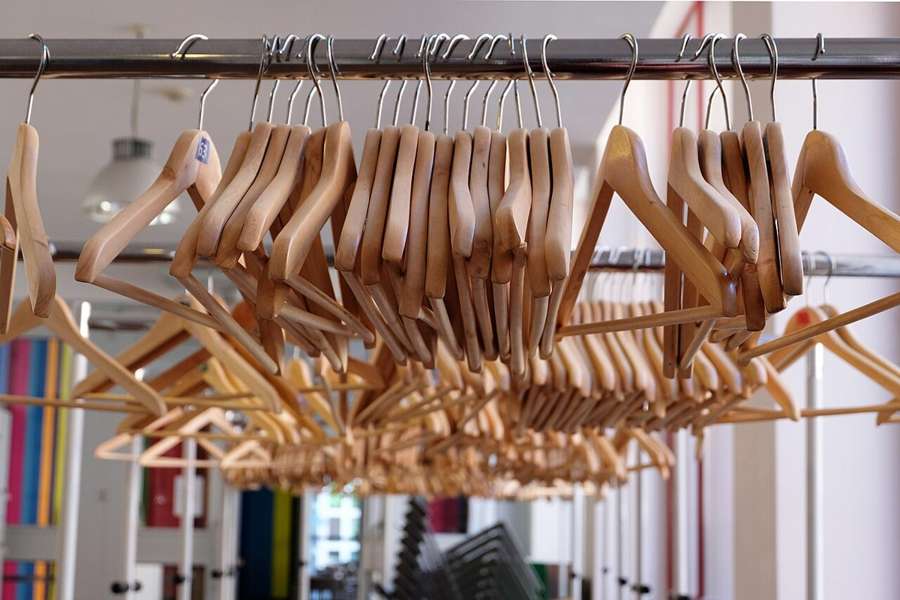
Cover photograph: wooden clothes hangers on a shop rail, Christian Fregnan, Wikimedia Commons, CC0 1.0. Resized. Illustrative, not a recommended Polish cleaner.
Choose the service, not just the nearest sign
Look for czyszczenie chemiczne for dry cleaning, pranie wodne for water-based washing and prasowanie for ironing. A self-service laundry, pralnia samoobsługowa, is a different proposition from handing a coat to a professional for assessment. Ask what is actually included rather than assuming that every business with "pralnia" in its name provides the same service.
For a delicate or expensive item, ask whether the branch performs the work or is a collection point sending garments elsewhere. Obtain the business name and contact details on the order. Knowing who accepted the garment and where to send a complaint is more useful than remembering only a shopping centre or a counter's location.
If you need English, check before making the trip. When a conversation is difficult, show a short written description of the item and the problem. Translation can help, but ask staff to confirm the specific service and risks in writing. A nod at a translated paragraph is not a clear agreement about a fragile lining or an immovable stain.
Bring the label and the whole problem
Photograph the care and fibre labels before drop-off. Do not cut them out to make the item look tidier. Tell the cleaner about missing labels, previous alterations, repairs, glued decoration, contrasting materials and any treatment you have already tried. Point out every stain you want assessed, including its cause if you know it. If you do not know, say so rather than guessing.
GINETEX, the textile-care labelling association, explains that care instructions account for the most sensitive part of an article, including finishes, buttons, zips and applications. The main fabric alone therefore does not tell the whole story. A jacket described as wool may also have a lining, trim or construction that affects the cleaning decision.
The circle on a care label relates to professional textile care; its letters and bars give information for professional cleaners. Professional wet cleaning is not simply the same as choosing a household washing programme. Rather than copying a symbol chart from a random website, ask the cleaner to explain the proposed treatment for your actual item. GINETEX also warns that care labelling does not guarantee the removal of every stain.
Record the condition before handing it over
Take clear photographs of the front, back, lining, collar, cuffs, fastenings and any existing marks. Include close-ups of decoration and vulnerable areas. These pictures are not a substitute for a proper intake assessment, but they can make a later disagreement more concrete than competing recollections about whether a button was already missing.
Ask for existing damage and reservations to be written on the acceptance slip. If staff identify a specific risk, ask what it is, what result is realistically expected and whether there is a safer alternative. Do not sign a statement you cannot understand merely because other customers are waiting. You can decide not to proceed while the item is still yours to take away.
Sopot's municipal consumer guidance, published on 26 August 2024, describes the cleaner as a specialist expected to assess whether the service can be performed properly and warn the customer about relevant risks. That does not make every cleaning attempt risk-free. It does make the initial conversation important, especially where the shop says an unusual garment might change shape or colour.
Agree the price and collection arrangements
Ask for the complete charge for the agreed work, including any separately priced stain treatment, lining, belt or other part. For a suit, check whether the quote covers both pieces. For curtains or bedding, ask how the price is calculated. This guide gives no nationwide price because the item, service and individual business determine the quote you need.
Get the collection date on the order and say if the garment is needed for a particular event. Ask whether the date is a firm agreement or an estimate. Leave a buffer before a flight, ceremony or interview rather than relying on the final possible collection hour. A compensation dispute afterwards cannot put a coat in your suitcase on time.
Keep the order number, payment evidence and a photograph of the slip. Check the item description and the number of pieces while still at the counter. If the slip names only "coat" but you have also left a detachable belt or hood, ask for the record to be corrected. Keep any later instructions or changed collection date with the same record.
Photograph: Michael Slaten, Wikimedia Commons, CC BY-SA 4.0. Resized; this adapted photograph is offered under the same licence. Illustrative, not a photograph of the business handling your clothes.
Inspect before taking the garment away
At collection, compare the order with what you receive. Check the number of pieces, belt and hood, then look at the lining, closures, seams and the areas originally marked. Ask about any remaining stain before assuming the item was not treated. If possible, inspect outside the protective cover rather than trying to judge colour and texture through plastic.
If you notice damage, photograph it promptly and ask staff to record the problem. Keep the garment, slip, packaging and messages. Avoid an improvised home repair or another cleaning attempt before documenting the issue and obtaining advice, because further treatment can make it harder to establish what happened during the disputed service.
Inspection at the counter is sensible evidence gathering, not a reason to abandon a problem discovered later. Federacja Konsumentów's published laundry case discusses a coat returned with discolouration and a torn collar and the importance of the cleaner's professional duties. Its older legal references should not be used as a current deadline calculator, but the case is a useful reminder to preserve evidence of the damage and the item's value.
Write a specific complaint
Address the complaint to the business responsible for your order. Give the order number, acceptance and collection dates, garment description, agreed work and the problem you discovered. Attach copies of the order and relevant photographs, keeping originals yourself. Explain the outcome you seek and ask for a written response. Preserve proof that the complaint was submitted.
Separate different issues. A stain that remains, a newly torn lining and a lost belt are different facts, even if they concern one order. Describe what you can show rather than accusing a named employee of something you did not witness. If a garment cannot be used, explain why and provide evidence supporting the amount claimed.
A useful opening in Polish is: "Składam reklamację usługi dotyczącej zamówienia nr ..." This means "I am making a complaint about the service under order number ..." Follow it with the facts, evidence and requested remedy. It is an opening, not a complete legal demand or a promise that any particular remedy must be granted.
Compensation depends on evidence
Sopot's guidance explains that a damages claim involves loss, improper performance and a causal link between them. The purchase receipt, age, earlier condition and evidence of damage can therefore matter. Do not assume a used garment will automatically be valued at the current price of a new replacement, or that every disputed cleaning fee entitles you to the full original purchase price.
An archived judgment on SAOS illustrates the other side: the court rejected a customer's claim after examining specific warnings, the garment's condition and the lack of evidence supporting the claimed loss. That is a historical case, not a rule that all customer-risk wording is valid today. Its practical lesson is to keep accurate records and take a specific warning seriously before agreeing to proceed.
If the shop invokes a blanket compensation cap or tells you that its rules end the matter, have a consumer adviser examine the actual clause. Equally, do not assume every signed warning is meaningless. The wording and circumstances need assessment. Ask for advice promptly rather than copying procedural deadlines from an old court case or a guide about buying faulty goods.
Get the right kind of help
UOKiK directs people with problems involving goods or services to consumer advice, municipal or county consumer ombudsmen and the Trade Inspection. Its information says consumer ombudsmen provide free help, including legal advice and assistance with complaint or court documents. Use the current official directory or your municipality's website to find the appropriate office.
Bring one organised file: the order, payment record, before-and-after photographs, garment purchase evidence, the shop's terms and the complete complaint exchange. Note whether you agreed to a specific risk or further treatment. Ask which remedy and time limit apply to your situation rather than waiting for repeated informal conversations to produce a result.
The European Consumer Centre has a separate cross-border role involving another EU country, Norway or Iceland, subject to its criteria and an initial complaint to the trader. Being a foreign citizen in Poland does not by itself make a dispute with a Polish cleaner cross-border. For an ordinary local dispute, start with domestic consumer help. Neither seeking advice nor submitting an informal complaint should be treated as a guaranteed pause on legal time limits.
Frequently asked questions
What is a dry cleaner called in Polish?
Look for "pralnia chemiczna" or "czyszczenie chemiczne". Confirm that the business accepts your particular garment and agree the treatment, price and collection date. A self-service laundry is not the same service.
Can a cleaner guarantee that every stain will disappear?
Do not assume so. GINETEX says care instructions do not guarantee removal of all dirt and stains. Ask for a realistic assessment and have any specific limitation recorded before agreeing to the work.
Should I leave a coat with no care label?
Tell the cleaner the label is missing and ask for a professional assessment and written explanation of risks. If the explanation is unclear or the risk unacceptable, do not proceed merely to save a trip.
Will I automatically receive the price of a new garment if it is damaged?
No. Responsibility, causation and the value of the loss need assessment. Keep purchase evidence and records of the garment's age and condition. Get consumer advice before accepting a disputed valuation or settlement.
Where can an expat ask for help with a Polish cleaner?
UOKiK lists domestic consumer-help routes, including municipal or county consumer ombudsmen. The European Consumer Centre is for qualifying cross-border disputes, not every case involving a foreign citizen.
Sources
- Sopot consumer guidance, 26 August 2024 (checked 27 October 2026)
- UOKiK consumer ombudsmen (checked 27 October 2026)
- UOKiK consumer help (checked 27 October 2026)
- European Consumer Centre complaint scope (checked 27 October 2026)
- GINETEX care labelling (checked 27 October 2026)
- GINETEX textile care symbols guide (checked 27 October 2026)
- Federacja Konsumentow historical laundry case (checked 27 October 2026)
- SAOS historical laundry dispute, evidence example (checked 27 October 2026)