The First 30 Days in Poland: What Every New Expat Must Do
The essentials: Register your address first - non-EU citizens have 4 days, EU citizens 30 - and the office assigns your PESEL automatically for stays over 30 days. Then open a bank account, set up your free Trusted Profile for e-services, and sort health cover through your employer. All core registrations are free.
The first month in Poland sets up everything that comes after: your legal registration, your PESEL number, your access to healthcare, banking and public e-services. The good news is that the process is more orderly than it looks from the arrivals hall. Most of it runs through one district office and one government login, and the core registrations are free. Here is the exact sequence that works, with the deadlines that actually matter, grounded in the official guidance as of October 2026.
Week one: register your address, because the clock is already running
The single most urgent task after you move into your flat is address registration, known as zameldowanie. The deadline depends on your citizenship, and it is shorter than most newcomers expect: if you are a non-EU citizen, you have four days from arriving at your new address to register; if you are a citizen of an EU or EFTA country or Switzerland, you have thirty days. Registration happens at the district office (urząd dzielnicy) for the area where you live - in Warsaw, each of the eighteen districts has its own office handling this.
Bring your rental agreement and your identity document. EU citizens show a passport or national ID; non-EU citizens show a passport plus a visa or residence card. If you entered under visa-free travel or hold a residence card from another Schengen country, you can register based on the stamp in your passport confirming you have applied for a residence permit - though if roughly nine months have passed since that stamp, the office may ask for confirmation from the immigration office that your case is still pending. You fill in a form at the office, submit it, and receive confirmation of registration. The service is free.
Two things flow directly from this visit. First, if you register a stay of more than thirty days, the office should assign you a PESEL number automatically - more on why that matters below. Second, remember the exit duty: when you change address or leave Poland, you notify the same office, at the latest on your last day at the old address, so your registration can be updated or closed.
*Data source: University of Warsaw Welcome Point registration-of-address guidance and gov.pl "Get a PESEL ID - a service for foreigners", checked October 21, 2026.*
PESEL: the eleven digits that unlock everything else
PESEL is Poland's universal personal identification number, and you will be asked for it constantly: by your employer's HR, at the clinic, by the tax office, by banks and mobile operators. There are two ways to get one, and new arrivals routinely miss the easy one. The easy way: it is assigned ex officio - automatically - when you register your residence for a stay of over thirty days. Ask at the registration desk and you walk out with it the same day.
If you cannot register your residence - say your landlord refuses to cooperate, a known friction point - you can still get a PESEL by application. You submit it in person at any municipal office, it is free of charge, and children born in Poland are exempt from the in-person requirement. One practical tip from the official guidance: the application asks for the legal basis of your obligation to have a PESEL, and if an office such as ZUS or the tax office is the one demanding your number, that office should tell you which legal basis to cite. If your application has formal defects, the office can leave it unprocessed, so fill it carefully.
*Data source: gov.pl "Get a PESEL ID - a service for foreigners", checked October 21, 2026.*
Set up your Trusted Profile before you need it
The Profil Zaufany, or Trusted Profile, is Poland's free digital identity for public services. With it you handle most official matters online - tax filings through e-Urząd Skarbowy, ZUS services, health-service logins - without printing, signing or queuing. You need a PESEL first, which is why the order of operations in this guide matters.
There are two setup routes. If you bank online with one of the participating banks - the list includes PKO, Pekao, ING, mBank, Millennium, BNP Paribas, Crédit Agricole, Alior and others - you can create the profile from your sofa: the bank forwards your verified identity to the government system. If your bank is not on the list, you register online and then confirm your identity in person at a verification point within fourteen days, or the application lapses. The profile is valid for three years and extends easily. One configuration trap worth knowing: if you want to log in to public services using your bank credentials, enable the external identity provider option in the profile's account management tab, or you will be stuck with login and password only.
The Trusted Profile also pairs with mObywatel, the government's wallet app, which carries digital versions of your documents - our student ID and mObywatel guide covers that side in detail.
*Data source: University of Warsaw Welcome Point Trusted Profile guidance and pz.gov.pl, checked October 21, 2026.*
Money, phone and internet: the practical trio
With PESEL in hand, the everyday infrastructure goes fast. A Polish bank account is effectively required for a normal life: employers pay salaries into it, landlords increasingly expect rent by transfer, and BLIK - the phone-based payment system Poles use for everything from splitting dinner to paying online - runs through your bank's app. Banks differ in how they treat brand-new residents, so bring your passport, PESEL confirmation and rental agreement, and expect the whole visit to take under an hour. This is editorial observation from current practice rather than a legal rule.
For a SIM card, prepaid starter packs from any operator cost a few złoty and work immediately with a passport registration; home internet is the slower piece - in Warsaw buildings, installation lead times vary by provider and building wiring, and our guide to getting internet installed in a Polish apartment walks through the realistic timeline and the questions to ask before signing.
Public transport needs no registration at all: download the city's ticket app or buy a personal monthly pass, which is where the savings start if you commute daily. Keep the paper or digital proof of your first registration of the pass - inspectors ask.
*Data source: editorial practice, October 2026; installation specifics in our internet guide.*
Healthcare and family admin in the background
If you are employed, your employer registers you for health insurance with ZUS from your first day, and that registration is what activates your right to NFZ-funded care. Do not leave family cover for later: children and a non-working spouse join through family registration, and the child's cover starts from the registration day, not from your first workday. Our guide to public healthcare for foreigners' children covers the exact mechanics, including the seven-day registration duty and the newborn PESEL shortcut. For your first doctor visits before the system feels familiar, our English-speaking doctor guide for Warsaw explains how to find an NFZ clinic and when private visits are worth the fee.
Parents should also file the 800+ child benefit application - it is paid per child per month by ZUS and is separate from health cover, which trips up many families who assume one implies the other. School-age children need kindergarten or school enrolment; our kindergarten guide compares the public and private tracks.
*Data source: healthcare benefits act framework per our linked guides; 800+ per the Family 800+ programme, October 2026.*
Surviving the paper flow
Two habits will save you real pain in month one. First, every official letter matters: Polish offices send decisions and demands by post with response deadlines, and ignoring a brown-envelope letter because it is in Polish is the classic newcomer's mistake - our guide to what to do when you receive an official letter in Polish explains how to identify what you are holding and how fast you must act. Second, keep every confirmation: the registration slip, the PESEL assignment, the bank agreement. Polish offices are good at re-asking for documents you have already shown, and a single folder - physical or scanned - turns a bureaucratic afternoon into a five-minute search.
If your situation involves documents from home - birth certificates, marriage certificates, diplomas - you will periodically need sworn translations (tłumaczenie przysięgłe) rather than ordinary ones. Only translators on the official Ministry of Justice registry can produce them, so budget both the per-page fee and a few days of lead time when an office asks.
*Data source: editorial practice; sworn-translator registry per the Ministry of Justice, October 2026.*
Your thirty days, condensed
Days 1-4 (non-EU) or 1-30 (EU): register your address at the district office and leave with a PESEL. Days 1-7: bank account, SIM, internet order, employer HR paperwork for ZUS and health cover. Week 2: Trusted Profile online, then the verification-point visit if your bank route is unavailable; family registration for healthcare; 800+ if you have children. Weeks 3-4: doctor and dentist declarations, school or kindergarten enrolment for the next intake, transport pass personalization, and your folder of confirmations. By day thirty you are not just visiting Poland - administratively, you live here.
*Data source: sequence per the official sources cited above, checked October 21, 2026.*
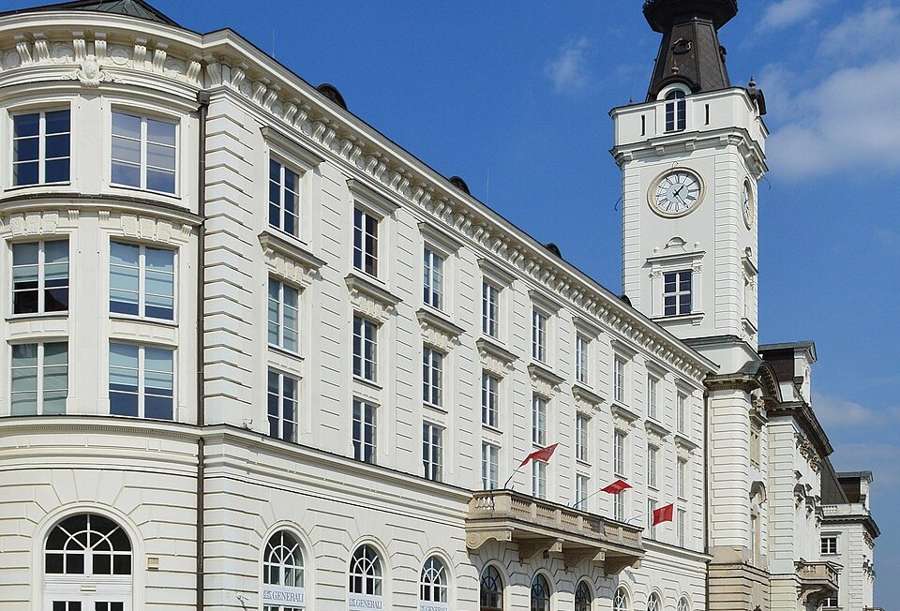
*Photos: Warsaw City Hall by Scotch Mist, CC BY-SA 4.0; passport and documents by Alex Robert, CC0, both via Wikimedia Commons.*
Frequently asked questions
How quickly must a foreigner register their address in Poland?
Non-EU citizens have four days from arriving at their new address; EU, EFTA and Swiss citizens have thirty days. Registration is free and done at the district office covering your address, with your rental agreement and ID. Source: University of Warsaw Welcome Point registration guidance, checked October 21, 2026.
Do I get a PESEL number automatically when I register?
Yes - if you register your residence for a stay of over thirty days, the office assigns your PESEL ex officio. Otherwise you can apply in person at any municipal office, free of charge. Source: gov.pl "Get a PESEL ID - a service for foreigners", checked October 21, 2026.
What do I need a Trusted Profile for, and how do I get one?
It is Poland's free login for public e-services - tax, ZUS, health portals. You need a PESEL first; then you can set it up online through most major banks or confirm your identity at a verification point within fourteen days. Source: University of Warsaw Welcome Point Trusted Profile guidance, checked October 21, 2026.
Is address registration in Poland free?
Yes. Both the initial registration and later notifications of a change of address or departure are free of charge at the district office. Source: University of Warsaw Welcome Point registration guidance, checked October 21, 2026.