Food-Contact Labels in Poland: Containers and Intended Use
The essentials: Find food-contact wording, a specific use indication or the glass-and-fork symbol, then read the actual conditions. Obvious food articles have a marking exception. Food-contact information is not unlimited permission for heating, cleaning or repeated use.

Cover: RDNE Stock project, source photograph, Pexels License. Image unchanged. Food-storage containers on a kitchen counter. Illustrative context, not proof of food-contact or appliance-use conditions.
A kitchen container can carry several different kinds of information: a material name, a recycling mark, a brand, a food-contact statement and instructions about use. These do not all answer the same question. Before using an unfamiliar box, jar or utensil for food, identify what the manufacturer actually says it is for and which conditions apply.
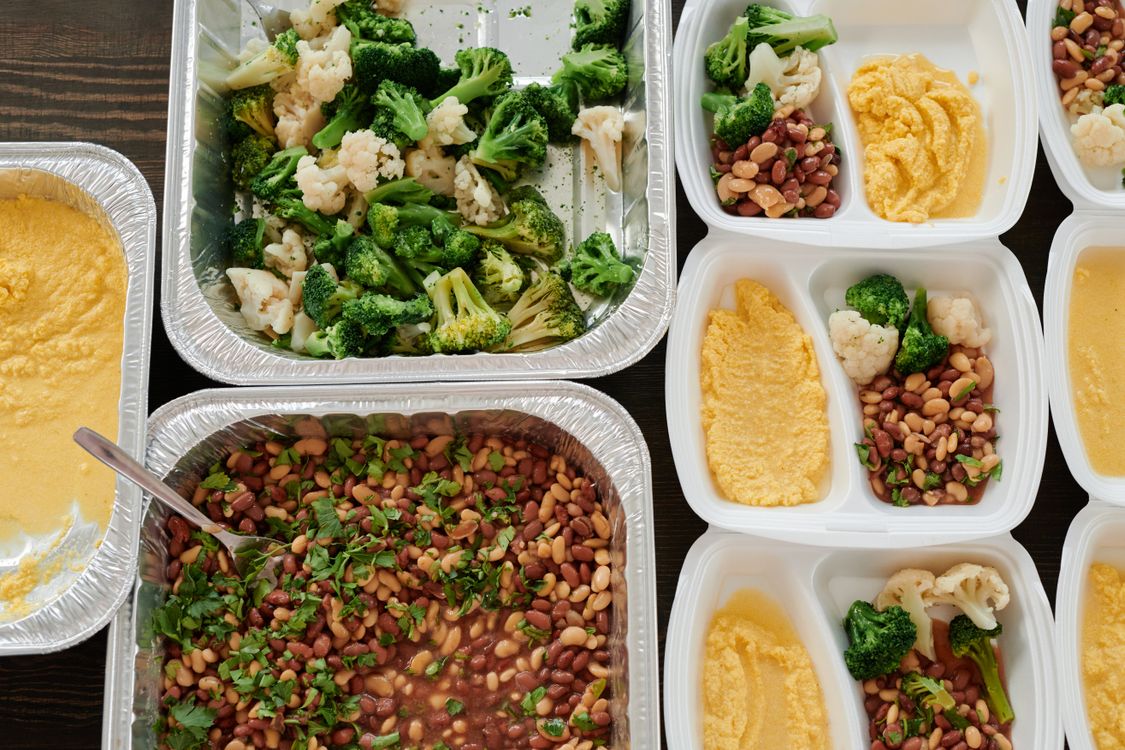
This guide explains food-contact label reading in Poland. It does not approve a particular container, infer chemical safety from a photograph or provide a home migration test. The photographs show ordinary storage and meal containers as context. They are not evidence that the pictured items are suitable for a temperature, food type or repeated use.
Find the food-contact information first
Poland's Chief Sanitary Inspectorate explains that articles not yet in contact with food when placed on the market must carry relevant information. This can be the words do kontaktu z żywnością, a specific indication of use or the recognised glass-and-fork symbol. The wording means for contact with food.
There is an important exception to a simple symbol hunt. The statement is not mandatory for articles whose characteristics make their food-contact purpose obvious. Absence of a glass-and-fork symbol is therefore not, on its own, a complete verdict that a spoon or another obvious food article is unsuitable or unlawful.
Read the whole presentation. At retail, the information may be on the article, its packaging, an attached label or a clearly visible notice immediately beside it. An online photograph of an unwrapped container can omit information supplied elsewhere. Ask for the actual product instructions when the visible picture is incomplete.
Treat the symbol as a starting point, not unlimited permission
A food-contact indication identifies the intended field of use. It does not mean every possible food, temperature, appliance and duration is covered. GIS says special recommendations must be supplied where necessary for safe and proper use. Those recommendations belong in the decision, not in the small print you ignore after seeing a familiar symbol.
A practical sequence is to identify the product, find the food-contact information and then read the conditions. If your intended use is more demanding than the use described, do not silently stretch the claim. A container that stores food is not automatically an oven dish or a vessel for every heating method.
This article gives no universal temperature limit. Different articles have different instructions. A number invented for all plastics, all glass or all reusable containers would be less useful than reading the limit for the item in your hand.
Read the intended use as specifically as it is written
Specific use information can be more helpful than a general symbol. A manufacturer may describe a storage purpose or another particular application. Match your plan to that description. Do not replace it with what a visually similar product from another brand can do.
Look for the conditions that matter to your intended use. These may concern heating, cooling, the food involved or how the article should be handled. If the product provides instructions, read all the relevant parts together rather than taking one reassuring line out of context.
The lid, seal and main body may need separate attention. If the instructions distinguish components, preserve that distinction. Do not assume that a statement about one part applies to every piece in the package. Ask the seller or manufacturer when the instructions leave the component you plan to use unclear.
Separate microwave, oven and dishwasher questions
For a microwave, look for the actual microwave-use information supplied for the item. Food-contact suitability alone does not answer whether it may be heated in that appliance. The same principle applies to an oven: do not convert a storage claim into a heat-resistance claim.
Dishwasher suitability is another separate question. Read the product's cleaning instructions instead of deriving them from a food-contact symbol or a material category. This guide does not prescribe a wash temperature, a cycle, a lid position or a heating duration for an unidentified article.
If you cannot establish an instruction relevant to your planned use, pause that use and seek product-specific information. This is especially important when a second-hand container has lost its original packaging and the only remaining information is a brand or a number on the base.
Do not use a recycling code as a food-use instruction
A material or recycling mark answers a different question from the article's intended food use. It should not be treated as a replacement for food-contact information or the manufacturer's conditions. A familiar material name does not, by itself, tell you whether a particular finished article is suitable for your task.
Avoid online shortcuts that assign one unconditional use rule to every item with the same base number or material description. The finished article and its instructions matter. This guide does not provide a resin-code chart or claim that one number proves an article is safe for all food storage or heating.
Keep environmental questions separate too. Whether an item can enter a particular waste stream does not establish what it should hold before disposal. Read disposal information for its own purpose and food-use information for its own purpose.
Keep the identity and instructions with reusable items
When buying a reusable container, keep the label or a clear photograph of it. Record the model if several similar versions exist. An unmarked lid found later in a cupboard is harder to identify than a complete product with its instructions.
GIS explains that labelling also includes the responsible business's name or trade name and address, along with identification that supports traceability. These details help you ask about the actual article. They are more useful than a vague description such as the clear box with the blue lid.
For an online purchase, save the product page's specification and instructions while they are available. Keep the packaging until you have checked that the supplied item matches the description. A changed listing or a missing leaflet should not force you to reconstruct important use conditions from memory.
Read Polish information, not only the pictures
GIS states that food-contact articles marketed in Poland are labelled in Polish; other languages can also appear. The purpose is usable information, not a requirement that a shopper decode an unfamiliar picture without context. If a Polish warning or condition is unclear, translate that exact text or ask the supplier to explain it.
Avoid guessing a permission from an icon that merely resembles one you remember. Product symbols can be small, worn or poorly photographed. A readable written instruction tied to the model is a better basis than a confident interpretation of a blurred base mark.
Useful words include żywność for food and kontakt for contact. However, recognising a few words is not enough when the rest of the sentence limits use. Read complete instructions, including negatives and exceptions, rather than extracting only the familiar nouns.
Be careful with unidentified or repurposed containers
An attractive box is not necessarily a food container. Nor does its previous presence in a kitchen establish what it originally held. Identify it from intact information rather than its colour, smell or the place where a previous occupant left it.
The same caution applies to repurposing. A package supplied for one described use does not automatically carry instructions for a different use or repeated heating. This guide does not approve a conversion from one purpose to another. Establish the relevant conditions before relying on the article for the new task.
Do not carry out a home chemical test to replace missing instructions. A container can look clean or undamaged without answering the question you need. If identity or permitted use cannot be established, choose an article whose instructions cover the task rather than manufacturing certainty from appearance.
Ask a question that names the intended conditions
A useful supplier question describes the exact article and what you want to do with it. Ask whether the model and its components are intended for that use, and where the corresponding instructions can be found. A general question such as Is this safe? can produce an answer too vague to guide a real decision.
If the label and online listing disagree, keep both. Check the model and component before assuming either applies. Ask for clarification in writing when the answer matters. Do not resolve a contradiction by choosing whichever statement gives the widest permission.
When reporting a concern, preserve the name, identification, photographs and proof of purchase where available. Describe what is missing or inconsistent without claiming laboratory evidence you do not have. This gives the supplier or relevant sanitary authority a clear factual issue to examine.
Use one repeatable routine in a new kitchen
Start with what the article is, then establish its intended food use. Read the relevant conditions for your task, including any component-specific limits. Check that the information concerns the actual model, and keep a usable record if the packaging will be discarded.
For ordinary storage, heating and cleaning questions, do not substitute one mark for another. Glass-and-fork, recycling information and an appliance-use instruction have different roles. Reading them separately prevents a familiar symbol from becoming a permission the manufacturer never gave.
The result should be a modest, specific conclusion: the instructions cover this use under these conditions, or more information is needed. That is more useful than declaring an entire material safe or unsafe. A label-reading guide helps you ask and answer the right question; it does not certify the container for every possible task.
Frequently asked questions
Does every food article need a glass-and-fork symbol?
No. GIS explains an exception where the article is obviously intended for food contact.
Does food-contact marking mean microwave suitable?
Not by itself. Read the actual item and component instructions for the proposed use.