Food Dates in Poland: Best Before, Use By and Opened Packs
The essentials: Najlepiej spożyć przed means best before, a quality date under proper storage. Należy spożyć do means use by, a safety deadline: do not eat food after it even if it looks or smells fine. Opening instructions can shorten the usable period.
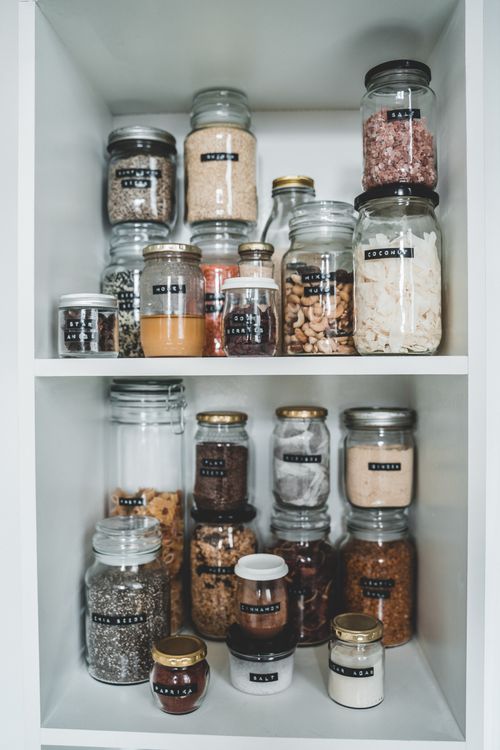
Cover: Taryn Elliott, source photograph, Pexels License. Image unchanged. Pantry food stored in glass jars. Illustrative storage context, not a Polish date-label example or a recommended shelf life.
A date on a Polish food packet is useful only when you read the words that go with it. Najlepiej spożyć przed and należy spożyć do are not two decorative ways of saying the same thing. One concerns the period of expected quality under the right storage conditions. The other is a food-safety deadline. Treating them as interchangeable can lead either to unnecessary waste or to keeping food that should not be eaten.
This is a cross-product label-reading guide, not a list of extra days you can add to particular foods. It uses Polish food-authority information and European Food Safety Authority guidance checked on 5 November 2026. Your actual package, its storage instructions, its condition and whether it has been opened still matter. A photograph of a tidy pantry or refrigerator cannot show that the food inside is safe.
Read the phrase before reading the number
Najlepiej spożyć przed means best before. Najlepiej spożyć przed końcem means best before the end of a stated period. These indicate the date of minimum durability: how long the food retains its particular properties when stored correctly. After that point, a change in texture or flavour is possible without the date alone proving that the product is unsafe. The storage qualification is part of the meaning, not a small-print exception.
Należy spożyć do means use by. This is used for foods that can become microbiologically unsafe after a short period. EFSA says not to eat food after its use-by date even if it still looks or smells fine. Harmful bacteria are not reliably detected by your senses. Do not translate this phrase loosely as a quality suggestion, and do not replace it with a personal rule about how many days food usually lasts.
A simple shopping habit is to identify the phrase first, then find the date, then read the storage instructions. If the date is printed elsewhere on the packaging, follow the reference to that place. The front of the pack may contain attractive descriptions while the information needed for your decision sits on a lid, seal or back panel. Read those parts together before throwing the outer packaging away.
Understand a date without inventing missing detail
The Polish sanitary inspectorate explains that best-before information can use day and month, month and year, or year alone, depending on durability. A month-and-year label is not automatically incomplete. Best before the end of a month or year has a different form from a date containing a particular day. Follow the actual wording rather than supplying a day from a similar packet you bought previously.
For use-by marking, the date is given as day, month and, where appropriate, year. GIS says the wording must not be abbreviated or modified and that separately packaged portions need their own use-by information. When dividing a multipack, keep the relevant marking with the portions you retain. An isolated number or production code is not a substitute for identifying the actual date statement.
If printing is rubbed off or a sticker covers information, do not decide that the latest-looking number must be the expiry date. Ask the retailer to help identify it, or choose a clearly labelled pack. This is especially important when you are shopping in a new language: a lot code and a food date answer different questions, even when both contain numbers. Photograph the readable information if you need help translating it later.
A use-by date is not a smell test
The clearest safety rule is also the easiest to forget: do not eat food after a use-by date. EFSA gives fresh meat, fish, ready-to-eat salads and dairy products as examples of foods that may carry this marking. Those examples are not a way to guess the label on every product in a category. Read the item in front of you, including any instructions that change after opening.
Correct storage before the date matters too. A use-by marking does not make food safe regardless of how it has been handled. Follow the stated temperature and other storage conditions. EFSA's consumer advice uses keeping food below 5°C as an example; a product's own instructions can be more specific. Do not turn a general refrigerator figure into permission to ignore the temperature printed on a package.
When deciding what to buy, compare the use-by date with the meal you actually plan to cook. A reduced-price pack is not a bargain if you cannot use it safely in time. Buy a suitable quantity, change the meal plan or choose another product. Planning before checkout is simpler than trying to rescue a purchase after its safety deadline has passed.
Best before is about quality, not unlimited life
For best-before foods, passing the date does not automatically mean the food must be discarded at home. EFSA describes checking appearance, smell and, where appropriate, taste for these foods, provided they have been stored correctly. This is different from its advice for use-by food. The point is to make an informed decision, not to treat all out-of-date food as safe.
Start with the actual condition and storage history, not a general internet claim that a food lasts for months or years. If you cannot establish that a packet has been kept as instructed, the best-before distinction does not repair that uncertainty. Equally, a date in the future is not a reason to eat something that is visibly spoiled or otherwise concerning. This guide gives no fixed grace period and no instruction to taste suspect food.
The same caution applies when products have been decanted into kitchen jars. Keep a record of the original date and storage directions rather than replacing all information with the name of the ingredient. A jar marked rice or flour is convenient, but that name does not tell you when the contents were bought, whether batches were mixed or what the original pack said. Labels should preserve useful information, not merely make a shelf look organised.
Opening starts a separate question
A distant printed date can stop being the only useful clock once the packet is opened. IJHARS explains that some products have a shorter usable period after opening than the unopened date suggests, including food packed in a protective atmosphere. Where needed, the producer must provide storage conditions or a period for consumption after opening. Look for instructions beginning po otwarciu, meaning after opening.
Read any time limit and storage requirement together. If the instruction says to refrigerate after opening and use within a stated period, keeping only one part of that instruction is not enough. Write the opening date on the container if it helps your household keep track. That is a practical reminder, not an extension of the manufacturer's limit or the original use-by date.
Do not invent a universal three-day or seven-day rule for every opened food. Different products, packaging and instructions differ. IJHARS's example of a meat product explains why an unopened protective-atmosphere shelf life cannot simply be carried over after opening; it does not establish one household deadline for all meat, sauces or dairy. When the instructions are unclear, ask the manufacturer about that actual product rather than borrowing a rule from another category.
Cooking and freezing need a plan before the deadline
EFSA advises that food can be cooked before its use-by date and then eaten within 48 hours if stored in the refrigerator, or frozen for later. This is a planning option before the deadline, not a method for making already out-of-date use-by food safe. Keep the product's own instructions in view, including any restrictions about freezing, and do not assume the guidance cancels earlier mishandling.
Label frozen items with the date they were frozen, as EFSA advises. Keep enough identity and original instruction information to know what is in the container. A frozen package that nobody can identify is hard to use sensibly. Plan the portion size before freezing so you are not repeatedly improvising around a large anonymous block of food.
This guide does not assign a freezing duration to individual foods or give a thawing timetable. Those decisions need appropriate product-specific guidance. If your real problem is uncertain storage history, cooking or freezing should not be presented as a way to erase that uncertainty. The useful habit is to act while the food is still within its suitable use period and you can follow its instructions.
Shop rules and home decisions are different
Polish shop rules are not the same as your household decision about a best-before product. GIS's May 2026 explanation says food marked with a minimum-durability date or use-by date must be withdrawn from sale after the relevant date or period. It explicitly distinguishes that sales restriction from whether a correctly stored best-before food may still be suitable at home. Do not assume advice about household food waste gives a Polish retailer permission to sell past-date food.
If you notice a problem before paying, show the marking to staff and choose a suitable alternative. If you discover it at home, keep the packaging and purchase evidence while you ask the retailer about it. Do not throw away the date panel before making a query. A photo of the whole label is generally more useful than a close-up containing only one unexplained number.
Finally, build a small repeatable routine: check the phrase, locate its date, read the storage and after-opening directions, and match the food to your plan. Keep use-by food out of the smell-test category, and do not treat best before as either automatic danger or unlimited permission. Learning those two Polish phrases is more useful than memorising a collection of supposed extra days for every shelf in the kitchen.
Frequently asked questions
Can I use a smell test after a use-by date?
No. EFSA says food should not be eaten after its use-by date even if it looks or smells fine. Harmful bacteria may not be detectable by your senses.
Does best before mean the food is automatically unsafe afterward?
No. It concerns quality under correct storage, but it is not unlimited permission or a fixed grace period. Consider the actual condition, instructions and storage history.
Does an unopened date still control after opening?
Read the after-opening instructions too. Some products have a shorter usable period after opening, with particular storage requirements.