Gliwice Palm House: Tickets, Pavilions and First-Visit Tips
The essentials: Gliwice Palm House has five pavilions and a Monday closure. The linked tariff lists ordinary adult admission at 20 zł, separate from the resident-card price. Check discounts, current notices and any guide or access support before going.
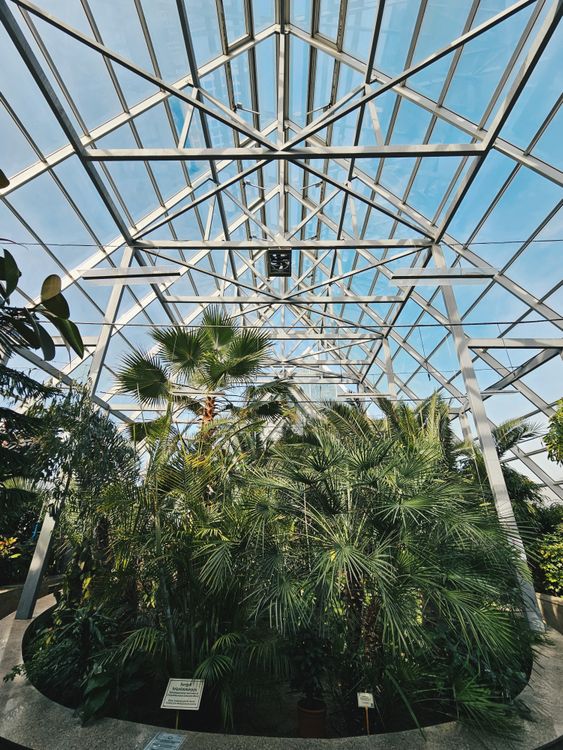
Cover: Ruslan Kruglov, Pexels source photograph, Pexels License. Image unchanged. Tropical plants inside a greenhouse, illustrative botanical context, not a photograph of Gliwice Palm House.
Gliwice's Palmiarnia Miejska is a five-pavilion indoor visit in Park Chopina, with useful plants, tropical planting, a historical collection, succulents and freshwater aquariums. It is a good option when you want a focused nature visit rather than a whole outdoor day, but it has its own admission, group and accessibility arrangements.
Start with the municipal operator MZUK's current page and price attachment. The tariff has two columns, one for the ordinary price and another for the Gliwice resident card. Reading the lower column as a price available to every visitor is an easy mistake. This guide separates those choices and explains how to plan a first visit without inventing a personal review.
Go to Park Chopina and the correct address
The operator gives the Palm House address as ul. Fredry 6, 44-100 Gliwice, in Park Chopina. Use that venue address rather than MZUK's administrative-office address. A municipal website can display both in its footer, and they are not interchangeable destinations for a visitor.
The park can form part of the outing, but its paths are not the same as the Palm House's indoor route. Plan for the outside approach as well as time inside, particularly in wet or cold weather. A greenhouse visit is still reached through an ordinary city and park environment.
Check the weekday before travelling
The current venue page lists Monday as closed, Tuesday to Friday from 9:00 to 18:00, and Saturdays, Sundays and holidays from 10:00 to 18:00. Do not assume the weekend opening time also applies on an ordinary Tuesday or that a public holiday follows the normal weekday start.
Special notices remain worth checking before the journey. A published weekly schedule is not a guarantee that maintenance, an exceptional event or an operational problem cannot alter access. Avoid arriving close to closing with the expectation that a multi-pavilion visit can be completed at the pace you would prefer.
Read the ordinary price column first
The current linked tariff gives an ordinary adult ticket at 20 zł and a concession ticket at 13 zł. The separate Gliwicka Karta Mieszkańca column lists 14 zł and 9 zł respectively. A visitor without the relevant resident-card entitlement should budget from the ordinary column.
The document is an official tariff attached to a January 2025 order and remains linked from the operator's current page when checked. Use the live tariff before buying rather than treating its folder date or an old travel article as the final authority. MZUK says payment can be made by cash or payment card.
Check the actual family-ticket definition
The family ticket in the linked tariff costs 40 zł in the ordinary column and covers at most two adults and no more than three children under sixteen. The resident-card column gives 30 zł. Those limits are more precise than the phrase family ticket on its own.
Count your actual party against the rule before deciding which option is cheaper. Two adults with several teenagers are not automatically covered in the same way as two adults with younger children. Ask the cashier about an unusual combination rather than buying a category on the assumption that family is defined the same at every attraction.
Bring proof for a concession or exemption
The tariff lists concession categories including children from age three, pupils, students up to twenty-six, retirees and pensioners, with the required document. It separately lists exemptions for children under three and seniors over seventy-five on presentation of evidence. The venue page tells eligible visitors to show supporting documents.
Do not assume a foreign document will be accepted without checking if your budget depends on the discount. Bring what establishes the relevant status and ask about your case. Age, student status, a local resident card and a large-family programme are separate kinds of entitlement, not interchangeable labels for any discounted visitor.
The useful-plants pavilion gives a practical starting theme
MZUK describes the first pavilion around plants useful to people, many from subtropical conditions. This makes a good beginning if botanical Latin is not your usual interest: connect the plant in front of you with a familiar food, spice or material rather than trying to identify everything at once.
Use the actual labels and official interpretation to make those connections. A plant photograph in a guide is not a reliable identification key, and a familiar-looking leaf does not establish an edible species. The purpose of the visit is observation and learning, not sampling or collecting material from the displays.
The tropical pavilion has a different environment
The operator describes high humidity and a temperature that does not fall below eighteen degrees in the tropical pavilion, with layered planting and a water feature. Its explanation focuses on plants that do not follow the same seasonal rest pattern as outdoor vegetation in Poland.
Treat those conditions as part of visit planning. Layers that can be adjusted are more practical than assuming the whole route feels like the weather outside. If someone in your party needs a cooler break or a particular pace, ask staff where to pause. The published plant environment is not a medical assurance about an individual's comfort.
Look for the historical collection, not a generic palm photo
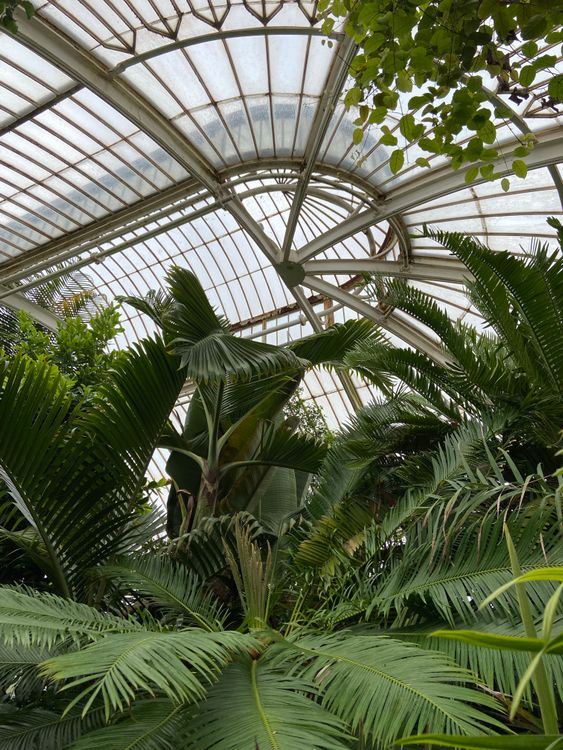
The historical pavilion holds some of the oldest and largest plants described by MZUK. The operator connects its Canary Island date palms with the 1924 exhibition and the institution's earlier collection. That gives the visit a specific Gliwice story rather than making it interchangeable with any glasshouse elsewhere.
Read the labels and interpretive information for the actual specimens. Do not expect every plant mentioned in a long-standing website description to be in identical condition or position on your visit. Living collections change, and an image of a palm in another greenhouse should not be used as evidence of a particular specimen here.
Succulents make a useful contrast
The succulent pavilion is described as having low air and soil humidity, with plants adapted to storing water. After the tropical environment, the change offers a clear way to compare different survival strategies. Look at differences in shape and where plants store water rather than treating every spiny plant as the same kind of cactus.
Stay on the designated route and keep children close. The rules prohibit touching plants outside specifically designated places, and the official educational-path description does not grant permission to handle everything. A guided activity or signed touch point is different from deciding that an accessible-looking leaf must be safe to touch.
The aquarium pavilion is freshwater, not a marine show
MZUK describes four freshwater environments: Amazonia, Lake Tanganyika, Polish rivers and Southeast Asian rivers. This matters if you are choosing between the Palm House and a separate aquarium attraction. The offer here combines plant pavilions with a particular freshwater display rather than promising every type of sea life.
The rules prohibit flash photography of live animals and disturbing them by tapping aquarium or terrarium glass. Move slowly, let other visitors see and use the labels. A brief look at an unfamiliar fish is an opportunity to learn its environment, not a reason to feed it or test whether it responds to noise.
Guided groups need advance arrangements
The regulations say organised groups and guide services should be requested at least seven days before the planned visit, in person, by telephone or by email. The current venue page separately lists group-registration contact details. A group should not arrive expecting an available guide merely because individuals can buy admission.
Ask about group size, language, meeting time, the fee and whether admissions are included in the quoted arrangement. Requesting a guide is not the same as receiving confirmation. Keep the agreed details and tell participants which entrance and time to use so that one late arrival does not hold up the whole visit.
Accessibility includes ramps and staffed lifts
MZUK's accessibility declaration describes a ramp beside the main entrance stairs, lifts between levels, an adapted toilet and an induction loop at the ticket desk. It says lift systems can call staff, who help where needed. This is more useful detail than a broad claim that the building has no access questions.
If you need assistance, a particular wheelchair route or confirmation that equipment is working, contact the venue before travelling. The declaration also notes limits, including the absence of tactile maps and Braille signs. Assistance and guide dogs are permitted under the accessibility information, which should be read alongside general visitor rules about animals.
Keep bags, children and photographs manageable
The regulations require children under twelve to be accompanied by an adult and visitors to follow marked paths and staff instructions. They prohibit running and noise, collecting plant material, feeding animals outside designated arrangements and bringing ordinary animals. A visit with children works best as a paced observation outing, not an indoor playground.
Professional or occasion photography has separate paid provisions in the tariff. An ordinary camera visit should not be confused with organising a commercial shoot. Ask before bringing a setup that changes how others move through the pavilions, and preserve the no-flash rule around live animals regardless of your equipment.
Parking advice is not a guaranteed space
MZUK's published access page points to streets around Park Chopina and warns that part of ul. Sienkiewicza is in a paid parking zone. That is useful orientation, but the page is older than the current tariff and does not establish a free space or today's exact restrictions.
Read the actual parking signs and use current transport information for your day. Do not depend on an old bus number or a quoted driving time from another city. The reliable fixed anchor is the venue address; the route, timetable and parking conditions need a current check from your own starting point.
Plan a visit around the five distinct areas
A good first visit has a simple focus: useful plants, tropical growing conditions, the historical collection, succulent adaptation and freshwater environments. Decide which interests your party most and allow a pace that lets everyone use the paths comfortably. No fixed article duration can guarantee how long your family will want to stay.
Before leaving home, confirm the current opening notice, choose the correct tariff column, bring discount evidence and arrange any guide or access support. Our other city guides can help with a wider day in Poland, but Gliwice's Palm House is best planned from its own rules. That keeps the outing about the living collection rather than an avoidable ticket or entrance surprise.
Related: Indoor sights in Wrocław.
Frequently asked questions
Is the resident-card price available to every visitor?
No. The tariff has a separate Gliwicka Karta Mieszkańca column; use the ordinary price unless you qualify.
Does the venue publish wheelchair access information?
Yes. MZUK describes a ramp, lifts with staff support, an adapted toilet and other features. Confirm specific needs and equipment availability before travelling.